
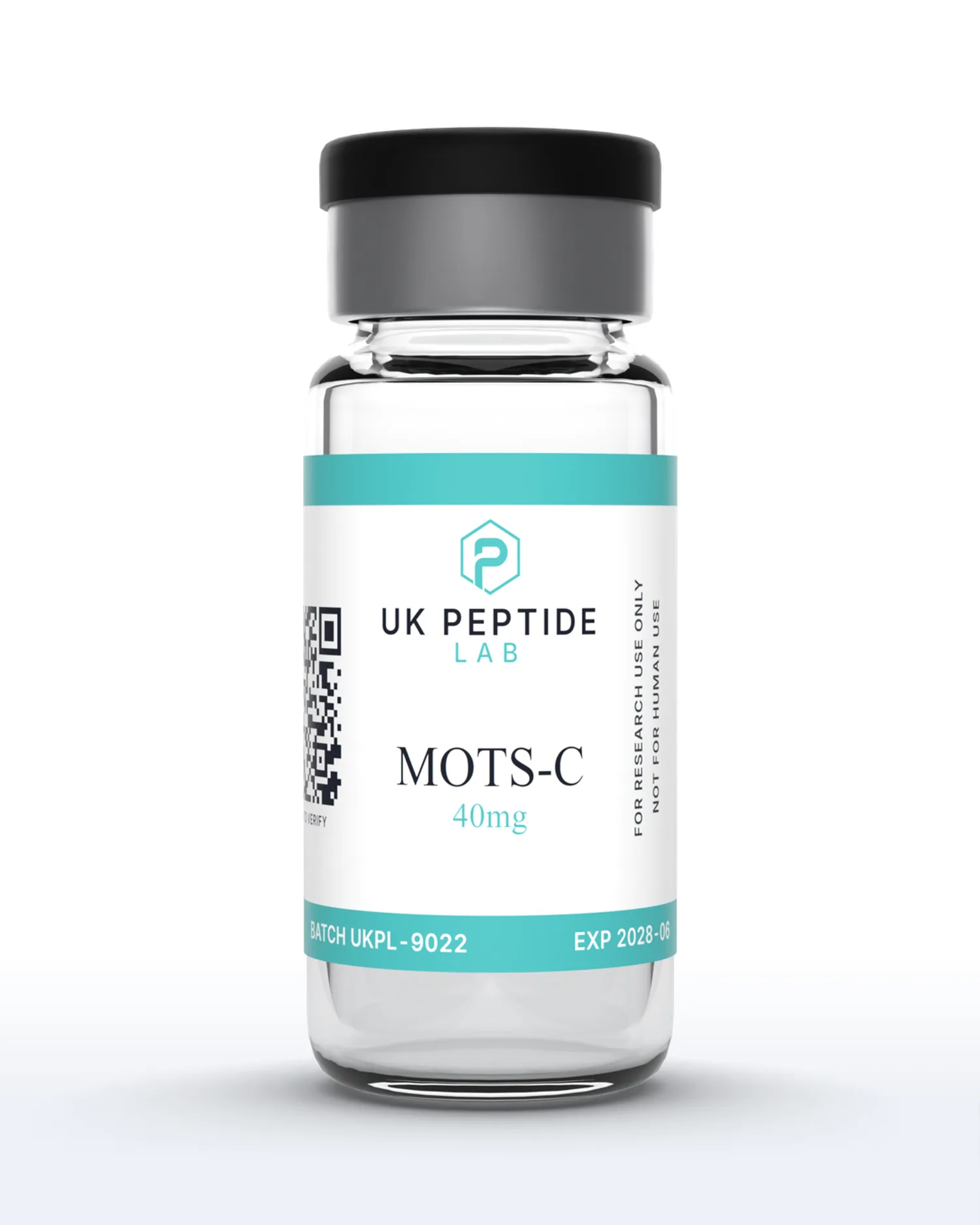
MOTS-C
40mg
MOTS-C is a 16 amino acid mitochondrial-derived peptide encoded within the mitochondrial 12S rRNA region. Research has studied its role in metabolic regulation, including AMPK pathway activation and effects on glucose and fatty acid metabolism. This 40mg vial suits extended or higher-throughput research protocols. Lyophilised powder, third-party tested.
Published research on MOTS-C is indexed on PubMed. See our full UK buyer's guide for MOTS-C.
Intended Use: Strictly for in-vitro laboratory research. Not for use in humans or animals. Not to be used in foods, drugs, or medical diagnostics. This product has not been evaluated by the MHRA or FDA. Buyer assumes full responsibility for safe handling and regulatory compliance.
98.896%
Purity
LAB
Certified
SAME
Day Ship
Quantity
Qualifies for free UK delivery · Royal Mail Tracked 24
Damaged or lost? Free reshipment guaranteed
Bacteriostatic Water 10ml
Required to reconstitute lyophilised peptides.
Research Use Only
This product is intended strictly for research and laboratory use only. Not for human consumption, medical use, or diagnostic purposes.
Certificate of Analysis
Third-party tested
Lyophilised Stability
24 months
Sealed at -20°C, light-protected
Reconstituted Stability
Up to 3 months
Stored at 2-8°C after mixing
Cold-Chain Shipping
Always
Dry-cold pack, Royal Mail Tracked 24
Important Notice
All compounds are sold individually and do not include research supplies. Products are provided in lyophilised (powder) form and require proper reconstitution before use in research settings.
Related Products
MOTS-C Price (UK)
MOTS-C is supplied in 2 vial sizes, priced from £24.99 for 10mg to £69.99 for 40mg. Every size ships from our UK facility with the same third-party HPLC certificate published on this page. This vial clears the £45 threshold on its own, so UK Royal Mail Tracked 24 delivery is free. Orders placed before 2pm on a working day are dispatched the same day.
| Vial | Price | Cost per mg | Availability |
|---|---|---|---|
| MOTS-C 10mg | £24.99 | £2.50 | In stock |
| MOTS-C 40mgThis page | £69.99 | £1.75Best value | In stock |
Prices are in GBP and shown per vial as supplied, lyophilised, for in-vitro laboratory research only. Cost per mg is given so researchers can compare vial sizes on a like-for-like basis. Stock and pricing on this table are read live from our inventory, so they match the basket. See our FAQ for delivery and payment options, and quality & testing for how each batch is verified.
Product Specifications
Research Overview
This page covers the 40mg presentation. The compound is the same 16-residue mitochondrial-derived peptide supplied in the standard vial, sequence MRWQEMGYIFYPRKLR, molecular formula C₁₀₁H₁₅₂N₂₈O₂₂S₂, molecular weight 2174.5 g/mol, CAS 1627580-64-6, and its mechanism, the folate-methionine cycle route to AICAR accumulation and AMPK activation, together with the retrograde mitochondrial-to-nuclear signalling literature, is documented in full on the main MOTS-C page. What is specific to the 40mg vial is handling. Forty milligrams is four times the content of the standard vial in the same glass format, so at a fixed fill volume the reconstituted stock is four times more concentrated. Fill volume is therefore scaled to the target concentration rather than carried over from work done on smaller vials, and the resulting concentration should be recorded against the batch. The more consequential point at this size is oxidative exposure across the vial's working life. The sequence carries two methionine residues, one tryptophan and two tyrosines, all oxidation-labile side chains. A vial holding four times the mass is typically accessed over a longer period and across more stopper penetrations, which increases cumulative headspace air exposure, light exposure and freeze-thaw opportunities on a single reconstituted stock. Aliquoting into single-use volumes immediately after reconstitution therefore matters more here than on a small vial, and is the reason to select this format only where throughput genuinely justifies it. The offsetting advantages are batch continuity under one certificate of analysis and a lower cost per milligram, since vial, stopper, lyophilisation and assay costs are incurred per vial. Supplied as lyophilised powder for in-vitro research use only.
Product Specifications
Laboratory Handling
- Scale the bacteriostatic water fill volume to your target concentration. A 40mg vial reaches four times the concentration of a 10mg vial at the same fill volume, so a volume carried across from smaller-vial work will not reproduce the same stock.
- Aliquot into single-use volumes immediately after reconstitution and hold them at -20°C. This matters more on a 40mg vial than a small one, because four times the mass in one vial means a longer working life and more accumulated stopper penetrations on a single stock.
- Minimise headspace air exposure and protect from light at every step. The two methionines, tryptophan and two tyrosines in the sequence are oxidation-sensitive side chains, and a vial with a long in-use window accumulates more oxidative exposure than a small one.
- Do not leave dilute solution standing at room temperature. Return aliquots to cold storage promptly after each withdrawal rather than working from a stock left out across a session.
- Introduce the diluent slowly down the inner glass wall, never onto the lyophilised cake, and swirl gently until fully dissolved. Never shake or vortex. Allow the vial to reach room temperature before opening.
Frequently Asked Questions
What is MOTS-C?
The 40mg vial is the largest presentation stocked of this 16-residue mitochondrial-derived peptide, holding four times the lyophilised mass of the standard 10mg vial in the same glass format. The compound is identical in both, sequence MRWQEMGYIFYPRKLR, molecular formula C₁₀₁H₁₅₂N₂₈O₂₂S₂, molecular weight 2174.5 g/mol, CAS 1627580-64-6. The mechanism, the folate-methionine cycle route to AICAR accumulation and AMPK activation, the nuclear translocation and NRF2 work, and the wider mitochondrial-derived peptide family context are all documented on the main MOTS-C page and are not repeated here. This page documents what is specific to the 40mg format: the fourfold concentration at fixed fill volume, and above all the oxidative-exposure consequences of holding four times the mass in a single vial that will be accessed over a longer working life. Supplied as lyophilised powder for in-vitro research use only.
The 40mg Vial vs the 10mg Vial: Oxidative Exposure Over Working Life
Both vials hold the same peptide, so the comparison is entirely about handling. The sequence carries two methionine residues, one tryptophan and two tyrosines, all oxidation-labile side chains, which makes cumulative exposure a real experimental variable rather than a generic caution. A vial holding four times the mass is typically consumed over a longer period and across more stopper penetrations, so a single reconstituted stock accumulates more headspace air contact, more light exposure and more freeze-thaw opportunity before the last of it is used. The 10mg vial limits that exposure structurally, simply by running out sooner. The 40mg vial answers with batch continuity, one certificate of analysis across four times as much work, and a lower cost per milligram, since vial, stopper, lyophilisation and third-party assay costs fall per vial rather than per milligram. The reconciling practice is aliquoting: drawn into single-use volumes at the point of reconstitution, a 40mg vial behaves like a set of small ones, and the oxidative-exposure objection largely disappears.
MOTS-C Research Applications
The applications are those documented for the standard vial, since the compound is the same: AMPK signalling, folate-methionine cycle flux, de novo purine biosynthesis and AICAR accumulation, glucose and fatty acid metabolism, skeletal muscle bioenergetics, and mitochondrial-to-nuclear retrograde signalling. Vial content matters to study logistics rather than to endpoint selection. Higher-throughput designs, dose-response matrices across many wells or plates, and extended time-course work all consume material faster than a 10mg vial supports comfortably, and running the whole design against one batch removes inter-batch variance from the analysis. Analytical method development is the other common case, where a low molecular weight mtDNA-encoded peptide is needed as a standard and repeated standard preparations from a single batch are more internally consistent than the same work spread across several.
Reconstitution Guide
Allow the vial and the bacteriostatic water to reach room temperature so condensation does not settle on the powder, then swab both rubber stoppers with alcohol. Inject the diluent slowly down the inner glass wall rather than onto the lyophilised cake, and swirl gently until fully dissolved. Never shake or vortex. The solution should be clear and colourless. Two points are specific to the 40mg vial. First, fill volume must be set from your target concentration, since 40mg reaches four times the concentration of 10mg at identical volume: 40mg in 4mL gives a 10mg/mL stock, the same 40mg in 2mL gives 20mg/mL. We specify no fill volume, as that is a protocol decision, and provide no dosing information. Second, aliquot into single-use volumes at the point of reconstitution rather than later, minimising headspace air exposure and time at room temperature while the oxidation-sensitive side chains in the sequence are in dilute solution.
See our full peptide reconstitution guide and reconstitution calculator for step-by-step protocol.
Storage Instructions
Lyophilised vials should be stored at -20°C, protected from light and moisture, and remain stable for up to 24 months. Once reconstituted, hold the solution at 2-8°C, and for anything beyond short-term use prepare single-use aliquots at -20°C. On a 40mg vial this is not optional good practice but the main defence of the material, because the sequence contains two methionines, a tryptophan and two tyrosines and a stock intended to last a long protocol accumulates oxidative exposure with every re-entry. Minimise headspace air, keep vials and aliquots protected from light, never leave dilute solution standing at room temperature, and avoid repeated freeze-thaw cycles. Label every aliquot with the reconstitution date.
Frequently Asked Questions
Research References
- The mitochondrial-derived peptide MOTS-c promotes metabolic homeostasis and reduces obesity and insulin resistance (Cell Metab, 2015)
- The mitochondrial-encoded peptide MOTS-c translocates to the nucleus to regulate nuclear gene expression in response to metabolic stress (Cell Metab, 2018)
- MOTS-c is an exercise-induced mitochondrial-encoded regulator of age-dependent physical decline and muscle homeostasis (Nat Commun, 2021)
Related Research Compounds
Research Guides
MOTS-C
40mg · £69.99