
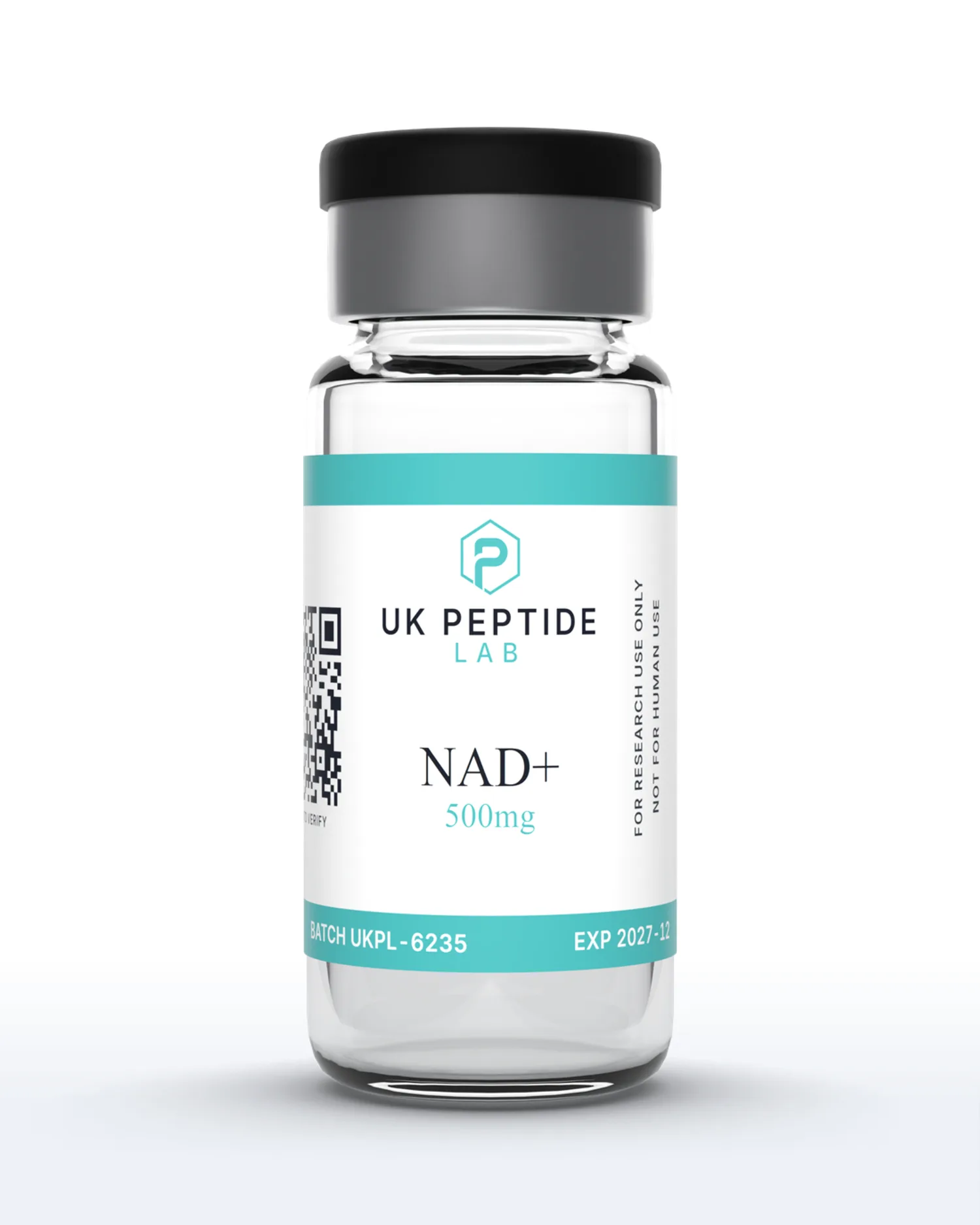
NAD+
500mg
Nicotinamide Adenine Dinucleotide (NAD+) is a coenzyme central to cellular redox chemistry, present in every living cell. Research has examined its role in electron transport, mitochondrial function, sirtuin activity and DNA repair pathways. Of particular interest in ageing and metabolism research, where NAD+ levels and precursor strategies are widely studied. Lyophilised powder, third-party tested.
Published research on NAD+ is indexed on PubMed. See our full UK buyer's guide for NAD+.
Intended Use: Strictly for in-vitro laboratory research. Not for use in humans or animals. Not to be used in foods, drugs, or medical diagnostics. This product has not been evaluated by the MHRA or FDA. Buyer assumes full responsibility for safe handling and regulatory compliance.
Pending
Purity
LAB
Certified
SAME
Day Ship
Quantity
Qualifies for free UK delivery · Royal Mail Tracked 24
Damaged or lost? Free reshipment guaranteed
Bacteriostatic Water 10ml
Required to reconstitute lyophilised peptides.
Research Use Only
This product is intended strictly for research and laboratory use only. Not for human consumption, medical use, or diagnostic purposes.
Certificate of Analysis
Third-party tested
Lyophilised Stability
24 months
Sealed at -20°C, light-protected
Reconstituted Stability
Up to 3 months
Stored at 2-8°C after mixing
Cold-Chain Shipping
Always
Dry-cold pack, Royal Mail Tracked 24
Important Notice
All compounds are sold individually and do not include research supplies. Products are provided in lyophilised (powder) form and require proper reconstitution before use in research settings.
Related Products
NAD+ Price (UK)
NAD+ is supplied in 2 vial sizes, priced from £49.99 for 500mg to £84.99 for 1000mg. Every size ships from our UK facility with the same third-party HPLC certificate published on this page. This vial clears the £45 threshold on its own, so UK Royal Mail Tracked 24 delivery is free. Orders placed before 2pm on a working day are dispatched the same day.
| Vial | Price | Cost per mg | Availability |
|---|---|---|---|
| NAD+ 500mgThis page | £49.99 | £0.100 | In stock |
| NAD+ 1000mg | £84.99 | £0.085Best value | In stock |
Prices are in GBP and shown per vial as supplied, lyophilised, for in-vitro laboratory research only. Cost per mg is given so researchers can compare vial sizes on a like-for-like basis. Stock and pricing on this table are read live from our inventory, so they match the basket. See our FAQ for delivery and payment options, and quality & testing for how each batch is verified.
Product Specifications
Research Overview
NAD+ (nicotinamide adenine dinucleotide, oxidised form, often written NAD plus where the charge symbol cannot be rendered) has the molecular formula C₂₁H₂₇N₇O₁₄P₂, a molecular weight of 663.43 g/mol, and CAS number 53-84-9. Structurally it is nicotinamide mononucleotide joined to adenosine monophosphate through a pyrophosphate bridge, and its redox chemistry is confined to the nicotinamide ring: reduction is a stereospecific two-electron hydride transfer to C4 giving NADH, with a standard reduction potential near -0.32 V at pH 7. That single couple carries the bulk of catabolic electron flow into complex I of the respiratory chain, which is why bioenergetics research reports the free NAD+/NADH ratio rather than absolute NAD+ concentration. The second half of nicotinamide adenine dinucleotide biology is non-redox and consumptive. Sirtuins, poly(ADP-ribose) polymerases and the CD38/CD157 ectoenzymes cleave the glycosidic bond between the nicotinamide and the ADP-ribosyl moiety, releasing nicotinamide stoichiometrically, so NAD+ is destroyed rather than recycled and must be resynthesised through the NAMPT-limited salvage pathway (Cantó, Menzies and Auwerx, Cell Metabolism, 2015). Camacho-Pereira and colleagues (Cell Metabolism, 2016) reported that CD38 expression and NADase activity rise with age in mice and drive tissue NAD+ decline alongside SIRT3-dependent mitochondrial dysfunction, while Liu and colleagues (Cell Metabolism, 2018) applied stable-isotope tracing to quantify NAD synthesis and breakdown fluxes directly and map tissue-specific turnover rather than inferring it from pool sizes. One mechanistic point matters to anyone designing experiments: intact NAD+ is not efficiently transported across the mammalian plasma membrane. Extracellular NAD+ is processed by surface ectoenzymes instead, with CD73 shown to generate nicotinamide riboside that is subsequently taken up (Grozio et al., Journal of Biological Chemistry, 2013). Laboratories buying NAD+ in the UK typically use it as a defined cofactor in oxidoreductase assays and in sirtuin, PARP and mitochondrial bioenergetics work. Supplied as lyophilised powder for in-vitro research use only.
Product Specifications
Laboratory Handling
- Store lyophilised vials at -20°C, protected from light and moisture. Reconstituted solution should be kept at 2-8°C and used within 4 weeks.
- Reconstitute with bacteriostatic water, injecting the solvent slowly down the inner glass wall rather than onto the powder, then swirl gently until fully dissolved. Do not shake or vortex.
- NAD+ is comparatively stable in acidic solution and labile in alkaline solution, where both the nicotinamide-ribose glycosidic bond and the pyrophosphate linkage are susceptible to hydrolysis. NADH shows the opposite pH profile, so keep reconstituted NAD+ cold and avoid basic buffers.
- Oxidised NAD+ absorbs at 260 nm, and reduction to NADH adds the characteristic 340 nm band that is the standard spectrophotometric check on redox state and integrity. Prepare single-use aliquots and avoid repeated freeze-thaw cycles.
Frequently Asked Questions
What is NAD+?
NAD+ (nicotinamide adenine dinucleotide, oxidised form, also written NAD plus) is a dinucleotide cofactor with the molecular formula C₂₁H₂₇N₇O₁₄P₂, molecular weight 663.43 g/mol, CAS 53-84-9. It comprises nicotinamide mononucleotide joined to adenosine monophosphate through a pyrophosphate bridge, and its redox activity is restricted to the nicotinamide ring, where a stereospecific two-electron hydride transfer to C4 yields NADH at a standard reduction potential near -0.32 V at pH 7. Beyond redox catalysis it is consumed stoichiometrically by sirtuins, poly(ADP-ribose) polymerases and CD38/CD157, which cleave the nicotinamide-ribosyl glycosidic bond and force resynthesis through the NAMPT-limited salvage pathway (Cantó, Menzies and Auwerx, Cell Metabolism, 2015). Supplied as lyophilised powder for in-vitro research use only.
NAD+ vs NMN vs NR (Nicotinamide Riboside)
NAD+ is the finished dinucleotide cofactor. NMN (nicotinamide mononucleotide) and NR (nicotinamide riboside) are salvage-pathway precursors sitting one and two steps upstream, converted to NAD+ by NMNAT and by NRK followed by NMNAT respectively. The reason the distinction dominates the literature is transport: intact NAD+ is not efficiently carried across the mammalian plasma membrane, and extracellular NAD+ is instead dismantled by surface ectoenzymes, with CD73 shown to generate nicotinamide riboside that is subsequently imported and rebuilt (Grozio et al., Journal of Biological Chemistry, 2013). For that reason most in-vivo NAD-raising literature is written about precursors rather than the dinucleotide itself (Rajman, Chwalek and Sinclair, Cell Metabolism, 2018), while NAD+ remains the compound of choice for cell-free and enzymatic work where the cofactor is added directly. All three are research compounds only.
NAD+ Research Applications
NAD+ is used as a defined cofactor and cosubstrate across bioenergetics, redox biology and enzymology. Applications include dehydrogenase and oxidoreductase assays monitored at 340 nm, sirtuin deacylase activity assays, PARP and ADP-ribosyltransferase reactions, CD38 and NADase kinetics, NAD+/NADH ratio measurement as a readout of cytosolic and mitochondrial redox state, and cellular ageing research where tissue NAD+ decline has been attributed largely to increased consumption by CD38 (Camacho-Pereira et al., Cell Metabolism, 2016) and quantified by stable-isotope flux analysis (Liu et al., Cell Metabolism, 2018).
Reconstitution Guide
Allow the vial to reach room temperature, then sterilise the rubber stopper of both the NAD+ vial and the bacteriostatic water vial with an alcohol swab. Draw the bacteriostatic water into a sterile syringe and inject it slowly down the inner glass wall, never directly onto the lyophilised powder. Swirl gently until fully dissolved. Never shake or vortex. Avoid alkaline solvents and buffers: NAD+ is comparatively stable in acid but hydrolyses in base at both the nicotinamide-ribose glycosidic bond and the pyrophosphate linkage, and NADH behaves in the opposite direction. Label the vial with the reconstitution date and refrigerate immediately.
See our full peptide reconstitution guide and reconstitution calculator for step-by-step protocol.
Storage Instructions
Lyophilised vials should be stored at -20°C, protected from light and moisture, and remain stable for up to 24 months. Once reconstituted with bacteriostatic water, store at 2-8°C and use within approximately 4 weeks. For longer storage prepare single-use aliquots at -20°C and avoid repeated freeze-thaw cycles. Integrity can be checked spectrophotometrically, since oxidised NAD+ absorbs at 260 nm and only the reduced form contributes the characteristic 340 nm band. Handle under sterile laboratory conditions throughout.
Frequently Asked Questions
Research References
Related Research Compounds
Research Guides
NAD+
500mg · £49.99