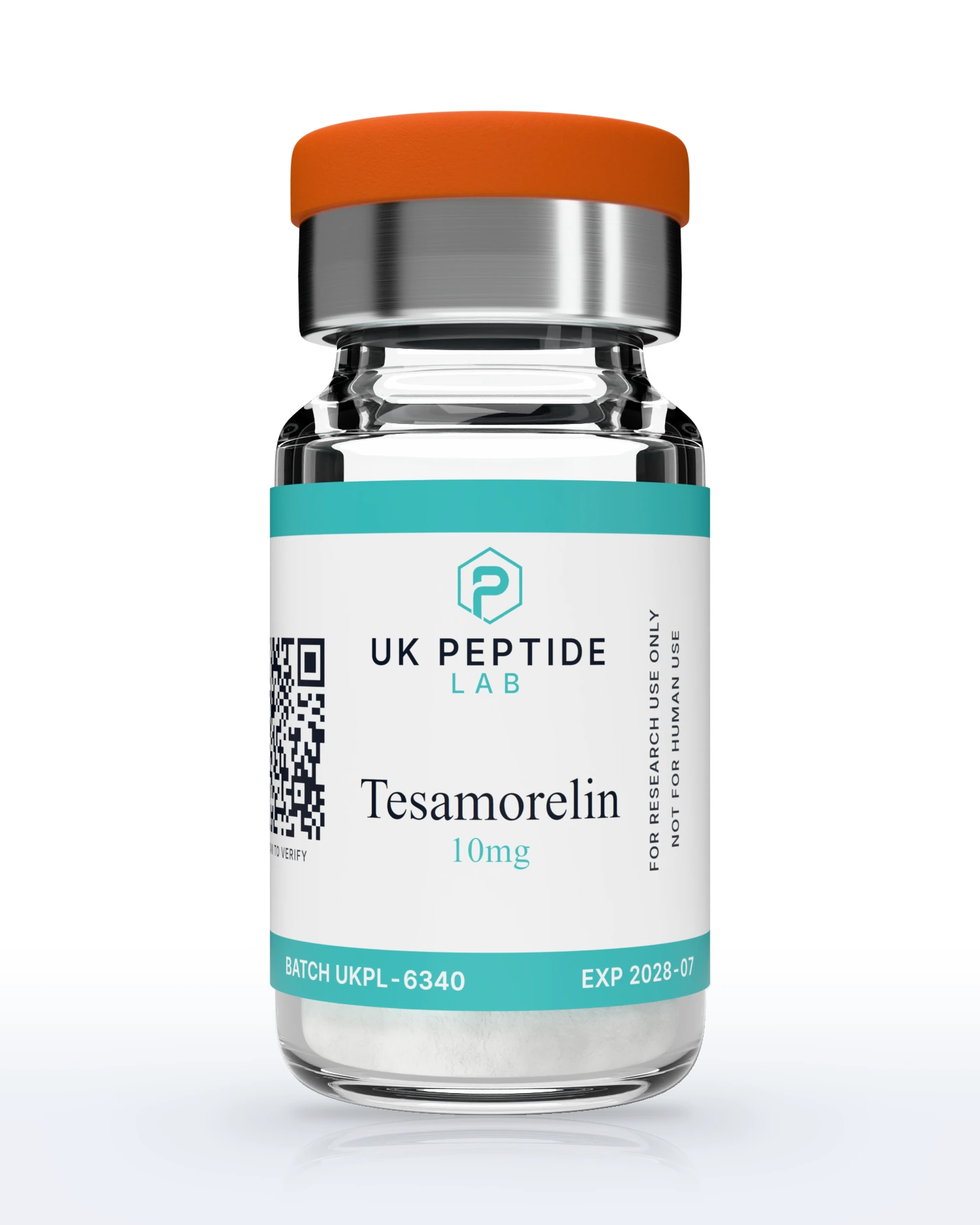
Growth Hormone Secretagogues
Tesamorelin
10mg
GHRH(1-44) analogue, 10mg vial. GHRH receptor and somatotroph research.
96.914% purity · Third-party tested · Batch UKPL-6340 · View certificate
- Same-day dispatch before 3pm, Mon to Fri
- Qualifies for free UK delivery
- Cold-chain shipping. Always. Dry-cold pack, Royal Mail Tracked 24
- Secure checkout


- Lost, damaged or wrong? Replaced free if you tell us within 48 hours.
- Research use only. For in-vitro laboratory research. Not for use in humans or animals, or in food, drugs or diagnostics. Not evaluated by the MHRA or FDA. The buyer is responsible for handling and regulatory compliance.
Bacteriostatic Water 10ml
Required to reconstitute lyophilised peptides.
What is Tesamorelin?
UK Peptide Lab supplies tesamorelin peptide, developed under the code TH9507, as a lyophilised powder in 5mg and 10mg vials. Each batch has its own third-party certificate.
Full description
Tesamorelin is an agonist at the GHRH receptor on anterior pituitary somatotrophs. Native GHRH is cleaved between Tyr1 and Ala2 by dipeptidyl peptidase-4 and inactivated within minutes. The hexenoyl cap on Tyr1 blocks that cleavage. Ferdinandi et al. (Basic Clin Pharmacol Toxicol, 2007) reported resistance to DPP-IV, slower degradation in rat, dog and human plasma, and enhanced potency and duration of action.
Tesamorelin is a 44 residue synthetic analogue of human growth hormone releasing hormone, hGRF(1-44)NH₂, developed under the code TH9507 and acting as an agonist at the GHRH receptor on anterior pituitary somatotrophs. Its single structural modification is a trans-3-hexenoyl group on Tyr1, which blocks the dipeptidyl peptidase-4 cleavage site between Tyr1 and Ala2 that inactivates native GHRH within minutes. The non-clinical evaluation of TH9507 published in Basic and Clinical Pharmacology and Toxicology in 2007 reported resistance to dipeptidyl aminopeptidase-IV alongside enhanced potency and duration of action.
Tesamorelin peptide: research overview
The tesamorelin peptide is a synthetic analogue of growth hormone releasing hormone, modified at the N-terminus with a trans-3-hexenoyl group. Here it is listed as 5mg and 10mg lyophilised research vials, each with a batch certificate of analysis. Further reading: tesamorelin UK sourcing guide and Tesamorelin vs CJC-1295 comparison.
Tesamorelin Research Applications
Tesamorelin is used in endocrine research on GHRH receptor pharmacology, somatotroph biology and DPP-4 resistance as a peptide stabilisation strategy. Because it acts upstream of the pituitary, endogenous GH secretion and feedback stay in the loop. In a 2 week study of 13 healthy men, Stanley et al. (J Clin Endocrinol Metab, 2011) reported higher mean overnight GH, GH peak area and basal GH secretion. Insulin-stimulated glucose uptake did not change significantly. Clinical trials ran mainly in HIV-associated abdominal fat accumulation, in supervised patient populations.
Tesamorelin is used in endocrine research examining GHRH receptor pharmacology, dipeptidyl peptidase-4 resistance as a peptide stabilisation strategy, somatotroph biology, and the kinetics of endogenous growth hormone secretion when driven from upstream of the pituitary rather than replaced directly. Stanley and colleagues (Journal of Clinical Endocrinology and Metabolism, 2011) reported increased basal and pulsatile GH secretion in healthy men with no change in pulse frequency, which is the endpoint distinguishing a GHRH analogue from recombinant growth hormone. The clinical literature ran principally in HIV associated lipodystrophy, with a later randomised trial extending to non-HIV subjects with reduced GH secretion. Those findings belong to defined patient populations studied under medical supervision and are reported here as literature background only.
Tesamorelin vs CJC-1295 vs Sermorelin
All three act at the GHRH receptor. They differ in sequence length and in how they resist enzymatic breakdown. Sermorelin is the truncated GHRH(1-29) fragment with no stabilising modification, so it is the shortest-acting of the three. CJC-1295 is a modified GRF(1-29) analogue, sold with or without the DAC linker that extends its duration. Tesamorelin keeps the full 44 residue GHRH sequence and gets its stability from one hexenoyl group on Tyr1. Choose tesamorelin when a design calls for full-length GHRH with DPP-4 resistance.
All three act at the same receptor, and the differences are sequence length and the mechanism of enzymatic stabilisation. Sermorelin is the truncated GHRH(1-29) fragment with no stabilising modification, so it is the shortest-acting of the three. CJC-1295 is a modified GRF(1-29) analogue, supplied with or without the DAC linker, where the linker is what extends duration substantially. Tesamorelin is the outlier in retaining the complete 44 residue GHRH sequence, with stability coming from one trans-3-hexenoyl group on Tyr1 rather than from truncation or a conjugated linker. Researchers choose tesamorelin when a full-length GHRH sequence with DPP-4 resistance is what the design calls for, and it is the only GHRH analogue of the three to have completed phase 3 clinical trials, which means its human pharmacology is documented in far more detail than that of the GRF(1-29) analogues.
Research Overview
Tesamorelin, developed under the code TH9507, is a synthetic analogue of human growth hormone releasing factor, hGRF(1-44)NH₂, and acts as an agonist at the growth hormone releasing hormone (GHRH) receptor on anterior pituitary somatotrophs. Structurally it is the full 44 residue GHRH sequence carrying one modification: a trans-3-hexenoyl group attached to Tyr1 at the N-terminus, with the native C-terminal amide retained. That single acylation is the entire design rationale. Endogenous GHRH is cleaved between Tyr1 and Ala2 by dipeptidyl peptidase-4 within minutes, and the hexenoyl cap blocks access to that bond. The non-clinical pharmacology and safety evaluation of TH9507 (Basic and Clinical Pharmacology and Toxicology, 2007) reported that the analogue resists dipeptidyl aminopeptidase-IV deactivation and shows enhanced potency and duration of action relative to unmodified hGRF(1-44)NH₂. Because a GHRH analogue acts upstream at the receptor rather than substituting for growth hormone itself, endogenous secretion patterns and pituitary feedback remain in the loop. Stanley and colleagues (Journal of Clinical Endocrinology and Metabolism, 2011) reported increased basal and pulsatile GH secretion in healthy men with no change in pulse frequency, which is the pharmacological distinction that matters when choosing between a GHRH analogue and recombinant growth hormone. Clinical investigation ran principally in HIV associated lipodystrophy, where Falutz and colleagues (New England Journal of Medicine, 2007) and a later pooled phase 3 analysis reported changes in visceral adipose tissue and in circulating IGF-I within that specific supervised patient population, and Makimura and colleagues (2012) extended the work to non-HIV subjects with reduced GH secretion. The compound was approved by the FDA in November 2010 under the brand Egrifta for that one narrow indication. It has never held a UK marketing authorisation, and the EU centralised application was withdrawn by the applicant in June 2012. For laboratories sourcing a tesamorelin peptide UK side, it remains the reference DPP-4 resistant GHRH receptor agonist.
Product Specifications
- Molecular Formula
- C₂₂₁H₃₆₆N₇₂O₆₇S
- Molecular Weight
- 5135.8 g/mol
- CAS Number
- 218949-48-5
- Sequence
- trans-3-hexenoyl-YADAIFTNSYRKVLGQLSARKLLQDIMSRQQGESNQERGARARL-NH₂
- Modification
- trans-3-hexenoyl group on Tyr1, C-terminal amide, 44 residues
- Development Code
- TH9507
- Cysteine Content
- None, the single sulfur atom is the methionine at position 27, so there are no disulfide bonds
- Purity
- 96.914%
- Batch
- UKPL-6340
- Storage
- -20°C lyophilised, 2-8°C reconstituted
- Appearance
- White to off-white lyophilised powder
- Form
- Lyophilised powder
Certificate of Analysis
Third-party tested
- Batch
- UKPL-6340
- Purity
- 96.914%
- Specification
- ≥95.0%
- Method
- RP-HPLC
- Lab
- Janoshik Analytical
- Tested
- Sep 2026
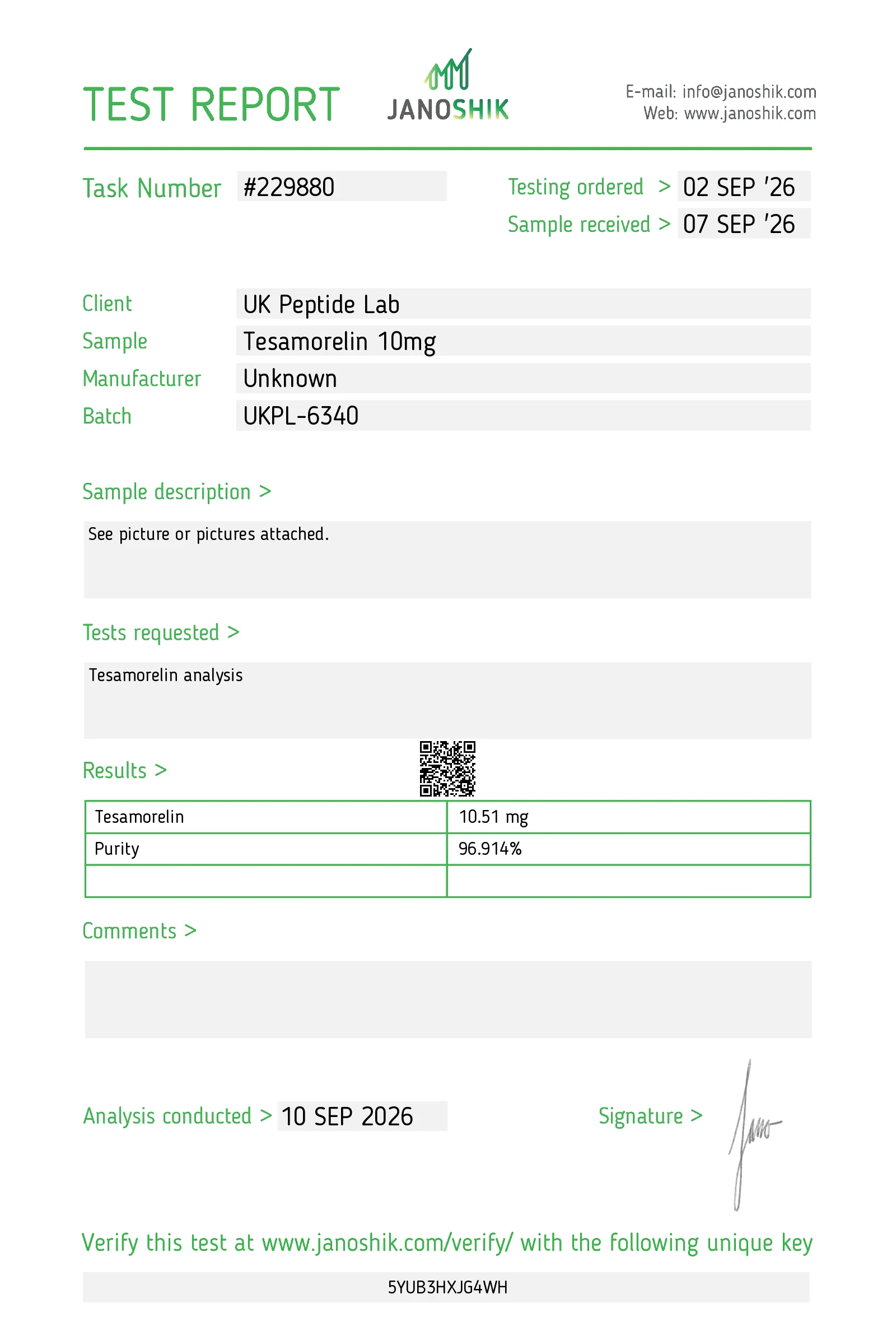 Original Janoshik report. Tap to enlarge.
Need the certificate for an earlier batch? Request an older CoA, or browse every Janoshik report.
Storage and Reconstitution
When storing tesamorelin powder, keep the sealed vial at -20°C, dry and dark. Heat, light and moisture shorten its shelf life. Once mixed, keep the solution refrigerated at 2-8°C and freeze single-use aliquots for longer holding. Methionine 27 and the two tyrosines are the oxidation-sensitive positions, so minimise headspace air. Avoid strongly alkaline buffers and heat, which could hydrolyse the hexenoyl group that gives DPP-4 resistance. Protect from light throughout, since the methionine at position 27 and the two tyrosine residues are the oxidation-sensitive positions in the sequence. There are no cysteines and therefore no disulfide network to scramble, but avoid conditions that could hydrolyse the N-terminal hexenoyl group, which is the feature giving the molecule its dipeptidyl peptidase-4 resistance.
Vials are sold on their own, without bacteriostatic water for mixing or other supplies.
How to reconstitute and handle
Let the vial reach room temperature so condensation does not settle on the cake. Run bacteriostatic water slowly down the inside wall of the vial and swirl gently until the solution is clear and colourless. Do not shake or vortex, because the long chain and the hydrophobic hexenoyl cap raise aggregation risk. Label the vial with the reconstitution date.
- Allow the vial to reach room temperature before opening so condensation does not settle on the cake.
- The single methionine at position 27 and the two tyrosine residues are the oxidation-sensitive positions in the sequence. Minimise headspace air exposure, protect from light, and do not leave dilute solutions standing at room temperature.
- There are no cysteines in tesamorelin, so there is no disulfide network to scramble. Aggregation risk sits instead with the hydrophobic hexenoyl cap and the length of the chain, which is another reason to avoid agitation and repeated warming.
- Note that the N-terminal acyl group is what confers dipeptidyl peptidase-4 resistance. Any handling that could hydrolyse it, such as strongly alkaline buffers or extended exposure to high temperature, changes the molecule you are actually studying.
- Store the reconstituted solution at 2-8°C and prepare single-use aliquots at -20°C for longer holding. Avoid repeated freeze-thaw cycles.
- Handle under aseptic conditions, swabbing the stopper of both vials with alcohol before each needle entry. The site reconstitution guide and reconstitution calculator cover the full aseptic workflow and dilution arithmetic.
For the full method, see the peptide reconstitution guide and the reconstitution calculator.
Research References
- Non-clinical pharmacology and safety evaluation of TH9507, a human growth hormone-releasing factor analogue (Basic Clin Pharmacol Toxicol, 2007)
- Effects of a growth hormone-releasing hormone analog on endogenous GH pulsatility and insulin sensitivity in healthy men (J Clin Endocrinol Metab, 2011)
- Metabolic effects of a growth hormone-releasing factor in patients with HIV (N Engl J Med, 2007)
Published research on Tesamorelin is indexed on PubMed.
Tesamorelin Price (UK)
Tesamorelin is for sale in 2 vial sizes, priced from £30.99 for 5mg to £49.99 for 10mg. Every size ships from our UK facility, each with its own batch certificate. UK delivery is £4.50 by Royal Mail Tracked 24, free over £59.
| Vial | Price | Cost per mg | Availability |
|---|---|---|---|
| Tesamorelin 5mg | £30.99 | £6.20 | In stock |
| Tesamorelin 10mgThis page | £49.99 | £5.00Best value | In stock |
Prices are in GBP per vial and match the basket. See the FAQ for delivery and payment options, and quality & testing for how each batch is checked.
Frequently Asked Questions
How does tesamorelin work?
Tesamorelin binds the GHRH receptor on anterior pituitary somatotrophs, the same receptor used by endogenous GHRH, and its distinguishing feature is resistance to enzymatic inactivation. Native GHRH is cleaved between Tyr1 and Ala2 by dipeptidyl peptidase-4 within minutes; the trans-3-hexenoyl cap on Tyr1 blocks that cleavage, and the non-clinical evaluation of TH9507 published in 2007 reported both DPP-IV resistance and enhanced duration of action relative to unmodified hGRF(1-44)NH₂. Because it acts upstream of the pituitary rather than substituting for growth hormone, endogenous pulsatility and feedback control remain part of the system.
Can I buy tesamorelin in the UK?
Yes. Tesamorelin 10mg and 10mg vials are available from UK Peptide Lab for laboratory research use, with the batch certificate of analysis linked on each product page. Orders placed before 3pm on a working day are dispatched the same day.
Is tesamorelin legal in the UK?
Tesamorelin is not a licensed medicine in the United Kingdom and holds no UK marketing authorisation. It has never been authorised as a medicinal product here, and the EU centralised marketing authorisation application for Egrifta was withdrawn by the applicant in June 2012 after the CHMP indicated it could not reach a positive benefit-risk conclusion. It is approved only in the United States, by the FDA in November 2010, for one narrow indication. UK Peptide Lab supplies tesamorelin solely as a laboratory reference material for in-vitro research use: not for human or veterinary use, not for consumption, and not for any therapeutic purpose. Buyers must be 18 or over and must confirm research-only use. This is regulatory background rather than legal advice, and researchers remain responsible for confirming the rules that apply to their own institution and jurisdiction.
Is tesamorelin the same as Egrifta?
Egrifta is the US brand name for tesamorelin as a prescription medicinal product, so the active molecule is the same but the article is not. A licensed medicine is manufactured, released and labelled to a marketing authorisation with an approved indication and prescribing information behind it. What is supplied here is tesamorelin as a research reagent, batch UKPL-6340, measured at 96.914% by HPLC (Janoshik Analytical, 26 October 2026) with the certificate of analysis published on this page. It is not Egrifta, is not a medicine, and is for in-vitro research use only.
What is the difference between tesamorelin, CJC-1295 and sermorelin?
All three are GHRH receptor agonists, and the difference is how much of the native sequence they keep and how they resist degradation. Sermorelin is the truncated GHRH(1-29) fragment with no stabilising modification. CJC-1295 is a modified GRF(1-29) analogue, available with or without the DAC linker that gives it a much longer duration. Tesamorelin is unusual in retaining the complete 44 residue GHRH sequence, with resistance coming from a single trans-3-hexenoyl group on Tyr1 rather than from truncation or a linker. Researchers pick tesamorelin when the design calls for a full-length GHRH sequence with DPP-4 resistance, and it is the only one of the three that has ever been through phase 3 trials.
What is the half-life of tesamorelin?
Mean elimination half-life reported in the FDA prescribing information is 26 minutes in healthy subjects and 38 minutes in HIV-infected patients following subcutaneous administration. That is short in absolute terms but dramatically longer than native GHRH, which dipeptidyl peptidase-4 degrades within minutes, and it illustrates why the growth hormone response outlasts the plasma presence of the analogue itself: the readout is pituitary secretion, not the concentration of the secretagogue.
What has published tesamorelin research examined?
The published human literature falls into two groups. Endocrine pharmacology studies characterised what a DPP-4 resistant GHRH analogue does to secretion patterns, with Stanley and colleagues (Journal of Clinical Endocrinology and Metabolism, 2011) reporting increased basal and pulsatile GH secretion in healthy men without a change in pulse frequency. Clinical trials ran principally in HIV associated lipodystrophy, where Falutz and colleagues (New England Journal of Medicine, 2007) and a later pooled phase 3 analysis reported changes in visceral adipose tissue and circulating IGF-I, with Makimura and colleagues (2012) extending the work to non-HIV subjects with reduced GH secretion. Those findings belong to defined patient populations studied under medical supervision and are reported here as literature background only, not as claims about this product.
What is in a tesamorelin 5mg vial and how do I mix it?
Each vial contains tesamorelin as a lyophilised powder, formula C₂₂₁H₃₆₆N₇₂O₆₇S, molecular weight 5135.8 g/mol, CAS 218949-48-5, batch UKPL-6340, tested at 96.914% purity by HPLC (Janoshik Analytical, 26 October 2026) with the certificate of analysis published on this page. To reconstitute, inject bacteriostatic water slowly down the inner glass wall of the vial and swirl gently until the solution is clear and colourless. Do not shake or vortex. Allow both vials to reach room temperature first and swab each stopper with alcohol before needle entry.
What is tesamorelin peptide?
Tesamorelin is a synthetic analogue of human growth hormone releasing factor, hGRF(1-44)NH₂, developed under the code TH9507, that acts as an agonist at the GHRH receptor. UK Peptide Lab supplies it as a lyophilised powder in 5mg and 10mg vials, batch UKPL-6340, measured at 96.914% purity by HPLC (Janoshik Analytical, 26 October 2026). It is sold for in-vitro research use only.
Is tesamorelin a peptide?
Yes. Tesamorelin is a 44 residue peptide, the full human GHRH sequence with a single trans-3-hexenoyl group attached to Tyr1. Its formula is C₂₂₁H₃₆₆N₇₂O₆₇S with a molecular weight of 5135.8 g/mol and CAS 218949-48-5.
What is the tesamorelin peptide?
Tesamorelin is a synthetic 44-amino-acid analogue of growth hormone releasing hormone (GHRH). In laboratory research it is used to study GHRH receptor signalling. The vials here are lyophilised powder for in-vitro research only, not for human or veterinary use. The batch certificate for the lot is shown on this page.
Where can I buy tesamorelin in the UK?
UK Peptide Lab has tesamorelin peptide for sale online in 5mg and 10mg vials, dispatched from the UK. Each batch has its own third-party certificate, and the batch on this listing is UKPL-6340. Orders placed before 3pm on a working day are dispatched the same day, with free UK delivery over £59.
Is your tesamorelin peptide UK third-party tested?
Yes. Every batch has a third-party certificate of analysis. Batch UKPL-6340 was measured by Janoshik Analytical on 26 October 2026 at 96.914% purity by HPLC, with 5.07mg of tesamorelin per 5mg vial. The certificate is published in the certificate section, so you can check purity and content before ordering.
What is tesamorelin used for in research?
Tesamorelin is used in endocrine research on GHRH receptor activation, somatotroph pharmacology and endogenous growth hormone secretion. It is also a reference compound for DPP-4 resistance as a peptide stabilisation strategy. It is supplied for laboratory research only.
Related Products