
Research Blog
Guides, comparisons, and laboratory resources for peptide researchers.

Are Peptides Legal in the UK? The Actual Legal Position
The honest answer is that it depends entirely on what the peptide is sold for, not what the peptide is. Buying and possessing research peptides for laboratory work is lawful in the UK. Supplying them for human consumption is a criminal offence, and that distinction is the whole of the law here.

BPC-157 Research Guide: What Scientists Need to Know
BPC-157 is one of the most widely studied research peptides in preclinical science. Learn about its molecular structure, stability, research applications, and laboratory handling.
TB-500 vs BPC-157: A Researcher's Comparison
TB-500 and BPC-157 are two of the most widely studied peptides in preclinical research. Explore their molecular differences, research applications, and combined laboratory protocols.

GHK-Cu and Collagen: What the ECM and Fibroblast Research Shows
GHK-Cu is a naturally occurring copper-binding tripeptide studied for collagen synthesis, ECM biology, and gene expression research. Learn about its molecular properties and laboratory handling.
CJC-1295 vs Ipamorelin: Differences and Combined Use
CJC-1295 and Ipamorelin are two widely studied growth hormone secretagogues with complementary mechanisms. Learn about their differences, research applications, and why they're often combined in laboratory protocols.
Peptide Storage Guide: How to Store Research Peptides Correctly
Proper storage is critical for maintaining peptide stability and integrity. Learn the essential storage conditions for lyophilised and reconstituted peptides, and avoid common mistakes that compromise research quality.
BPC-157 and TB-500: Research Overview
BPC-157 and TB-500 are two of the most extensively studied tissue-repair research peptides. A complete overview of their mechanisms and combined use.
GHK Peptide (GHK-Cu): What the Copper Tripeptide Is and How It Works
GHK-Cu is a naturally occurring copper tripeptide studied across collagen synthesis, gene expression, and tissue remodelling research. A complete guide.
Tesamorelin vs CJC-1295: GH Secretagogue Research Comparison
Tesamorelin is a stabilised full-length GHRH analogue. CJC-1295 is a truncated GHRH(1-29) analogue with optional DAC technology. Comparison of mechanism, pulsatility, and research applications.
Melanotan I vs Melanotan II: Receptor Selectivity Comparison
Melanotan I and Melanotan II differ in receptor selectivity. One acts narrowly at MC1R, the other broadly across the melanocortin receptor family. A research comparison of mechanism and applications.
Semax vs Selank: Russian Nootropic Peptide Comparison
Semax and Selank are both Russian-developed heptapeptides studied in cognitive and anxiolytic research, but they derive from different parent hormones and act through different pathways.
PT-141 (Bremelanotide): Melanocortin Receptor Research Guide
PT-141 (Bremelanotide) is a cyclic heptapeptide derived from Melanotan II, modified to remove MC1R activity and concentrate action at the central MC3R and MC4R receptors.
MOTS-C: Mitochondrial-Derived Peptide Research Guide
MOTS-C is a short peptide encoded within mitochondrial DNA. Discovered in 2015, it has become a central tool in research on AMPK signalling, metabolic homeostasis, and mitochondrial-nuclear crosstalk.
IGF-1 LR3 Research Guide: Mechanism, Pharmacology, Laboratory Use
IGF-1 LR3 is a long-acting analogue of insulin-like growth factor 1 with an Arg substitution at position 3 and a 13-amino-acid N-terminal extension. Extended half-life and reduced IGFBP binding make it a widely used tool in cell proliferation and myogenesis research.
DSIP (Delta Sleep-Inducing Peptide): Evidence Review
DSIP is a 9-amino-acid peptide first isolated from rabbit cerebral venous blood in 1977. Despite five decades of research, its receptor and mechanism remain uncharacterised. A research guide with an honest review of the evidence base.
CJC-1295 With DAC vs Without DAC: Research Comparison
CJC-1295 exists in two distinct research forms. The 'no DAC' variant produces a pulsatile GH research model with a half-life of around 30 minutes. The 'DAC' variant binds albumin covalently and extends half-life to multiple days. The receptor mechanism is identical; the pharmacokinetics are not.
KPV: Anti-Inflammatory Tripeptide Research Guide
KPV is a tripeptide (lysine-proline-valine) derived from the C-terminal of alpha-MSH. Studied for anti-inflammatory effects in gastrointestinal research models, with NF-kB pathway modulation as the principal proposed mechanism.

Why GLOW Combines Three Repair Peptides in One Vial
GLOW is a pre-blended three-peptide research vial pairing BPC-157, TB-500, and GHK-Cu in a single lyophilised powder. A research guide to the component mechanisms and the co-administration rationale.

KLOW vs GLOW: What Adding KPV Changes
KLOW is a pre-blended four-peptide research vial extending GLOW by adding KPV, a tripeptide with NF-kB-modulating anti-inflammatory activity. A research guide to the four components and their combined application.
NAD+: Cellular Redox Cofactor Research Guide
NAD+ is the central cellular redox cofactor and a substrate for the sirtuin, PARP, and CD38 enzyme families. A research guide to mechanism, the documented decline with ageing, and laboratory applications.
Glutathione: Tripeptide Antioxidant Research Guide
Glutathione is the most abundant non-protein thiol in mammalian cells and the principal cytosolic antioxidant. A research guide to structure, biosynthesis, the GSH/GSSG redox indicator, and laboratory handling.
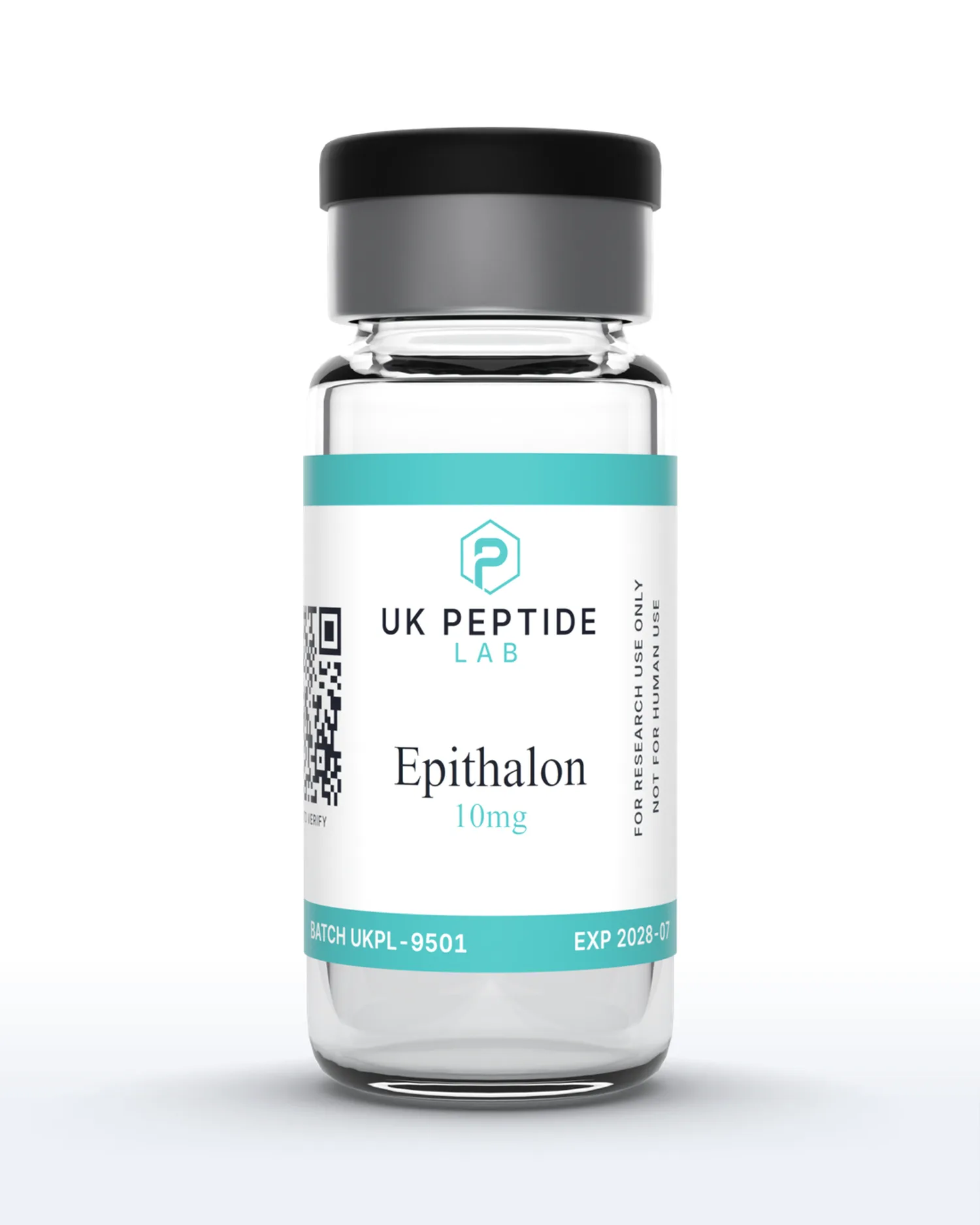
Epithalon Peptide: Research Guide (Ala-Glu-Asp-Gly)
Epithalon is a synthetic tetrapeptide (Ala-Glu-Asp-Gly) designed from the pineal preparation Epithalamin. This guide covers the telomerase and lifespan literature, the circadian work it inherits, and the structural weaknesses in the evidence base that any researcher should weigh before designing around it.

AOD-9604 Research Guide: The hGH (177-191) Fragment
AOD-9604 is the Tyr-hGH(177-191) fragment: sixteen residues of the human growth hormone C-terminus with an added N-terminal tyrosine. Sequence, disulfide chemistry, the preclinical lipolysis data, and why the phase 2b programme was wound down.

Sermorelin (GHRH 1-29): 5mg vs 10mg Research Guide
Sermorelin is the synthetic GHRH (1-29) fragment, the shortest portion of growth-hormone-releasing hormone that retains full receptor activity. The 5mg and 10mg vials hold the same molecule — this guide covers what the 10mg format changes and what it does not.

Thymosin Alpha-1 Research Guide: The 28-Residue Thymic Peptide
Thymosin alpha-1 is a 28-residue, N-terminally acetylated peptide first isolated from bovine thymus. A research guide to its chemistry, toll-like receptor mechanism, licensed-medicine history and laboratory use.