
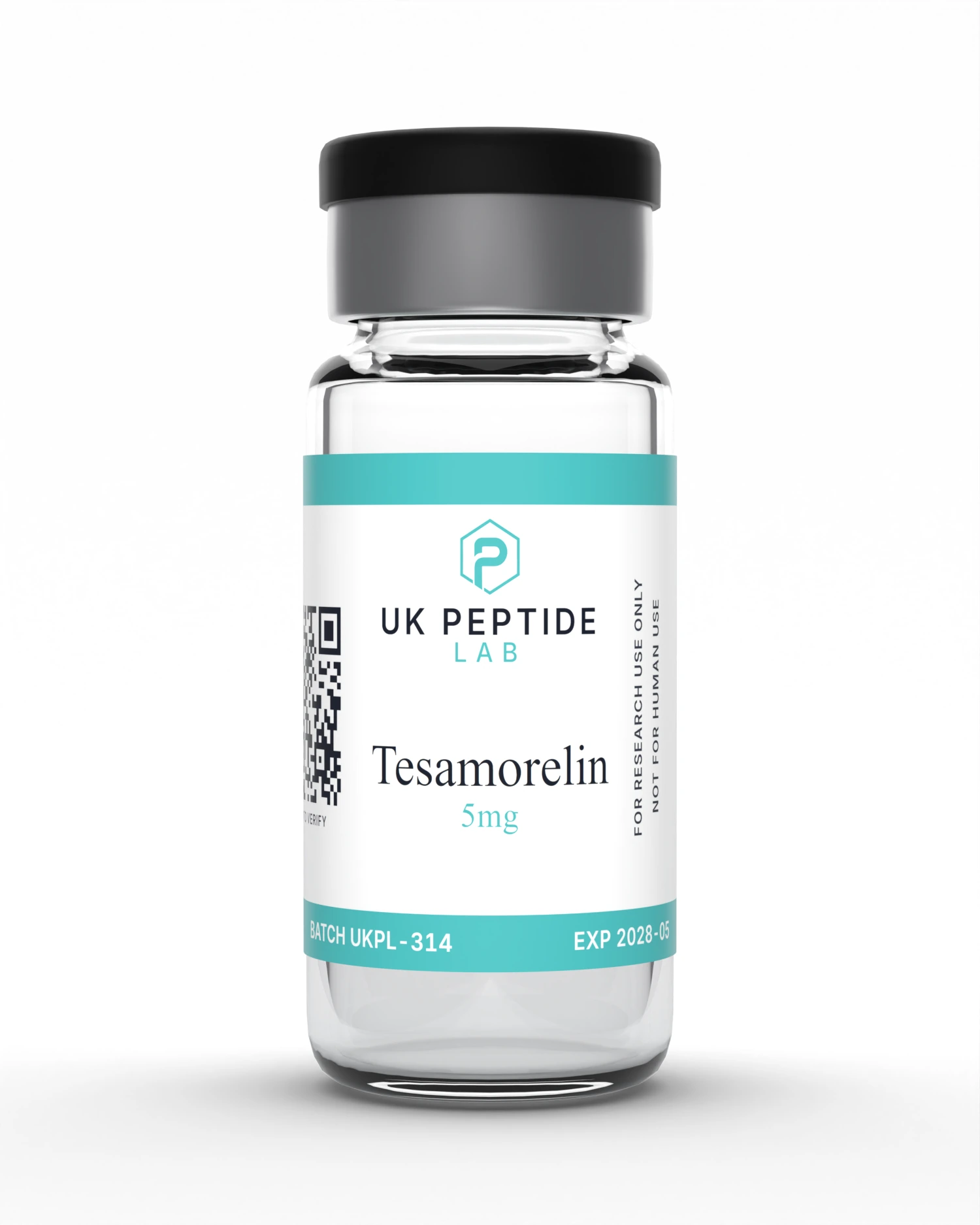
Tesamorelin
5mg
Tesamorelin is a synthetic analogue of growth hormone-releasing hormone (GHRH) consisting of 44 amino acids with a hexenoyl modification at the N-terminus that confers resistance to enzymatic cleavage. Research has examined its effects on growth hormone and IGF-1 release, with particular interest in visceral adipose tissue and lipid metabolism in clinical and preclinical contexts. Lyophilised powder, third-party tested. Lab certificate published on this page when stock arrives.
Published research on Tesamorelin is indexed on PubMed. See our full UK buyer's guide for Tesamorelin.
Intended Use: Strictly for in-vitro laboratory research. Not for use in humans or animals. Not to be used in foods, drugs, or medical diagnostics. This product has not been evaluated by the MHRA or FDA. Buyer assumes full responsibility for safe handling and regulatory compliance.
98.21%
Purity
LAB
Certified
SAME
Day Ship
Quantity
Add £12.01 more for free UK delivery
Damaged or lost? Free reshipment guaranteed
Bacteriostatic Water 10ml
Required to reconstitute lyophilised peptides.
Research Use Only
This product is intended strictly for research and laboratory use only. Not for human consumption, medical use, or diagnostic purposes.
Certificate of Analysis
Third-party tested
Lyophilised Stability
24 months
Sealed at -20°C, light-protected
Reconstituted Stability
Up to 3 months
Stored at 2-8°C after mixing
Cold-Chain Shipping
Always
Dry-cold pack, Royal Mail Tracked 24
Important Notice
All compounds are sold individually and do not include research supplies. Products are provided in lyophilised (powder) form and require proper reconstitution before use in research settings.
Related Products
Tesamorelin Price (UK)
Tesamorelin is supplied in 2 vial sizes, priced from £32.99 for 5mg to £49.99 for 10mg. Every size ships from our UK facility with the same third-party HPLC certificate published on this page. UK delivery is £4.50 by Royal Mail Tracked 24, or free once your basket reaches £45 (£12.01 away at this price). Orders placed before 2pm on a working day are dispatched the same day.
| Vial | Price | Cost per mg | Availability |
|---|---|---|---|
| Tesamorelin 5mgThis page | £32.99 | £6.60 | In stock |
| Tesamorelin 10mg | £49.99 | £5.00Best value | In stock |
Prices are in GBP and shown per vial as supplied, lyophilised, for in-vitro laboratory research only. Cost per mg is given so researchers can compare vial sizes on a like-for-like basis. Stock and pricing on this table are read live from our inventory, so they match the basket. See our FAQ for delivery and payment options, and quality & testing for how each batch is verified.
Product Specifications
Research Overview
Tesamorelin, developed under the code TH9507, is a synthetic analogue of human growth hormone releasing factor, hGRF(1-44)NH₂, and acts as an agonist at the growth hormone releasing hormone (GHRH) receptor on anterior pituitary somatotrophs. Structurally it is the full 44 residue GHRH sequence carrying one modification: a trans-3-hexenoyl group attached to Tyr1 at the N-terminus, with the native C-terminal amide retained. That single acylation is the entire design rationale. Endogenous GHRH is cleaved between Tyr1 and Ala2 by dipeptidyl peptidase-4 within minutes, and the hexenoyl cap blocks access to that bond. The non-clinical pharmacology and safety evaluation of TH9507 (Basic and Clinical Pharmacology and Toxicology, 2007) reported that the analogue resists dipeptidyl aminopeptidase-IV deactivation and shows enhanced potency and duration of action relative to unmodified hGRF(1-44)NH₂. Because a GHRH analogue acts upstream at the receptor rather than substituting for growth hormone itself, endogenous secretion patterns and pituitary feedback remain in the loop. Stanley and colleagues (Journal of Clinical Endocrinology and Metabolism, 2011) reported increased basal and pulsatile GH secretion in healthy men with no change in pulse frequency, which is the pharmacological distinction that matters when choosing between a GHRH analogue and recombinant growth hormone. Clinical investigation ran principally in HIV associated lipodystrophy, where Falutz and colleagues (New England Journal of Medicine, 2007) and a later pooled phase 3 analysis reported changes in visceral adipose tissue and in circulating IGF-I within that specific supervised patient population, and Makimura and colleagues (2012) extended the work to non-HIV subjects with reduced GH secretion. The compound was approved by the FDA in November 2010 under the brand Egrifta for that one narrow indication. It has never held a UK marketing authorisation, and the EU centralised application was withdrawn by the applicant in June 2012. For laboratories sourcing a tesamorelin peptide UK side, it remains the reference DPP-4 resistant GHRH receptor agonist. Supplied as lyophilised powder for in-vitro research use only.
Product Specifications
Laboratory Handling
- Store lyophilised vials at -20°C, sealed and protected from light and moisture. Allow the vial to reach room temperature before opening so condensation does not settle on the cake.
- Reconstitute with bacteriostatic water or sterile water for injection, injecting slowly down the inner glass wall rather than onto the lyophilised powder. Swirl gently until the solution is clear and colourless. Never shake or vortex.
- The single methionine at position 27 and the two tyrosine residues are the oxidation-sensitive positions in the sequence. Minimise headspace air exposure, protect from light, and do not leave dilute solutions standing at room temperature.
- There are no cysteines in tesamorelin, so there is no disulfide network to scramble. Aggregation risk sits instead with the hydrophobic hexenoyl cap and the length of the chain, which is another reason to avoid agitation and repeated warming.
- Note that the N-terminal acyl group is what confers dipeptidyl peptidase-4 resistance. Any handling that could hydrolyse it, such as strongly alkaline buffers or extended exposure to high temperature, changes the molecule you are actually studying.
- Store the reconstituted solution at 2-8°C and prepare single-use aliquots at -20°C for longer holding. Avoid repeated freeze-thaw cycles.
- Handle under aseptic conditions, swabbing the stopper of both vials with alcohol before each needle entry. The site reconstitution guide and reconstitution calculator cover the full aseptic workflow and dilution arithmetic.
Frequently Asked Questions
What is Tesamorelin?
Tesamorelin is a 44 residue synthetic analogue of human growth hormone releasing hormone, hGRF(1-44)NH₂, developed under the code TH9507 and acting as an agonist at the GHRH receptor on anterior pituitary somatotrophs. Its single structural modification is a trans-3-hexenoyl group on Tyr1, which blocks the dipeptidyl peptidase-4 cleavage site between Tyr1 and Ala2 that inactivates native GHRH within minutes. The non-clinical evaluation of TH9507 published in Basic and Clinical Pharmacology and Toxicology in 2007 reported resistance to dipeptidyl aminopeptidase-IV alongside enhanced potency and duration of action. Supplied as lyophilised powder for in-vitro research use only.
Tesamorelin vs CJC-1295 vs Sermorelin
All three act at the same receptor, and the differences are sequence length and the mechanism of enzymatic stabilisation. Sermorelin is the truncated GHRH(1-29) fragment with no stabilising modification, so it is the shortest-acting of the three. CJC-1295 is a modified GRF(1-29) analogue, supplied with or without the DAC linker, where the linker is what extends duration substantially. Tesamorelin is the outlier in retaining the complete 44 residue GHRH sequence, with stability coming from one trans-3-hexenoyl group on Tyr1 rather than from truncation or a conjugated linker. Researchers choose tesamorelin when a full-length GHRH sequence with DPP-4 resistance is what the design calls for, and it is the only GHRH analogue of the three to have completed phase 3 clinical trials, which means its human pharmacology is documented in far more detail than that of the GRF(1-29) analogues.
Tesamorelin Research Applications
Tesamorelin is used in endocrine research examining GHRH receptor pharmacology, dipeptidyl peptidase-4 resistance as a peptide stabilisation strategy, somatotroph biology, and the kinetics of endogenous growth hormone secretion when driven from upstream of the pituitary rather than replaced directly. Stanley and colleagues (Journal of Clinical Endocrinology and Metabolism, 2011) reported increased basal and pulsatile GH secretion in healthy men with no change in pulse frequency, which is the endpoint distinguishing a GHRH analogue from recombinant growth hormone. The clinical literature ran principally in HIV associated lipodystrophy, with a later randomised trial extending to non-HIV subjects with reduced GH secretion. Those findings belong to defined patient populations studied under medical supervision and are reported here as literature background only.
Reconstitution Guide
Allow vials to reach room temperature, then sterilise the rubber stopper of both the peptide vial and the bacteriostatic water vial with an alcohol swab. Slowly draw your bacteriostatic water into a sterile insulin syringe, then inject it gently down the inner glass wall of the peptide vial, never directly onto the lyophilised powder. Once added, gently swirl the vial in a slow circular motion until fully dissolved. Never shake or vortex. The solution should be clear and colourless. Label the vial with the reconstitution date and store immediately.
See our full peptide reconstitution guide and reconstitution calculator for step-by-step protocol.
Storage Instructions
Lyophilised vials should be stored at -20°C, protected from light and moisture, and remain stable for up to 24 months. Once reconstituted with bacteriostatic water, store the solution at 2-8°C (standard refrigerator) and use within approximately 3 months. For storage beyond that, prepare single-use aliquots at -20°C, where reconstituted peptide remains stable for up to 6 months. Avoid repeated freeze-thaw cycles and always handle under sterile laboratory conditions. Protect from light throughout, since the methionine at position 27 and the two tyrosine residues are the oxidation-sensitive positions in the sequence. There are no cysteines and therefore no disulfide network to scramble, but avoid conditions that could hydrolyse the N-terminal hexenoyl group, which is the feature giving the molecule its dipeptidyl peptidase-4 resistance.
Frequently Asked Questions
Research References
- Non-clinical pharmacology and safety evaluation of TH9507, a human growth hormone-releasing factor analogue (Basic Clin Pharmacol Toxicol, 2007)
- Effects of a growth hormone-releasing hormone analog on endogenous GH pulsatility and insulin sensitivity in healthy men (J Clin Endocrinol Metab, 2011)
- Metabolic effects of a growth hormone-releasing factor in patients with HIV (N Engl J Med, 2007)
Related Research Compounds
Tesamorelin
5mg · £32.99