
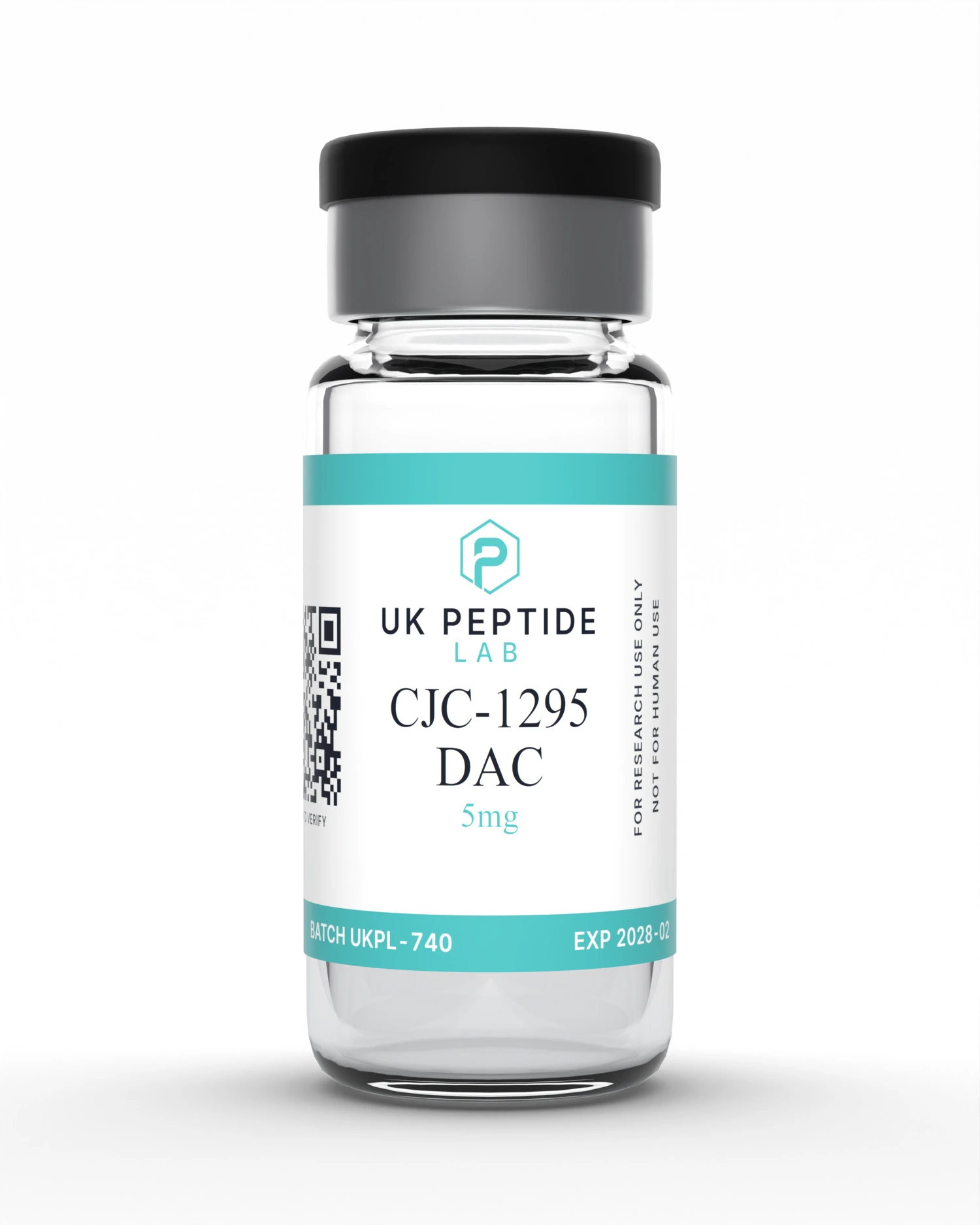
CJC-1295 DAC
5mg
CJC-1295 with DAC (Drug Affinity Complex) is a modified GHRH analogue conjugated with a maleimidopropionic acid linker that allows covalent binding to serum albumin in vivo. The albumin binding extends its plasma half-life substantially compared to the no-DAC variant, sustaining elevated growth hormone and IGF-1 release for an extended period in research models. Lyophilised powder, third-party tested.
Published research on CJC-1295 DAC is indexed on PubMed. See our full UK buyer's guide for CJC-1295.
Intended Use: Strictly for in-vitro laboratory research. Not for use in humans or animals. Not to be used in foods, drugs, or medical diagnostics. This product has not been evaluated by the MHRA or FDA. Buyer assumes full responsibility for safe handling and regulatory compliance.
98.65%
Purity
LAB
Certified
SAME
Day Ship
Quantity
Add £5.01 more for free UK delivery
Damaged or lost? Free reshipment guaranteed
Bacteriostatic Water 10ml
Required to reconstitute lyophilised peptides.
Research Use Only
This product is intended strictly for research and laboratory use only. Not for human consumption, medical use, or diagnostic purposes.
Certificate of Analysis
Third-party tested
Lyophilised Stability
24 months
Sealed at -20°C, light-protected
Reconstituted Stability
Up to 3 months
Stored at 2-8°C after mixing
Cold-Chain Shipping
Always
Dry-cold pack, Royal Mail Tracked 24
Important Notice
All compounds are sold individually and do not include research supplies. Products are provided in lyophilised (powder) form and require proper reconstitution before use in research settings.
Related Products
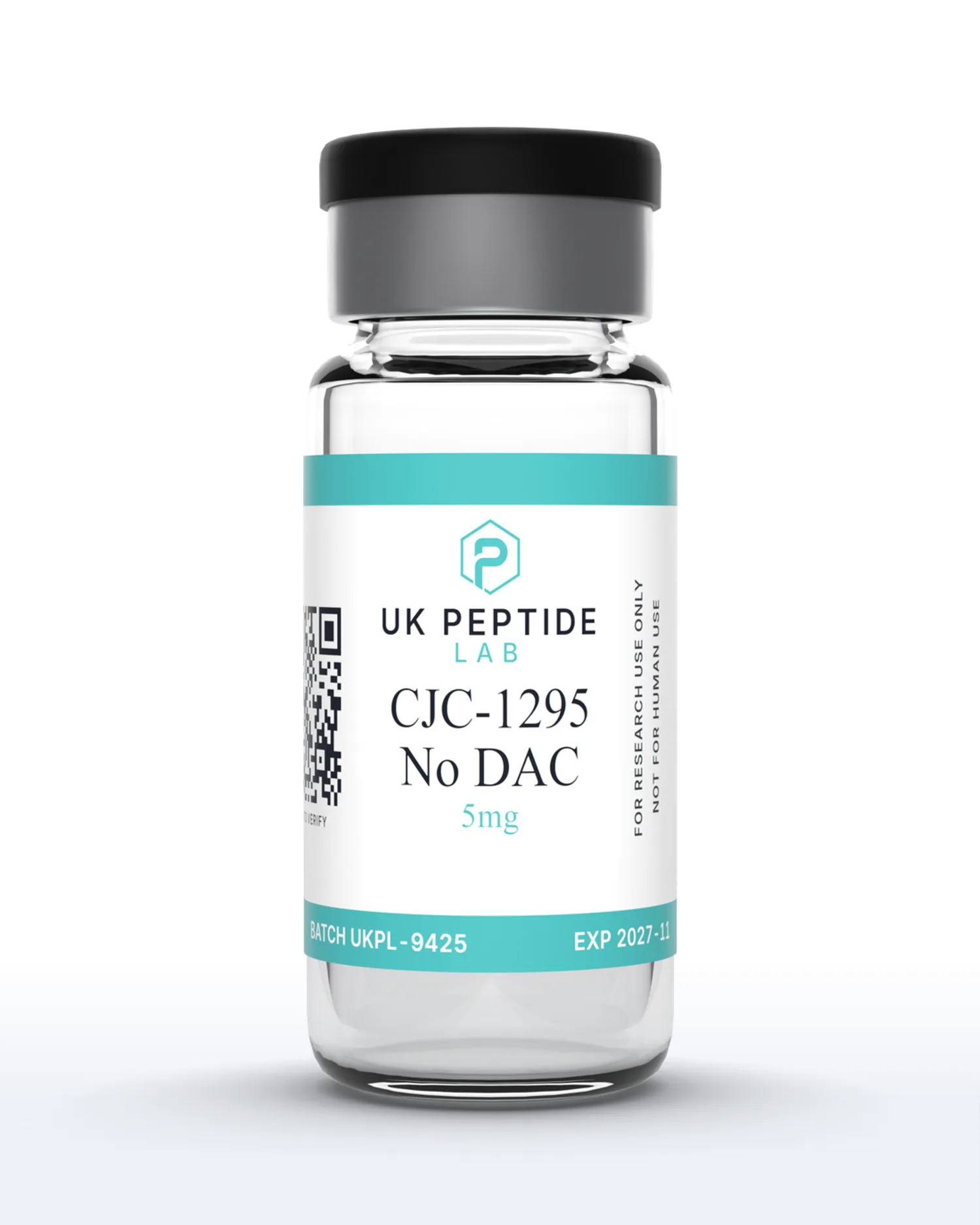
CJC-1295 DAC Price (UK)
CJC-1295 DAC 5mg is £39.99 per vial, supplied from stock in the UK with a third-party HPLC certificate published on this page. UK delivery is £4.50 by Royal Mail Tracked 24, or free once your basket reaches £45 (£5.01 away at this price). Orders placed before 2pm on a working day are dispatched the same day.
| Vial | Price | Cost per mg | Availability |
|---|---|---|---|
| CJC-1295 DAC 5mgThis page | £39.99 | £8.00 | In stock |
Prices are in GBP and shown per vial as supplied, lyophilised, for in-vitro laboratory research only. Cost per mg is given so researchers can compare vial sizes on a like-for-like basis. Stock and pricing on this table are read live from our inventory, so they match the basket. See our FAQ for delivery and payment options, and quality & testing for how each batch is verified.
Product Specifications
Research Overview
CJC-1295 DAC is a 30-residue growth hormone releasing hormone analogue carrying a maleimide group that binds covalently to serum albumin in circulation, molecular formula C₁₆₅H₂₆₉N₄₇O₄₆, molecular weight 3647.2 g/mol, CAS 863288-34-0. In modification nomenclature it is Nε30-maleimidopropionyl-[D-Ala2, Gln8, Ala15, Leu27]-Sermorelin-Lys30, that is the tetrasubstituted hGRF(1-29) backbone extended by a thirtieth residue, lysine, whose side-chain amine carries 3-maleimidopropionic acid. DAC stands for Drug Affinity Complex, and it is the entire reason cjc 1295 dac and cjc dac are searched separately from the no-DAC compound. A maleimide is a Michael acceptor, and the most abundant free thiol in plasma is Cys34 of human serum albumin, so the peptide forms a stable covalent thioether conjugate with albumin after administration rather than binding it reversibly. Jetté and colleagues (Endocrinology, 2005) synthesised three maleimido hGRF(1-29) derivatives, bioconjugated them to albumin and identified CJC-1295 as the long-lasting analogue; Teichman and colleagues (J Clin Endocrinol Metab, 2006) reported a terminal half-life of roughly 6 to 8 days in healthy adults. The four backbone substitutions each remove a degradation liability of native GRF(1-29): D-Ala2 blocks dipeptidyl peptidase-4 cleavage at the Tyr1-Ala2 bond, Gln8 removes an asparagine deamidation site, Leu27 removes a methionine oxidation site, and Ala15 is associated with increased potency. One widely repeated claim about the DAC form is contradicted by the literature. Ionescu and Frohman (J Clin Endocrinol Metab, 2006) reported that pulsatile GH secretion persisted during continuous GHRH-receptor stimulation by CJC-1295, indicating that pulse generation is not set by GHRH pulse frequency alone. Alba and colleagues (Am J Physiol Endocrinol Metab, 2006) examined the analogue in the GHRH knockout mouse. Supplied as lyophilised powder for in-vitro research use only.
Product Specifications
Laboratory Handling
- Store lyophilised vials at -20°C, protected from light and moisture. Allow the vial to reach room temperature before opening so condensation does not settle on the powder.
- Reconstitute with bacteriostatic water, injecting slowly down the inner glass wall rather than onto the lyophilised cake, then swirl gently until fully dissolved. Never shake or vortex.
- Keep thiols out of the system. The maleimide is a reactive Michael acceptor and will be consumed by any free sulfhydryl in the preparation, so dithiothreitol, beta-mercaptoethanol, free cysteine, reduced glutathione and thiol-containing buffer additives will quench the DAC function even though the peptide backbone appears intact by HPLC.
- Avoid alkaline conditions during reconstitution and storage. Maleimide hydrolyses to the unreactive maleamic acid at elevated pH, which is the quietest way to lose the albumin-conjugating chemistry that distinguishes this compound from the no-DAC form.
- Hold reconstituted solution at 2-8°C and prepare single-use aliquots at -20°C for longer storage. Repeated freeze-thaw cycling degrades GHRH analogue peptides.
- Handle under aseptic conditions, swabbing both vial stoppers with 70% isopropyl alcohol before each needle entry and using a fresh sterile syringe per transfer.
Frequently Asked Questions
What is CJC-1295 DAC?
CJC-1295 DAC is a 30-residue growth hormone releasing hormone analogue, molecular formula C₁₆₅H₂₆₉N₄₇O₄₆, molecular weight 3647.2 g/mol, CAS 863288-34-0, written in modification nomenclature as Nε30-maleimidopropionyl-[D-Ala2, Gln8, Ala15, Leu27]-Sermorelin-Lys30. It is the tetrasubstituted hGRF(1-29) backbone extended by a thirtieth lysine whose side-chain amine carries 3-maleimidopropionic acid. DAC stands for Drug Affinity Complex: the maleimide is a Michael acceptor that reacts with Cys34 of human serum albumin, the most abundant free thiol in plasma, forming a covalent thioether conjugate that extends the terminal half-life to roughly 6 to 8 days. It binds the GHRH receptor on pituitary somatotrophs. Supplied as lyophilised powder for in-vitro research use only, not a licensed medicine.
CJC-1295 DAC vs CJC-1295 No DAC (Modified GRF 1-29)
The two compounds share an identical receptor, an identical binding mode and, in the first 29 residues, an identical sequence. Everything that separates them sits at the C-terminus. CJC-1295 without DAC, sold as modified GRF (1-29), stops at residue 29 and is C₁₅₂H₂₅₂N₄₄O₄₂ at 3367.9 g/mol, with a half-life of the order of 30 minutes. CJC-1295 with DAC adds Lys30 bearing 3-maleimidopropionic acid, taking the mass to 3647.2 g/mol; the 279.3 difference corresponds precisely to a lysine residue plus a maleimidopropionyl group, which is the simplest bench check that a vial contains the DAC form. Jetté and colleagues (Endocrinology, 2005) identified CJC-1295 from three maleimido GRF derivatives and demonstrated albumin bioconjugation, and Teichman and colleagues (J Clin Endocrinol Metab, 2006) reported the multi-day terminal half-life in healthy adults. The frequently repeated claim that the DAC form abolishes pulsatile secretion is not supported: Ionescu and Frohman (J Clin Endocrinol Metab, 2006) reported that pulsatile GH secretion persisted during continuous stimulation by CJC-1295. Researchers choose the no-DAC form when short, controllable exposure is required and the DAC form when sustained receptor occupancy is the experimental variable.
CJC-1295 DAC Research Applications
CJC-1295 DAC is studied in endocrine research on GHRH receptor pharmacology, somatotroph biology, and the consequences of sustained versus intermittent receptor stimulation, a question the compound is unusually well suited to because its albumin conjugation converts a minutes-long agonist into a multi-day one without changing the ligand's receptor interaction. Published work includes albumin bioconjugation chemistry and GRF receptor activation in rats (Jetté et al., Endocrinology, 2005), human pharmacokinetic and pharmacodynamic characterisation (Teichman et al., J Clin Endocrinol Metab, 2006), analysis of GH pulsatility under continuous stimulation (Ionescu and Frohman, J Clin Endocrinol Metab, 2006), and normalisation of growth in the GHRH knockout mouse (Alba et al., Am J Physiol Endocrinol Metab, 2006). It is also a reference analyte in anti-doping method development, since GHRH analogues are prohibited in sport and CJC-1295 detection assays in human and equine plasma are an established literature.
Reconstitution Guide
Allow vials to reach room temperature, then sterilise the rubber stopper of both the peptide vial and the bacteriostatic water vial with an alcohol swab. Slowly draw your bacteriostatic water into a sterile insulin syringe, then inject it gently down the inner glass wall of the peptide vial, never directly onto the lyophilised powder. Once added, gently swirl the vial in a slow circular motion until fully dissolved. Never shake or vortex. One precaution is specific to the DAC form: the maleimide is a reactive electrophile, so keep free thiols out of the preparation. Dithiothreitol, beta-mercaptoethanol, free cysteine and reduced glutathione will all react with it, and alkaline buffers hydrolyse the maleimide to an unreactive maleamic acid. Either route destroys the albumin-conjugating chemistry while leaving the peptide backbone looking intact. The solution should be clear and colourless. Label the vial with the reconstitution date and refrigerate immediately.
See our full peptide reconstitution guide and reconstitution calculator for step-by-step protocol.
Storage Instructions
Lyophilised vials should be stored at -20°C, protected from light and moisture, and remain stable for up to 24 months. Once reconstituted with bacteriostatic water, store the solution at 2-8°C and use within approximately 4 weeks. For longer storage prepare single-use aliquots at -20°C. Avoid repeated freeze-thaw cycles, which degrade GHRH analogue peptides, and avoid prolonged storage of dilute solution at elevated pH, since maleimide hydrolysis is pH-dependent and is the quiet failure mode that separates a functional DAC vial from one that is merely the peptide. Handle under sterile laboratory conditions throughout.
Frequently Asked Questions
Research References
- hGRF(1-29)-albumin bioconjugates activate the GRF receptor, identification of CJC-1295 as a long-lasting GRF analog (Jetté et al., Endocrinology, 2005)
- Prolonged stimulation of GH and IGF-I secretion by CJC-1295, a long-acting analog of GH-releasing hormone, in healthy adults (Teichman et al., J Clin Endocrinol Metab, 2006)
- Pulsatile secretion of growth hormone persists during continuous stimulation by CJC-1295 (Ionescu and Frohman, J Clin Endocrinol Metab, 2006)
- Once-daily CJC-1295 normalizes growth in the GHRH knockout mouse (Alba et al., Am J Physiol Endocrinol Metab, 2006)
CJC-1295 DAC
5mg · £39.99