
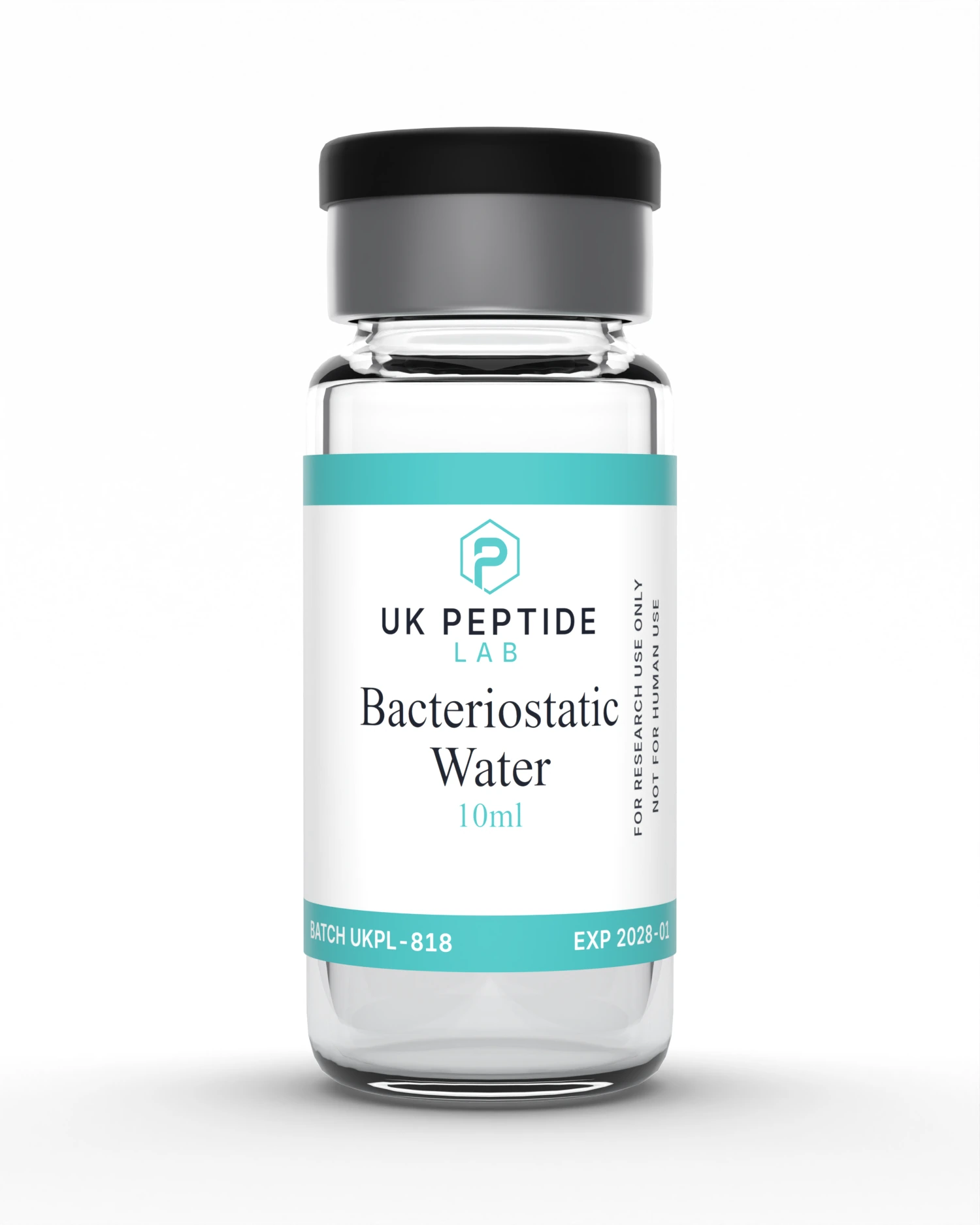
Bacteriostatic Water
10ml
Bacteriostatic water is sterile water containing 0.9% benzyl alcohol as a bacteriostatic preservative. It is used for dilution and reconstitution of research peptides in laboratory settings. Each vial is manufactured under sterile conditions and sealed for single or multi-use laboratory applications. The 0.9% benzyl alcohol concentration inhibits microbial growth, allowing the vial to be used over multiple reconstitution sessions without contamination. Essential for any peptide research laboratory handling lyophilised compounds.
Intended Use: Strictly for in-vitro laboratory research. Not for use in humans or animals. Not to be used in foods, drugs, or medical diagnostics. This product has not been evaluated by the MHRA or FDA. Buyer assumes full responsibility for safe handling and regulatory compliance.
Sterile
Purity
—
No CoA
SAME
Day Ship
Quantity
Add £38.01 more for free UK delivery
Damaged or lost? Free reshipment guaranteed
Research Use Only
This product is intended strictly for research and laboratory use only. Not for human consumption, medical use, or diagnostic purposes.
Lyophilised Stability
24 months
Sealed at -20°C, light-protected
Reconstituted Stability
Up to 3 months
Stored at 2-8°C after mixing
Cold-Chain Shipping
Always
Dry-cold pack, Royal Mail Tracked 24
Important Notice
All compounds are sold individually and do not include research supplies. Products are provided in lyophilised (powder) form and require proper reconstitution before use in research settings.
Related Products
Bacteriostatic Water Price (UK)
Bacteriostatic Water 10ml is £6.99 per vial, supplied from stock in the UK with a third-party HPLC certificate published on this page. UK delivery is £4.50 by Royal Mail Tracked 24, or free once your basket reaches £45 (£38.01 away at this price). Orders placed before 2pm on a working day are dispatched the same day.
| Vial | Price | Availability |
|---|---|---|
| Bacteriostatic Water 10mlThis page | £6.99 | In stock |
Prices are in GBP and shown per vial as supplied, lyophilised, for in-vitro laboratory research only. Cost per mg is given so researchers can compare vial sizes on a like-for-like basis. Stock and pricing on this table are read live from our inventory, so they match the basket. See our FAQ for delivery and payment options, and quality & testing for how each batch is verified.
Research Overview
Bacteriostatic water is sterile water containing 0.9% (9 mg/mL) benzyl alcohol as a bacteriostatic preservative, and it is the standard laboratory diluent for reconstituting lyophilised research peptides. Commonly shortened to bac water, it corresponds to the pharmacopoeial article Bacteriostatic Water for Injection, USP, and is distinguished from Sterile Water for Injection by that preservative alone. Sterile Water for Injection contains no bacteriostat, antimicrobial agent or added buffer, which is why it is presented as a single-use article; bacteriostatic water is presented as a multiple-dose container precisely because the benzyl alcohol permits repeated withdrawals from one vial. Benzyl alcohol is an aromatic alcohol that acts on microbial membrane integrity and permeability. Critically, it is bacteriostatic rather than bactericidal: it suppresses proliferation of organisms introduced at the septum during needle entry, it does not sterilise a solution that is already contaminated. That distinction drives handling practice, because bacteriostatic water does not rescue a compromised vial and is no substitute for aseptic technique. The pharmacopoeial article is supplied sterile and non-pyrogenic with a typical pH of 5.7 against a specified range of 4.5 to 7.0, and is held at controlled room temperature. In a peptide laboratory it is the highest-turnover consumable in the workflow, since lyophilised material must be brought into aqueous solution before any analytical or in-vitro work can begin, and the preservative lets a single 10ml vial serve multiple reconstitution sessions across a working period. Because preservative effectiveness is only required to be demonstrated for 28 days after first entry, standard multiple-dose vial practice, reflected in CDC injection safety guidance, is to date the vial at first puncture and discard it 28 days later. For laboratories sourcing bacteriostatic water UK side, the specifications worth confirming are sterility, benzyl alcohol concentration and fill volume. Supplied for research use only.
Product Specifications
Laboratory Handling
- Bacteriostatic water requires no preparation. Swab the stopper with 70% isopropyl alcohol before every needle entry and allow it to dry before piercing.
- Use a fresh sterile needle and syringe for each withdrawal, and never return withdrawn solution to the vial.
- Date the vial at first puncture and discard 28 days later in line with standard multiple-dose vial practice. Never use beyond the printed expiry, regardless of the in-use date.
- Store at controlled room temperature, 20-25°C, protected from direct light. Do not freeze.
- Inspect before every use. Discard the vial if the solution is not clear and colourless, if particulates are visible, or if seal or stopper integrity is in any doubt.
- Remember that the preservative is bacteriostatic, not sterilising. It suppresses growth of organisms introduced during needle entry and does not decontaminate a vial that has already been compromised.
- The site reconstitution guide and reconstitution calculator cover the aseptic workflow and dilution arithmetic for lyophilised peptides.
Frequently Asked Questions
What is Bacteriostatic Water?
Bacteriostatic water is sterile water containing 0.9% (9 mg/mL) benzyl alcohol as a bacteriostatic preservative, corresponding to the pharmacopoeial article Bacteriostatic Water for Injection, USP. Commonly shortened to bac water, it is the standard laboratory diluent for reconstituting lyophilised research peptides. The benzyl alcohol inhibits microbial growth, which is what allows the vial to be presented as a multiple-dose container and accessed repeatedly over a defined in-use period rather than discarded after a single entry. Supplied for research use only.
Bacteriostatic Water vs Sterile Water for Injection
The only compositional difference is the preservative, and it changes how each is handled. Sterile Water for Injection, USP is specified as containing no bacteriostat, antimicrobial agent or added buffer, so nothing suppresses microbial growth once the seal is broken, and it is treated as a single-use article. Bacteriostatic Water for Injection, USP carries 0.9% (9 mg/mL) benzyl alcohol and is presented as a multiple-dose container for exactly that reason. The pharmacopoeial article has a typical pH of 5.7 against a specified range of 4.5 to 7.0 and is supplied sterile and non-pyrogenic. Note that benzyl alcohol is bacteriostatic, not bactericidal: it inhibits proliferation of organisms introduced at the septum during needle entry, it does not sterilise a solution that is already contaminated, and preservative-free sterile water remains the specified vehicle in certain clinical contexts where benzyl alcohol is contraindicated.
Bacteriostatic Water Research Applications
Bacteriostatic water is required by any laboratory handling lyophilised research peptides, since the material must be brought into aqueous solution before analytical or in-vitro work can begin. It is used to reconstitute compounds across the catalogue including MOTS-C, BPC-157, TB-500, GHK-Cu, Melanotan II, Semax, Selank, Ipamorelin, CJC-1295, KPV and DSIP. The 0.9% benzyl alcohol concentration is the standard for peptide reconstitution work, and the multiple-dose presentation is what makes a single 10ml vial practical across several reconstitution sessions in a working period.
Reconstitution Guide
Bacteriostatic water is supplied ready to use and requires no reconstitution itself. Swab the stopper with 70% isopropyl alcohol before every needle entry and let it dry before piercing. Use a fresh sterile needle and syringe for each withdrawal, draw only the volume required, and never return withdrawn solution to the vial. When adding it to a lyophilised peptide vial, inject slowly down the inner glass wall rather than directly onto the powder, then swirl gently until dissolved and never shake or vortex. The site reconstitution guide and reconstitution calculator set out the full aseptic workflow and the dilution arithmetic. Record the first-puncture date on the bacteriostatic water vial before returning it to storage.
See our full peptide reconstitution guide and reconstitution calculator for step-by-step protocol.
Storage Instructions
Store unopened vials at controlled room temperature, 20-25°C, protected from direct light. Do not freeze, since freezing gives no stability benefit and freeze-thaw cycling stresses the closure that the preservative depends on. Once a vial has been pierced, mark the date of first puncture and discard 28 days later in line with standard multiple-dose vial practice, and never use beyond the printed expiry even if the 28 days have not elapsed. Keep the stopper clean between entries and discard any vial where the solution is not clear and colourless, particulates are visible, or seal integrity is in doubt.
Frequently Asked Questions
Research References
Bacteriostatic Water
10ml · £6.99