
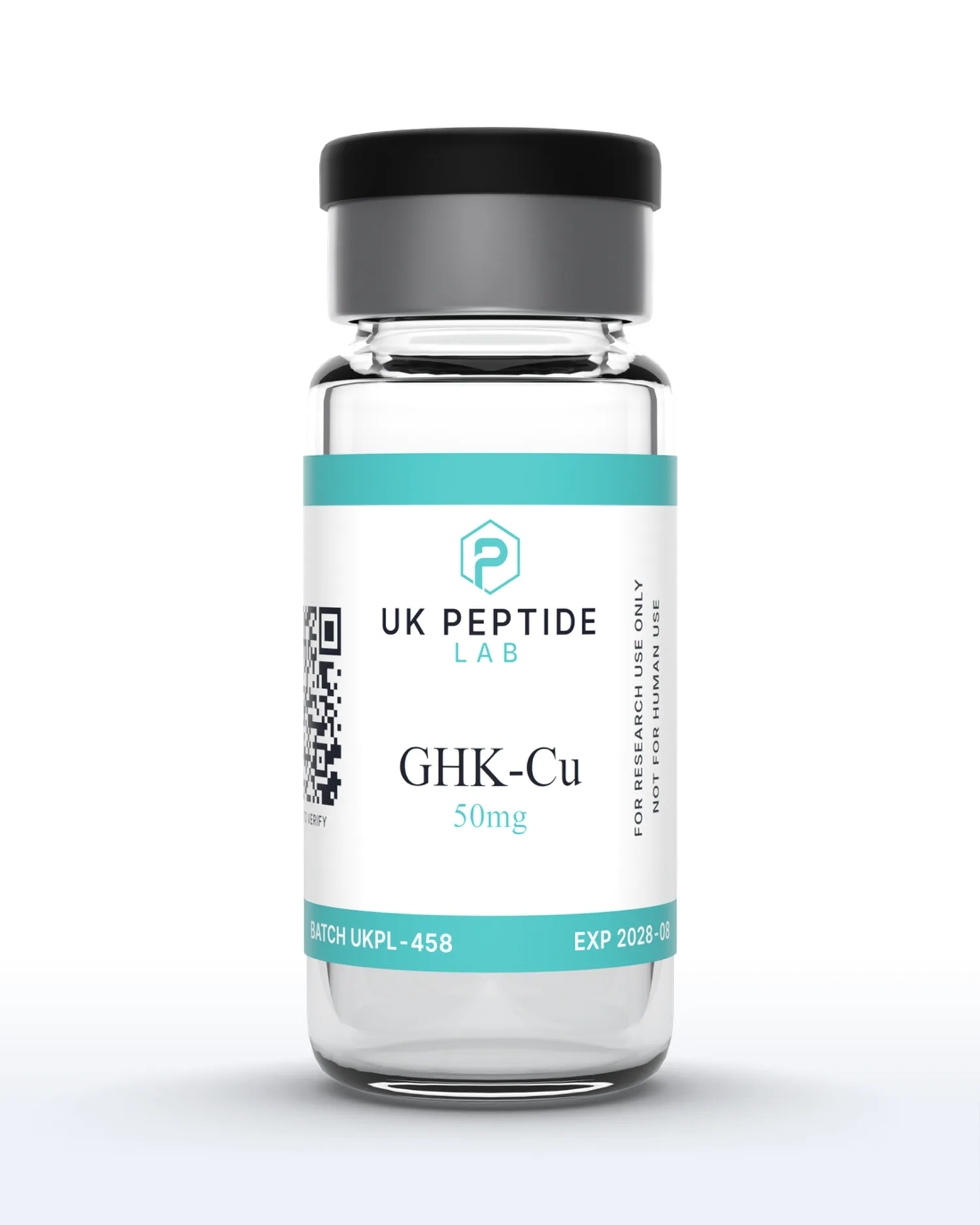
GHK-Cu
50mg
GHK-Cu 50mg is a smaller-content variant of the naturally occurring copper tripeptide complex. Same compound as our 100mg vial, half the lyophilised powder mass per vial for shorter protocols or pilot studies. Research has examined roles in tissue remodelling, anti-inflammatory pathways, antioxidant activity and gene expression related to collagen synthesis. Third-party tested.
Published research on GHK-Cu is indexed on PubMed. See our full UK buyer's guide for GHK-Cu.
Intended Use: Strictly for in-vitro laboratory research. Not for use in humans or animals. Not to be used in foods, drugs, or medical diagnostics. This product has not been evaluated by the MHRA or FDA. Buyer assumes full responsibility for safe handling and regulatory compliance.
>99%
Purity
LAB
Certified
SAME
Day Ship
Quantity
Add £25.01 more for free UK delivery
Damaged or lost? Free reshipment guaranteed
GLOW 70mg
Pre-blended regenerative research vial. BPC-157 10mg + TB-500 10mg + GHK-Cu 50mg.
All components in a single lyophilised vial. One reconstitution, one inventory line, one CoA.
Research Use Only
This product is intended strictly for research and laboratory use only. Not for human consumption, medical use, or diagnostic purposes.
Certificate of Analysis
Third-party tested
Lyophilised Stability
24 months
Sealed at -20°C, light-protected
Reconstituted Stability
Up to 3 months
Stored at 2-8°C after mixing
Cold-Chain Shipping
Always
Dry-cold pack, Royal Mail Tracked 24
Important Notice
All compounds are sold individually and do not include research supplies. Products are provided in lyophilised (powder) form and require proper reconstitution before use in research settings.
Related Products
GHK-Cu Price (UK)
GHK-Cu is supplied in 2 vial sizes, priced from £19.99 for 50mg to £29.99 for 100mg. Every size ships from our UK facility with the same third-party HPLC certificate published on this page. UK delivery is £4.50 by Royal Mail Tracked 24, or free once your basket reaches £45 (£25.01 away at this price). Orders placed before 2pm on a working day are dispatched the same day.
| Vial | Price | Cost per mg | Availability |
|---|---|---|---|
| GHK-Cu 100mg | £29.99 | £0.30Best value | In stock |
| GHK-Cu 50mgThis page | £19.99 | £0.40 | In stock |
Prices are in GBP and shown per vial as supplied, lyophilised, for in-vitro laboratory research only. Cost per mg is given so researchers can compare vial sizes on a like-for-like basis. Stock and pricing on this table are read live from our inventory, so they match the basket. See our FAQ for delivery and payment options, and quality & testing for how each batch is verified.
Product Specifications
Research Overview
This page covers the 50mg presentation of GHK-Cu, the copper(II) complex of glycyl-L-histidyl-L-lysine, molecular formula C₁₄H₂₄CuN₆O₄, molecular weight 403.9 g/mol, CAS 89030-95-5. The compound is identical to that in the 100mg vial, and the copper-shuttle model, matrikine classification and extracellular matrix literature are set out on the main GHK-Cu page. What this page addresses is what changes at half the vial content. The choice between 50mg and 100mg is mostly a question of in-use exposure rather than economy. GHK-Cu is a photolabile copper(II) complex, and freeze-thaw cycling can disrupt the copper coordination sphere independently of any damage to the peptide backbone. A 50mg vial is consumed across a shorter working life, which means fewer stopper penetrations, less cumulative light exposure and fewer freeze-thaw cycles on one reconstituted stock. For pilot studies, method development, or any protocol that will not consume 100mg inside a sensible in-use window, the smaller vial is the technically preferable choice rather than merely the cheaper one. The 100mg vial wins on cost per milligram and on batch continuity across a larger body of work. One arithmetic point is specific to this size, where a proportional error is easy to overlook. Molar calculations must use the mass of the complex, 403.9 g/mol, and not the free tripeptide at 340.4 g/mol. A 50mg vial of GHK-Cu therefore contains approximately 124 µmol of complex, whereas computing against the copper-free tripeptide would return roughly 147 µmol and overstate the figure by about 19 percent. Supplied as lyophilised powder for in-vitro research use only.
Product Specifications
Laboratory Handling
- Use 403.9 g/mol, the mass of the copper complex, for any molar calculation on this vial. Substituting the free tripeptide mass of 340.4 g/mol overstates the molar content of a 50mg vial by roughly 19 percent.
- Protect from light throughout handling. Copper(II) peptide complexes are photolabile, and reconstitution should be carried out away from direct light with aliquots transferred to amber or foil-wrapped vessels.
- Confirm the blue to blue-violet colour on reconstitution. A colourless or green-tinged solution indicates the complex has been disrupted rather than simply diluted. Visible absorption spectrophotometry around 500-600 nm is the standard bench check on complex integrity.
- Use glass or high-grade polypropylene labware and avoid prolonged contact with stainless steel or other chelating surfaces that can strip Cu(II) from the tripeptide. Strong chelators, phosphate-rich buffers and reducing agents in the experimental medium will compete for the copper centre.
- Prefer single-use aliquots to repeated access of one stock. Freeze-thaw cycling can disrupt the copper coordination sphere as well as degrade the peptide backbone. The shorter working life of a 50mg vial is part of its advantage over the 100mg presentation, so avoid extending it unnecessarily.
Frequently Asked Questions
What is GHK-Cu?
The 50mg vial is the smaller of the two presentations of GHK-Cu, the copper(II) complex of the tripeptide glycyl-L-histidyl-L-lysine, molecular formula C₁₄H₂₄CuN₆O₄, molecular weight 403.9 g/mol, CAS 89030-95-5. It holds half the lyophilised mass of the 100mg vial and contains approximately 124 µmol of complex. The compound is identical in both presentations, and the copper-shuttle model, the near-parity of the GHK-Cu stability constant with the albumin copper transport site, the matrikine classification and the extracellular matrix and transcriptomic literatures are all documented on the main GHK-Cu page rather than repeated here. This page documents what is specific to the 50mg format: why a shorter in-use window is a technical advantage for a photolabile copper complex, and the molar-mass error that is easy to make when calculating against a smaller vial. Supplied as lyophilised powder for in-vitro research use only.
GHK-Cu 50mg vs 100mg: Which Vial Size to Choose
The two vials contain the same complex, so this is a handling and logistics comparison rather than a chemical one, and unusually for a size comparison the smaller vial has a genuine technical argument in its favour. GHK-Cu is a photolabile copper(II) complex, and freeze-thaw cycling can disrupt the copper coordination sphere independently of any degradation of the peptide backbone, which means cumulative in-use exposure is a real variable and not a generic caution. A 50mg vial is consumed across a shorter working life, so one reconstituted stock takes fewer stopper penetrations, less light exposure and fewer freeze-thaw cycles before it is finished. That makes it the better choice for pilot studies, method development, spectrophotometric characterisation work, or any protocol that will not consume 100mg inside a sensible window. The 100mg vial answers with a lower cost per milligram and with batch continuity across a larger body of work, since one batch and one certificate of analysis cover twice as much. Molar content differs accordingly, roughly 124 µmol against roughly 248 µmol.
GHK-Cu Research Applications
Applications are those documented for the 100mg vial, since the compound is the same: copper transport and delivery to copper-dependent enzymes, extracellular matrix biology including collagen and glycosaminoglycan synthesis and matrix metalloproteinase-2 expression, matrikine signalling, and transcriptomic profiling. Where the 50mg presentation is specifically useful is in work whose scale is small but whose sensitivity to complex integrity is high. Spectrophotometric characterisation of the Cu(II) centre, stability studies across buffer compositions, competition experiments against other chelators, and method development for HPLC or ICP analysis all consume modest amounts of material while depending heavily on the complex not having degraded in storage. A vial that is opened, used and finished quickly serves that better than half a large vial held across months.
Reconstitution Guide
Allow the vial and the bacteriostatic water to reach room temperature, then swab both rubber stoppers with alcohol. Inject the diluent slowly down the inner glass wall rather than onto the powder, and swirl gently until the blue colour is uniform. Never shake or vortex. Carry out reconstitution away from direct light, since copper(II) peptide complexes are photolabile, and transfer any aliquots into amber or foil-wrapped vessels. Use glass or high-grade polypropylene labware and avoid prolonged contact with stainless steel or other chelating surfaces that can strip Cu(II) from the tripeptide. The solution will be blue to blue-violet, from the d-d transition of the Cu(II) centre, and this is expected. A colourless or green-tinged solution indicates the complex has been disrupted rather than simply diluted, and visible absorption spectrophotometry around 500-600 nm is the standard bench check on complex integrity. When converting a fill volume into molarity, use 403.9 g/mol for the complex, not 340.4 g/mol for the free tripeptide.
See our full peptide reconstitution guide and reconstitution calculator for step-by-step protocol.
Storage Instructions
Lyophilised vials should be stored at -20°C, protected from light and moisture, and remain stable for up to 24 months. Once reconstituted, hold the solution at 2-8°C in a light-protected container. Freeze-thaw cycling can disrupt the copper coordination sphere as well as degrade the peptide backbone, so single-use aliquots in amber or foil-wrapped vessels are preferable to repeated access of one stock. The shorter working life of a 50mg vial is part of what makes it the safer choice for sensitive work, so there is little value in extending that window unnecessarily. Keep both lyophilised material and reconstituted solution away from UV and fluorescent light throughout, and handle under sterile laboratory conditions.
Frequently Asked Questions
Research References
- Growth-modulating plasma tripeptide may function by facilitating copper uptake into cells (Nature, 1980)
- GHK-Cu stimulates matrix metalloproteinase-2 expression by fibroblast cultures (Life Sci, 2000)
- GHK Peptide as a Natural Modulator of Multiple Cellular Pathways in Skin Regeneration (Biomed Res Int, 2015)
Related Research Compounds
GHK-Cu
50mg · £19.99