Peptides
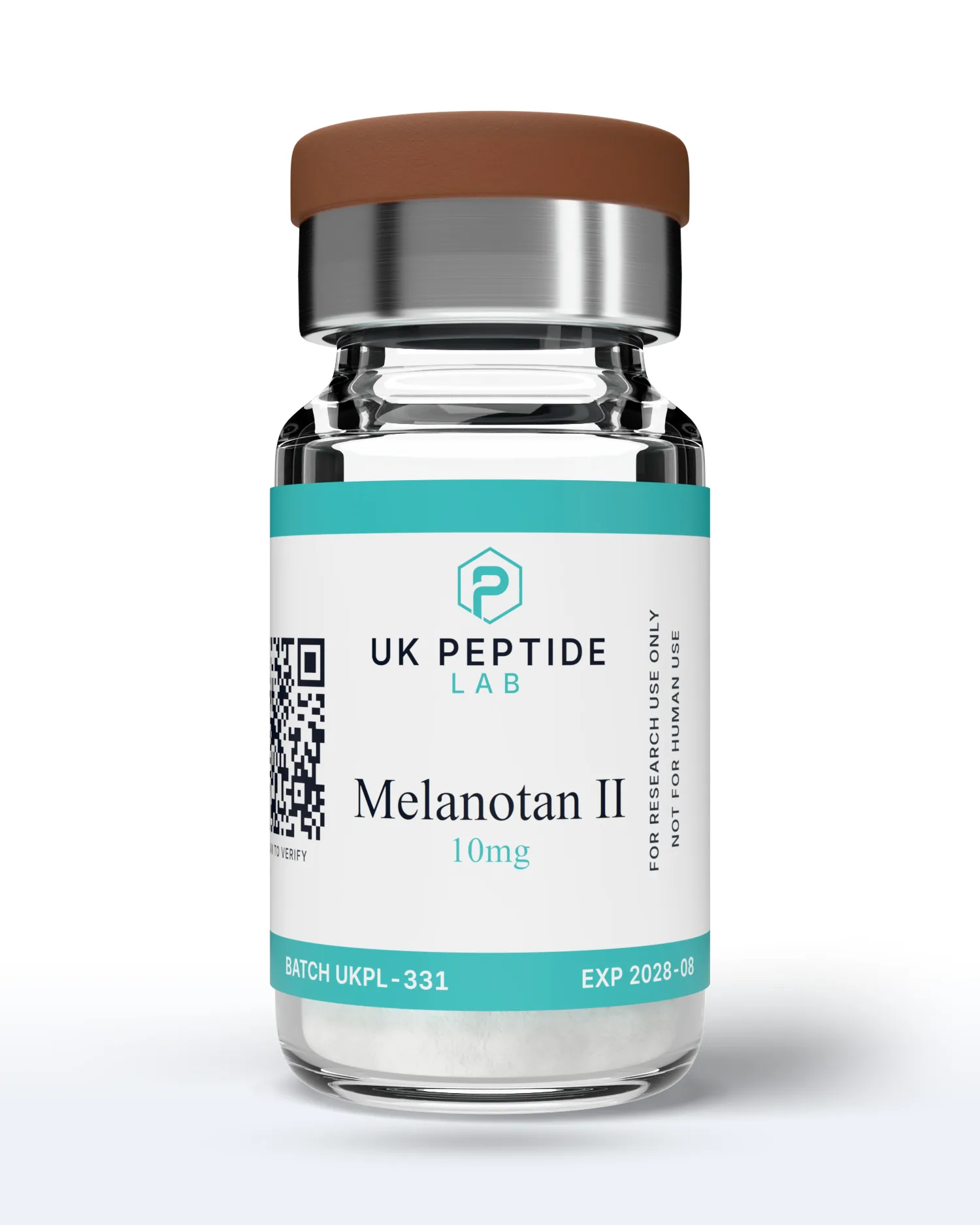
Melanotan II
10mg
Cyclic lactam heptapeptide. α-MSH synthetic analogue.
>99% purity · Third-party tested · Batch UKPL-331 · View certificate
Expected back in stock in about 10 days.
Email us about restock- Research use only. For in-vitro laboratory research. Not for use in humans or animals, or in food, drugs or diagnostics. Not evaluated by the MHRA or FDA. The buyer is responsible for handling and regulatory compliance.
Bulk Pricing
Counted across your basket, any mix of products.
| Vials in basket | Discount | Per vial |
|---|---|---|
| 1 | None | £19.99 |
| 3-4 | 5% | £18.99 |
| 5-9 | 8% | £18.39 |
| 10-50 | 12% | £17.59 |
What is Melanotan II?
Melanotan II (MT-II, also sold as Melanotan 2, MT-2 or MT2) is a synthetic cyclic heptapeptide analogue of alpha-melanocyte-stimulating hormone. Receptor pharmacology labs use it as a reference ligand at melanocortin receptors. Each Melanotan II 10mg vial holds a white lyophilised powder.
Full description
Its sequence is Ac-Nle-cyclo[Asp-His-D-Phe-Arg-Trp-Lys]-NH₂, with formula C₅₀H₆₉N₁₅O₉, molecular weight 1024.2 g/mol and CAS number 121062-08-6. Al-Obeidi, Castrucci, Hadley and Hruby reported it in the Journal of Medicinal Chemistry in 1989, with molecular dynamics guiding the design.
It makes three changes to the alpha-MSH 4-10 fragment. Norleucine replaces methionine at position 4 and D-phenylalanine sits at position 7. A lactam bridge between Asp5 and Lys10 closes a 23-membered ring.
Melanotan II Research Applications
- Potency: in the 1989 lizard skin bioassay, MT-II was about 90 times as potent as alpha-MSH, with prolonged activity (Al-Obeidi et al., J Med Chem, 1989).
- Receptor binding: it binds human MC1, MC3, MC4 and MC5 receptors expressed in cell lines (Schiöth et al., Peptides, 1997).
- Selectivity by design: on the same scaffold, D-Nal(2') at position 7 gives SHU-9119, which favours MC4R (Schiöth et al., 1997).
Study details
In receptor assays MT-II is the non-selective reference agonist that candidate subtype-selective ligands are compared against. It is also the parent scaffold for structure-activity work on positions 5 to 10. Its first potency data came from frog and lizard skin bioassays, before the human receptors were cloned.
Melanotan II vs Melanotan I vs SHU-9119
Melanotan I (afamelanotide) is Ac-[Nle4, D-Phe7]-alpha-MSH: linear, 13 residues, 1646.8 g/mol. Melanotan II keeps the Nle4 and D-Phe7 changes but uses only the 4-10 fragment, closed into a ring by a lactam bridge. SHU-9119 is the Melanotan II scaffold with D-Nal(2') at position 7, a change that shifts binding towards MC4R. Each is a separate compound with its own CAS number.
Research Overview
Melanotan II is a cyclic lactam heptapeptide analogue of alpha-melanocyte-stimulating hormone with the sequence Ac-Nle-cyclo[Asp-His-D-Phe-Arg-Trp-Lys]-NH₂. It was designed by Al-Obeidi, Castrucci, Hadley and Hruby and reported in the Journal of Medicinal Chemistry in 1989, using quenched molecular dynamics simulations to identify which conformation of the alpha-MSH 4-10 message sequence was worth constraining. The molecule makes three changes to the native hormone fragment: a lactam bridge between the aspartate side-chain carboxyl at position 5 and the lysine side-chain amine at position 10, inversion to D-phenylalanine at position 7, and substitution of norleucine for the oxidation-prone methionine at position 4. Cyclisation restricts backbone conformational freedom and confers marked resistance to proteolysis relative to linear analogues, which is why melanotan 2 became a standard reference agonist rather than a research curiosity. Pharmacologically, the melanotan 2 peptide is a non-selective agonist across four of the five human melanocortin receptors. Reported EC₅₀ values in transfected cell assays sit in the sub-nanomolar to low-nanomolar range at MC1R and MC4R, with roughly an order of magnitude lower potency at MC3R and MC5R, and it is essentially inactive at MC2R, the adrenocorticotropin receptor. All five subtypes are class A G-protein-coupled receptors signalling principally through Gs and adenylyl cyclase to raise intracellular cAMP. That flat selectivity profile is precisely what keeps MT2 useful in vitro: it serves as the positive-control full agonist against which subtype-selective ligands are benchmarked, and it is the parent scaffold for a large derivative family generated by single substitutions at positions 6, 7 and 9, including the MC3R/MC4R antagonist SHU-9119. Melanotan II is not a licensed medicine in the United Kingdom or elsewhere.
Product Specifications
- Molecular Formula
- C₅₀H₆₉N₁₅O₉
- Molecular Weight
- 1024.2 g/mol
- CAS Number
- 121062-08-6
- Sequence
- Ac-Nle-cyclo[Asp-His-D-Phe-Arg-Trp-Lys]-NH₂
- Peptide Class
- Cyclic lactam alpha-MSH (4-10) analogue
- Purity
- >99% (RP-HPLC)
- Batch
- UKPL-331
- Storage
- -20°C lyophilised, 2-8°C reconstituted, protect from light
- Appearance
- White lyophilised powder
- Form
- Lyophilised powder
Certificate of Analysis
Third-party tested
- Batch
- UKPL-331
- Purity
- >99%
- Method
- RP-HPLC
- Lab
- Marfleet Analytical Services
- Tested
- Aug 2026
Need the certificate for an earlier batch? Request an older CoA
Storage and Reconstitution
Store sealed vials at -20°C, in the dark and away from moisture, for up to 24 months. After reconstitution, keep the solution at 2-8°C in an amber or foil-wrapped vial and use it within 4 weeks. For longer storage, freeze single-use aliquots at -20°C and avoid repeated freeze-thaw cycles.
Vials are sold on their own, without bacteriostatic water for mixing or other supplies.
How to reconstitute and handle
Let the vial reach room temperature and swab both stoppers with alcohol. Add the bacteriostatic water slowly down the inside wall of the vial, away from direct sunlight and strong lighting. Swirl gently until the powder dissolves, without shaking. The solution should be clear and colourless.
- Protect from light at all stages. The tryptophan and histidine residues are the photolabile positions, and tryptophan oxidation is the most common degradation route detected by RP-HPLC in stored melanocortin analogues.
- Aliquot into amber or foil-wrapped single-use vessels. Avoid repeated freeze-thaw cycling, and verify concentration by UV absorbance at 280 nm where assay design requires it, since the single tryptophan residue gives a usable chromophore.
For the full method, see the peptide reconstitution guide and the reconstitution calculator.
Research References
- Potent and prolonged acting cyclic lactam analogues of alpha-melanotropin, design based on molecular dynamics (J Med Chem, 1989)
- Selectivity of cyclic D-Nal7 and D-Phe7 substituted MSH analogues for the melanocortin receptor subtypes (Peptides, 1997)
- Ligands for Melanocortin Receptors, Beyond Melanocyte-Stimulating Hormones and Adrenocorticotropin (Biomolecules, 2022)
Published research on Melanotan II is indexed on PubMed. See our full UK buyer's guide for Melanotan II.
Melanotan II Price (UK)
Melanotan II 10mg is for sale at £19.99 per vial, supplied from stock in the UK with a published third-party HPLC certificate. UK delivery is £4.50 by Royal Mail Tracked 24, free over £69.
| Vial | Price | Cost per mg | Availability |
|---|---|---|---|
| Melanotan II 10mgThis page | £19.99 | £2.00 | Out of stock |
Prices are in GBP per vial and match the basket. See the FAQ for delivery and payment options, and quality & testing for how each batch is checked.
Frequently Asked Questions
What is Melanotan 2 (MT2)?
Melanotan 2 is a synthetic cyclic lactam heptapeptide analogue of alpha-melanocyte-stimulating hormone, molecular formula C₅₀H₆₉N₁₅O₉, molecular weight 1024.2 g/mol, CAS 121062-08-6. It was first reported by Al-Obeidi and colleagues in the Journal of Medicinal Chemistry in 1989 as a conformationally constrained derivative of the alpha-MSH 4-10 fragment. It is supplied as lyophilised powder for in-vitro laboratory research use only and is not a licensed medicine.
How does Melanotan 2 work at the receptor level?
Melanotan 2 is an agonist at melanocortin receptors, a family of five class A G-protein-coupled receptors that signal principally through Gs and adenylyl cyclase to raise intracellular cAMP. The conserved His-Phe-Arg-Trp core of alpha-MSH forms the message sequence recognised by the receptor binding pocket, and the D-Phe substitution at position 7 together with the Asp5-Lys10 lactam bridge holds that core in a bioactive turn conformation. This is receptor pharmacology characterised in transfected cell lines and isolated skin bioassays, not evidence of any effect in humans.
Is MT2 selective for a single melanocortin receptor?
No. MT2 is explicitly non-selective, which is its defining pharmacological characteristic. Reported EC₅₀ values place it in the sub-nanomolar to low-nanomolar range at MC1R and MC4R, roughly an order of magnitude weaker at MC3R and MC5R, and essentially inactive at MC2R, the adrenocorticotropin receptor. Researchers requiring subtype discrimination use derivatives instead, for example N-methylated MT-II analogues for MC1R selectivity or SHU-9119 as an MC3R/MC4R antagonist.
What is the difference between Melanotan 1 and Melanotan II?
Melanotan I (afamelanotide, NDP-alpha-MSH) is a linear tridecapeptide analogue of alpha-MSH, whereas Melanotan II is a cyclic lactam heptapeptide built on the truncated 4-10 fragment. The structural consequence is different receptor and stability behaviour: the linear molecule retains relatively greater MC1R preference, while cyclisation in MT-II broadens activity across MC1R, MC3R, MC4R and MC5R and increases resistance to proteolytic cleavage. The two are distinct chemical entities with different CAS numbers and should not be treated as interchangeable in a protocol.
What is the molecular formula and CAS number of the Melanotan 2 peptide?
The melanotan 2 peptide has the molecular formula C₅₀H₆₉N₁₅O₉, a molecular weight of 1024.2 g/mol, and CAS number 121062-08-6. Its full sequence notation is Ac-Nle-cyclo[Asp-His-D-Phe-Arg-Trp-Lys]-NH₂, sometimes written Ac-Nle4-cyclo[Asp5-His6-D-Phe7-Arg8-Trp9-Lys10]-alpha-MSH(4-10)-NH₂. This vial contains 10mg of lyophilised powder, batch UKPL-331, with an HPLC purity above 99% and the certificate published on this page.
Is Melanotan II approved or licensed for human use in the UK?
No. Melanotan II holds no marketing authorisation from the MHRA or any other medicines regulator, has not completed the regulatory approval process anywhere, and is not approved for human or veterinary administration in any jurisdiction. It is supplied here solely as an analytical reference material for in-vitro laboratory research. Purchasers must be 18 or over and must confirm research-only use at checkout. No claim is made or implied regarding any effect in humans.
Why must Melanotan II be stored protected from light?
Because the tryptophan residue at position 9 is photolabile and oxidises readily, producing degradation peaks that are detectable by RP-HPLC and that alter the effective concentration of intact peptide in an assay. Histidine is a secondary site of concern. Store lyophilised vials at -20°C in the dark, keep reconstituted solution at 2-8°C in amber or foil-wrapped vessels, and carry out reconstitution away from direct sunlight and fluorescent lighting.
Is Melanotan II legal to buy in the UK, and is it a licensed medicine?
It can be bought in the UK as a reference material for in-vitro laboratory research. It is not a licensed medicine in the UK or anywhere else. Buyers must be 18 or over and confirm research-only use at checkout.
Where can I buy Melanotan II 10mg in the UK for research?
You can buy Melanotan II 10mg online from our UK stock, with a third-party certificate for each batch. Orders placed before 2pm on a working day are dispatched the same day, and UK delivery is free over £69.
What purity is your Melanotan 2 (MT2) and how is it verified?
The current batch measured above 99% by RP-HPLC at an independent laboratory. The certificate section gives the batch number, lab and test date, with the full report. After long storage, oxidised tryptophan is the impurity to look for on a repeat chromatogram.
What is MT2 peptide used for in research?
MT2 peptide is a reference agonist in melanocortin receptor binding assays and a parent scaffold for structure-activity studies. SHU-9119, for example, differs from it at position 7 only. It is sold for in-vitro research, not for human or cosmetic use.
Related Products
 Out of Stock