
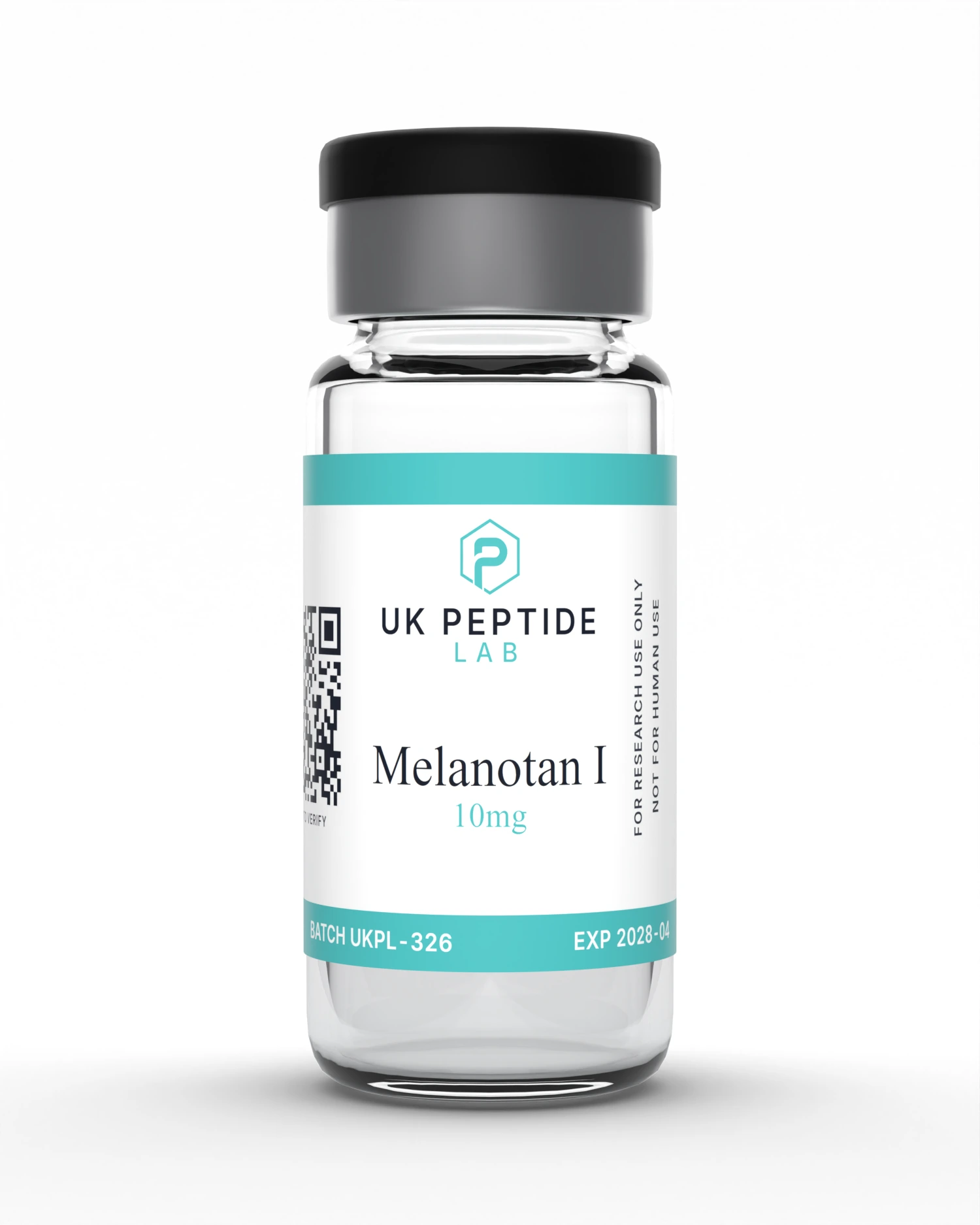
Melanotan I
10mg
Melanotan 1 (MT1, also known as afamelanotide) is a research peptide from the melanocortin family and one of the most widely studied analogues of α-MSH. It has a linear 13 amino acid structure, which is the main thing separating it from the cyclic Melanotan 2. It acts on all four melanocortin receptors, most strongly at MC1R. Supplied as a lyophilised powder with a batch-specific certificate of analysis from an independent lab. Research use only. Not a medicine and not authorised for human use in the UK.
Published research on Melanotan I is indexed on PubMed. See our full UK buyer's guide for Melanotan I.
Intended Use: Strictly for in-vitro laboratory research. Not for use in humans or animals. Not to be used in foods, drugs, or medical diagnostics. This product has not been evaluated by the MHRA or FDA. Buyer assumes full responsibility for safe handling and regulatory compliance.
99.553%
Purity
LAB
Certified
SAME
Day Ship
Quantity
Add £25.01 more for free UK delivery
Damaged or lost? Free reshipment guaranteed
Bacteriostatic Water 10ml
Required to reconstitute lyophilised peptides.
Research Use Only
This product is intended strictly for research and laboratory use only. Not for human consumption, medical use, or diagnostic purposes.
Certificate of Analysis
Third-party tested
Lyophilised Stability
24 months
Sealed at -20°C, light-protected
Reconstituted Stability
Up to 3 months
Stored at 2-8°C after mixing
Cold-Chain Shipping
Always
Dry-cold pack, Royal Mail Tracked 24
Important Notice
All compounds are sold individually and do not include research supplies. Products are provided in lyophilised (powder) form and require proper reconstitution before use in research settings.
Related Products
Melanotan I Price (UK)
Melanotan I 10mg is £19.99 per vial, supplied from stock in the UK with a third-party HPLC certificate published on this page. UK delivery is £4.50 by Royal Mail Tracked 24, or free once your basket reaches £45 (£25.01 away at this price). Orders placed before 2pm on a working day are dispatched the same day.
| Vial | Price | Cost per mg | Availability |
|---|---|---|---|
| Melanotan I 10mgThis page | £19.99 | £2.00 | In stock |
Prices are in GBP and shown per vial as supplied, lyophilised, for in-vitro laboratory research only. Cost per mg is given so researchers can compare vial sizes on a like-for-like basis. Stock and pricing on this table are read live from our inventory, so they match the basket. See our FAQ for delivery and payment options, and quality & testing for how each batch is verified.
Product Specifications
Research Overview
Melanotan I, also written Melanotan 1 or MT1, is the linear tridecapeptide [Nle⁴, D-Phe⁷]-alpha-melanocyte-stimulating hormone, catalogued in the literature as afamelanotide and as NDP-alpha-MSH, sequence Ac-Ser-Tyr-Ser-Nle-Glu-His-D-Phe-Arg-Trp-Gly-Lys-Pro-Val-NH₂ (C₇₈H₁₁₁N₂₁O₁₉, 1646.9 g/mol, CAS 75921-69-6). It was first reported by Sawyer, Hruby, Hadley and colleagues in the Proceedings of the National Academy of Sciences in 1980, and it departs from native human alpha-MSH at only two of thirteen positions: norleucine replaces the oxidation-prone methionine at position 4, and the phenylalanine at position 7 is inverted to its D-enantiomer. Chain length is unchanged, and unlike Melanotan II there is no lactam bridge, so the mt1 peptide remains fully linear. The D-Phe⁷ inversion sits inside the conserved His-Phe-Arg-Trp message tetrapeptide that every melanocortin receptor recognises, and it is the substitution responsible for the markedly prolonged receptor occupancy reported for this analogue relative to alpha-MSH, because inverting that stereocentre removes a favoured chymotrypsin-like cleavage point. Because the molecule is linear, MT-1 is frequently but imprecisely described as MC1R-selective. Curated affinity data instead describe a full agonist at four of the five human melanocortin receptors: reported pIC₅₀ 10.0 at MC1R, pKi 8.9 at MC3R, pKi 8.5 to 8.8 at MC4R, and pIC₅₀ 9.0 at MC5R, with no activity at MC2R, the adrenocorticotropin receptor, which is not engaged by alpha-MSH analogues of this class. MC1R affinity is therefore roughly an order of magnitude higher than at the other three subtypes, a preference rather than selectivity in the strict pharmacological sense. All five subtypes are class A G-protein-coupled receptors signalling principally through Gs and adenylyl cyclase to raise intracellular cAMP. The radioiodinated form of this molecule, ¹²⁵I-NDP-alpha-MSH, is the standard displacement radioligand for the whole receptor family, which is why it appears throughout melanocortin binding literature. Afamelanotide is authorised as a medicine in certain jurisdictions. The material supplied here is not a medicine, holds no UK marketing authorisation, and is supplied as lyophilised powder strictly for in-vitro laboratory research use only.
Product Specifications
Laboratory Handling
- Store lyophilised vials at -20°C, sealed and protected from light. Reconstituted solution should be held at 2-8°C and used within 4 weeks.
- Protect from light at all stages. Tryptophan at position 9 is the principal photolabile residue and oxidises readily, with tyrosine at position 2 and histidine at position 6 secondary sites of concern. Note that the norleucine substitution at position 4 has already removed the methionine thioether, so residual oxidation risk in this analogue is concentrated at tryptophan.
- Reconstitute with bacteriostatic water, directing the stream down the inner glass wall rather than onto the powder, and swirl gently until dissolved and clear. Do not vortex or shake.
- Aliquot into amber or foil-wrapped single-use vessels and avoid repeated freeze-thaw cycling. The molecule carries both a tryptophan and a tyrosine chromophore, so concentration can be verified by UV absorbance at 280 nm where assay design requires it.
Frequently Asked Questions
What is Melanotan I?
Melanotan I is a synthetic linear tridecapeptide analogue of alpha-melanocyte-stimulating hormone, sequence Ac-Ser-Tyr-Ser-Nle-Glu-His-D-Phe-Arg-Trp-Gly-Lys-Pro-Val-NH₂ (C₇₈H₁₁₁N₂₁O₁₉, 1646.9 g/mol, CAS 75921-69-6), catalogued in the literature as afamelanotide, as NDP-alpha-MSH, and in analogue notation as [Nle⁴, D-Phe⁷]-alpha-MSH. It was first reported by Sawyer, Hruby, Hadley and colleagues in the Proceedings of the National Academy of Sciences in 1980. Only two of the thirteen residues differ from the native human hormone: norleucine replaces the oxidation-prone methionine at position 4, and the phenylalanine at position 7 is inverted to its D-enantiomer inside the conserved His-Phe-Arg-Trp message tetrapeptide. There is no lactam bridge, so unlike Melanotan II the mt1 peptide is fully linear. Afamelanotide is authorised as a medicine in certain jurisdictions outside the UK. The material supplied here is not a medicine, holds no UK marketing authorisation, and is supplied as lyophilised powder strictly for in-vitro laboratory research use only, not for human or veterinary administration.
Melanotan 1 vs Melanotan II vs alpha-MSH
These three bracket the melanocortin agonist landscape and are constantly confused, so it is worth setting the chemistry out plainly. Native human alpha-MSH is the 13-residue parent, Ac-Ser-Tyr-Ser-Met-Glu-His-Phe-Arg-Trp-Gly-Lys-Pro-Val-NH₂, with a methionine at position 4 that is the most oxidation-prone group in the molecule and an all-L backbone that peptidases cleave readily. Melanotan 1 keeps all thirteen residues and changes two of them, Nle⁴ for Met⁴ and D-Phe⁷ for L-Phe⁷, which is why the 1980 characterisation described it as an alpha-melanotropin with unusually prolonged activity. Melanotan II takes a different route, truncating to the alpha-MSH 4-10 fragment and closing a lactam bridge between the Asp5 side-chain carboxyl and the Lys10 side-chain amine to give a 23-membered macrocycle (C₅₀H₆₉N₁₅O₉, 1024.2 g/mol, CAS 121062-08-6). The pharmacological consequence is the part that matters. Curated data place Melanotan 1 as a full agonist at four subtypes with a clear order-of-magnitude preference for MC1R: pIC₅₀ 10.0 at MC1R, pKi 8.9 at MC3R, pKi 8.5 to 8.8 at MC4R, pIC₅₀ 9.0 at MC5R, and no activity at MC2R. Cyclisation in Melanotan II flattens that profile, giving comparable potency at MC1R and MC4R and only modestly less at MC3R and MC5R, which is why Melanotan II is used as the non-selective positive control while Melanotan 1 is used where an MC1R-weighted reference agonist is wanted. Neither is subtype-selective in the strict sense, and all three are distinct chemical entities with distinct CAS numbers.
Melanotan I Research Applications
Melanotan I occupies a specific and unusually load-bearing position in melanocortin receptor pharmacology, because its radioiodinated form is the field's default radioligand. A very large fraction of published binding constants for melanocortin ligands, including those for cyclic analogues, peptidomimetics and candidate subtype-selective compounds, are reported as inhibition of ¹²⁵I-NDP-alpha-MSH binding to membranes from cell lines stably expressing a single human receptor subtype. The unlabelled peptide is used alongside it as a full-agonist reference point in cAMP accumulation assays, since all five melanocortin receptors are class A G-protein-coupled receptors signalling principally through Gs and adenylyl cyclase. Beyond assay plumbing, the molecule is a structure-activity reference in three recurring contexts: as the linear counterpoint against which conformationally constrained analogues are benchmarked, which is how the value of the Asp5 to Lys10 lactam bridge in the Melanotan II family was originally quantified; as a probe of the D-Phe⁷ stereocentre, the single inversion that both stabilises the bioactive turn of the His-Phe-Arg-Trp core and removes a favoured chymotrypsin-like cleavage point; and as a structural biology ligand, with cryo-EM structures of full-length MC4R in complex with heterotrimeric Gs resolving afamelanotide in the orthosteric pocket alongside alpha-MSH and describing a conserved binding mode for peptidic melanocortin agonists. All of this is receptor-level characterisation in transfected cell systems and recombinant complexes, and none of it constitutes evidence of any effect in humans.
Reconstitution Guide
Allow vials to reach room temperature, then sterilise the rubber stopper of both the peptide vial and the bacteriostatic water vial with an alcohol swab. Slowly draw your bacteriostatic water into a sterile insulin syringe, then inject it gently down the inner glass wall of the peptide vial, never directly onto the lyophilised powder. Once added, gently swirl the vial in a slow circular motion until fully dissolved. Never shake or vortex. The solution should be clear and colourless. Label the vial with the reconstitution date and store immediately. Melanotan I is photolabile, principally through oxidation of the tryptophan residue at position 9, so reconstitute away from direct sunlight and fluorescent lighting and transfer aliquots into amber or foil-wrapped vessels. Note that the norleucine substitution at position 4 has already removed the methionine thioether present in native alpha-MSH, so tryptophan governs handling. The molecule carries both a tryptophan and a tyrosine chromophore, so concentration can be verified by UV absorbance at 280 nm where assay design requires it.
See our full peptide reconstitution guide and reconstitution calculator for step-by-step protocol.
Storage Instructions
Lyophilised vials should be stored at -20°C, protected from light and moisture, and remain stable for up to 24 months. Once reconstituted with bacteriostatic water, store the solution at 2-8°C (standard refrigerator) and use within approximately 3 months. For storage beyond that, prepare single-use aliquots at -20°C, where reconstituted peptide remains stable for up to 6 months. Avoid repeated freeze-thaw cycles and always handle under sterile laboratory conditions. Melanotan I should be kept protected from UV and fluorescent light in both lyophilised and reconstituted form. Tryptophan oxidation is the degradation route most commonly detected by RP-HPLC in stored melanocortin analogues, with tyrosine at position 2 and histidine at position 6 secondary sites of concern, and freeze-thaw cycling accelerates both aggregation and oxidative degradation. Prepare single-use aliquots rather than repeatedly accessing one stock vial.
Frequently Asked Questions
Research References
- 4-Norleucine, 7-D-phenylalanine-alpha-melanocyte-stimulating hormone, a highly potent alpha-melanotropin with ultralong biological activity (Proc Natl Acad Sci USA, 1980)
- Characterization of melanocortin receptor ligands on cloned brain melanocortin receptors (Eur J Pharmacol, 1999)
- Structural insights into ligand recognition and activation of the melanocortin-4 receptor (Cell Res, 2021)
Related Research Compounds
Melanotan I
10mg · £19.99