
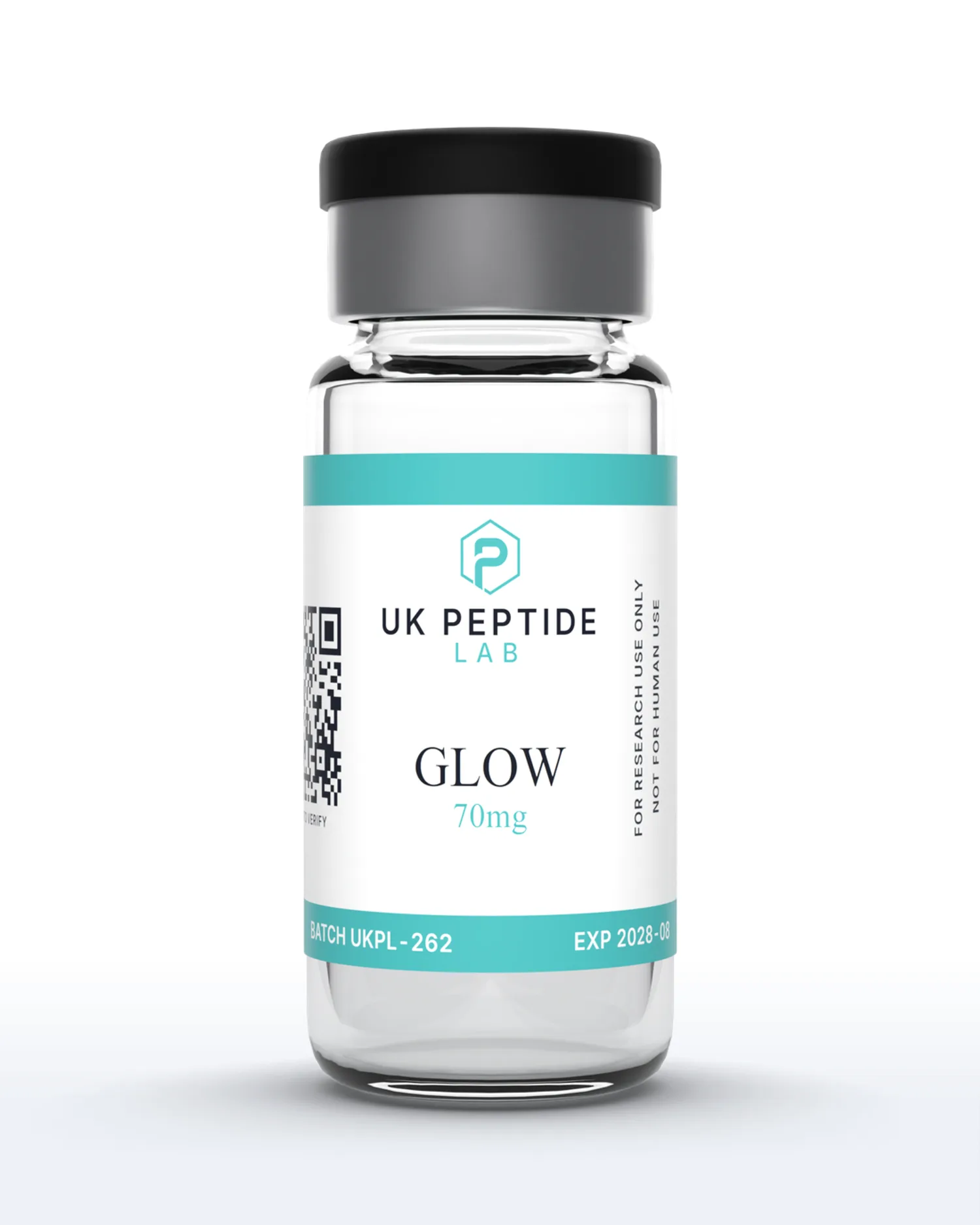
GLOW
70mg
GLOW is a pre-blended three-peptide research vial containing BPC-157 10mg, TB-500 10mg and GHK-Cu 50mg, supplied as a single lyophilised powder for one-step reconstitution. BPC-157 (Body Protection Compound, 15-residue pentadecapeptide) and TB-500 (synthetic fragment of thymosin beta-4) are extensively co-investigated in soft-tissue, angiogenesis and cell-migration research. GHK-Cu (glycyl-L-histidyl-L-lysine copper complex) is widely studied for collagen synthesis, copper-mediated tissue remodelling and skin/connective-tissue research pathways. Combining all three covers the most-referenced regenerative-research formulation in a single vial. Third-party tested, individual component purity reported on the lab certificate.
Published research on GLOW is indexed on PubMed. See our full UK buyer's guide for GLOW.
Intended Use: Strictly for in-vitro laboratory research. Not for use in humans or animals. Not to be used in foods, drugs, or medical diagnostics. This product has not been evaluated by the MHRA or FDA. Buyer assumes full responsibility for safe handling and regulatory compliance.
>99%
Purity
LAB
Certified
SAME
Day Ship
Quantity
Qualifies for free UK delivery · Royal Mail Tracked 24
Damaged or lost? Free reshipment guaranteed
Bacteriostatic Water 10ml
Required to reconstitute lyophilised peptides.
Research Use Only
This product is intended strictly for research and laboratory use only. Not for human consumption, medical use, or diagnostic purposes.
Certificate of Analysis
Third-party tested
Lyophilised Stability
24 months
Sealed at -20°C, light-protected
Reconstituted Stability
Up to 3 months
Stored at 2-8°C after mixing
Cold-Chain Shipping
Always
Dry-cold pack, Royal Mail Tracked 24
Important Notice
All compounds are sold individually and do not include research supplies. Products are provided in lyophilised (powder) form and require proper reconstitution before use in research settings.
Related Products
GLOW Price (UK)
GLOW 70mg is £59.99 per vial, supplied from stock in the UK with a third-party HPLC certificate published on this page. This vial clears the £45 threshold on its own, so UK Royal Mail Tracked 24 delivery is free. Orders placed before 2pm on a working day are dispatched the same day.
| Vial | Price | Cost per mg | Availability |
|---|---|---|---|
| GLOW 70mgThis page | £59.99 | £0.86 | In stock |
Prices are in GBP and shown per vial as supplied, lyophilised, for in-vitro laboratory research only. Cost per mg is given so researchers can compare vial sizes on a like-for-like basis. Stock and pricing on this table are read live from our inventory, so they match the basket. See our FAQ for delivery and payment options, and quality & testing for how each batch is verified.
Product Specifications
Research Overview
GLOW is a supplier designation for a pre-blended multi-peptide research vial, not a single molecule. The GLOW 70mg vial supplied here contains BPC-157 10mg, TB-500 10mg and GHK-Cu 50mg co-lyophilised in one container. The honest starting point for evaluating any glow peptide product is that the blend has not been studied as a combination: no published in-vitro or in-vivo work has examined these three compounds co-administered at this ratio, and no synergy between them has been demonstrated. What exists is three separate literatures, one per component, and that is what the glow stack peptide format aggregates. BPC-157 is a 15-residue pentadecapeptide, GEPPPGKPADDAGLV, 1419.53 g/mol, corresponding to a partial sequence of Body Protection Compound originally characterised in human gastric juice, and unusual among peptides of this length for resisting hydrolysis at low pH. Hsieh and colleagues (J Mol Med, 2017, PMID 27847966) reported upregulation and internalisation of VEGFR2 in human umbilical vein endothelial cells; Chang and colleagues (J Appl Physiol, 2011, PMID 21030672) reported increased FAK and paxillin phosphorylation in cultured rat tendon fibroblasts. TB-500 is synthetic thymosin beta 4, a 43-residue N-terminally acetylated polypeptide of 4963.4 g/mol and the principal G-actin sequestering molecule in eukaryotic cells. Philp and colleagues (FASEB J, 2003, PMID 14500546) showed the LKKTETQ actin-binding motif at residues 17 to 23 is sufficient to promote endothelial cell migration in aortic ring and chorioallantoic assays, and Bock-Marquette and colleagues (Nature, 2004, PMID 15565145) reported integrin-linked kinase and Akt activation in mouse cardiac models. GHK-Cu, the copper(II) chelate of glycyl-L-histidyl-L-lysine at 403.9 g/mol, is the largest fraction of the glow blend peptide by mass. Pickart and colleagues (Nature, 1980, PMID 7453802) reported facilitated copper uptake into cultured cells, and Siméon and colleagues (Life Sci, 2000, PMID 11045606) reported upregulated MMP-2 alongside its tissue inhibitors in fibroblast culture. One format distinction is worth noting when comparing glow peptides between suppliers: this is a single pre-blended vial taking one reconstitution step, rather than a multi-vial kit reconstituted component by component. Supplied strictly for in-vitro laboratory research use only. No therapeutic, cosmetic or appearance claim is made or implied.
Product Specifications
Laboratory Handling
- Store lyophilised vials at -20°C, sealed, dry and protected from light. Allow the vial to reach room temperature before opening so condensation does not settle on the lyophilised cake.
- Handle the whole vial according to the most fragile component in it. Because GHK-Cu is a photolabile copper(II) peptide complex, keep the entire blend light-protected throughout storage, reconstitution and aliquoting, and use amber or foil-wrapped vessels for aliquots.
- Reconstitute with bacteriostatic water or sterile water for injection, directing the stream slowly down the inner glass wall rather than onto the powder. Swirl gently until fully dissolved. Never shake or vortex, the 43-residue thymosin beta 4 chain is shear sensitive and agitation reduces recovery of intact peptide.
- Use glass or high-grade polypropylene labware and avoid prolonged contact with stainless steel or other chelating surfaces, which can strip Cu(II) from the tripeptide. Strong chelators, phosphate-rich buffers and reducing agents in an experimental medium will compete for the copper centre and alter the species actually present.
- Expect the reconstituted solution to carry a blue to blue-violet tint contributed by the Cu(II) centre of the GHK-Cu component. Visible absorption in the 500 to 600 nm region is the standard bench check on copper complex integrity, and a colourless solution indicates the complex has been disrupted rather than simply diluted.
- Hold reconstituted solution at 2-8°C and prepare single-use aliquots rather than repeatedly accessing one stock. Freeze-thaw cycling degrades peptide backbones and can additionally disrupt the copper coordination sphere.
- The three components cannot be separated once dissolved. Any experiment requiring a single-compound control, an independent concentration per compound, or component-level attribution of an observed effect must use the individual BPC-157, TB-500 and GHK-Cu vials instead.
- Maintain aseptic technique throughout. Swab the stopper of both the GLOW vial and the bacteriostatic water vial with 70% isopropyl alcohol before every needle entry and use a fresh sterile syringe for each transfer.
Frequently Asked Questions
What is GLOW?
GLOW is a supplier designation for a pre-blended multi-peptide research vial, not a single chemical entity. The GLOW 70mg vial contains BPC-157 10mg (pentadecapeptide GEPPPGKPADDAGLV, C₆₂H₉₈N₁₆O₂₂, 1419.53 g/mol, CAS 137525-51-0), TB-500 10mg (synthetic thymosin beta 4, 43 residues N-terminally acetylated, C₂₁₂H₃₅₀N₅₆O₇₈S, 4963.4 g/mol, CAS 77591-33-4) and GHK-Cu 50mg (glycyl-L-histidyl-L-lysine copper(II) complex, C₁₄H₂₄CuN₆O₄, 403.9 g/mol, CAS 89030-95-5), co-lyophilised in a single container. Because the components are co-lyophilised, one reconstitution step puts all three into solution at a fixed ratio, and they cannot subsequently be separated or independently varied. The blend itself has not been studied as a combination; the published evidence is three separate single-compound literatures. Supplied as lyophilised powder for in-vitro research use only, not a licensed medicine, and no therapeutic, cosmetic or appearance claim is made or implied.
GLOW vs KLOW vs Individual Vials
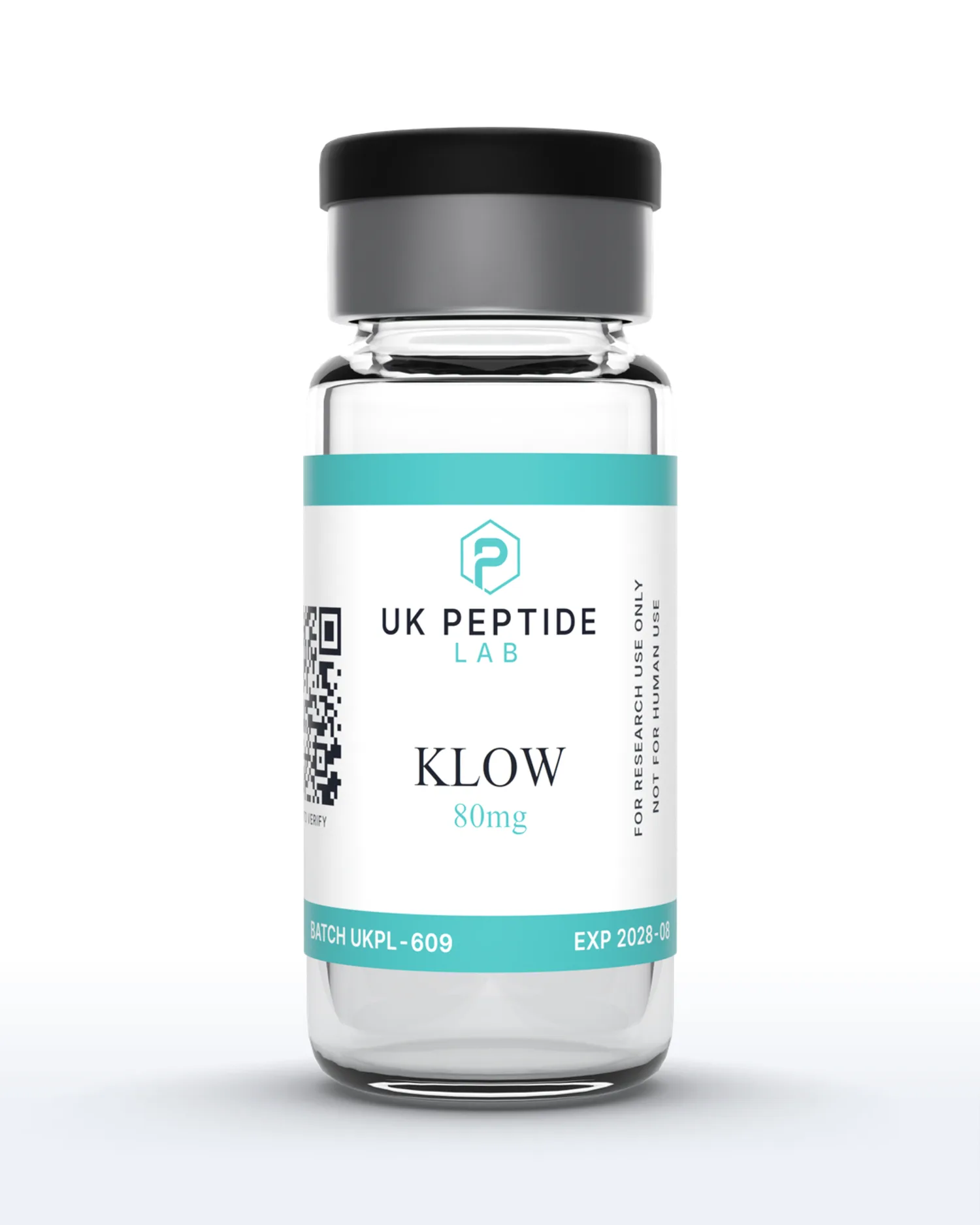
The three formats differ in composition and in experimental flexibility, not in quality. GLOW is 70mg total: BPC-157 10mg, TB-500 10mg, GHK-Cu 50mg. KLOW is the same three components at the same masses plus KPV 10mg, giving 80mg total, and adds a mechanistically distinct compound whose literature centres on PepT1-mediated uptake and NF-κB signalling in epithelial and colitis models rather than on angiogenesis, actin dynamics or copper transport. Individual BPC-157, TB-500 and GHK-Cu vials cost more in handling steps but are the only format that permits a single-compound control arm, an independent concentration per compound, or attribution of an observed effect to a specific molecule. One further note on the blend formats: because GHK-Cu is 403.9 g/mol against 1419.53 for BPC-157 and 4963.4 for thymosin beta 4, the 50:10:10 mass split is nothing like a 5:1:1 molar ratio, so molar arithmetic must be done component by component. Note also the supply-format difference across the market: GLOW and KLOW are sold by some suppliers as five- and six-vial kits, whereas the material here is a single pre-blended vial taking one reconstitution.
GLOW Research Applications
Each component of the GLOW blend has its own preclinical and in-vitro literature, and the blend has none of its own. BPC-157 appears in in-vitro and animal work on angiogenesis and endothelial tube formation, focal adhesion signalling, gastrointestinal mucosal integrity and nitric oxide pathway modulation; Hsieh et al. (J Mol Med, 2017) reported VEGFR2 upregulation and receptor internalisation in human umbilical vein endothelial cells, and Chang et al. (J Appl Physiol, 2011) reported FAK and paxillin phosphorylation with increased outgrowth and migration in cultured rat tendon fibroblasts. A 2025 review by McGuire and colleagues in Current Reviews in Musculoskeletal Medicine found no adequately powered randomised controlled trial. TB-500 is synthetic thymosin beta 4, the principal G-actin sequestering molecule in eukaryotic cells; Philp et al. (FASEB J, 2003) reported that the LKKTETQ actin-binding motif at residues 17 to 23 is sufficient to promote endothelial cell migration in aortic ring and chorioallantoic assays, and Bock-Marquette et al. (Nature, 2004) reported integrin-linked kinase and Akt activation in mouse cardiac models. GHK-Cu is studied as a copper delivery ligand and as a matrikine, the GHK motif occurring within the alpha-2(I) chain of type I collagen; Pickart et al. (Nature, 1980) reported facilitated copper uptake into cultured cells, Siméon et al. (Life Sci, 2000) reported upregulated matrix metalloproteinase-2 alongside its tissue inhibitors in fibroblast culture, and Maquart et al. (J Clin Invest, 1993) reported connective tissue accumulation endpoints in a rat diffusion-chamber model. Because these findings come from different systems at different scales, they cannot be summed into a prediction about the blend, and any design attributing an effect to a single component requires the individual vials.
Reconstitution Guide
Allow vials to reach room temperature, then sterilise the rubber stopper of both the peptide vial and the bacteriostatic water vial with an alcohol swab. Slowly draw your bacteriostatic water into a sterile insulin syringe, then inject it gently down the inner glass wall of the peptide vial, never directly onto the lyophilised powder. Once added, gently swirl the vial in a slow circular motion until fully dissolved. Never shake or vortex. The solution should be clear and colourless. Label the vial with the reconstitution date and store immediately. Two blend-specific points apply. Never shake or vortex, the 43-residue thymosin beta 4 component is shear sensitive and agitation reduces recovery of intact peptide. And the reconstituted solution will not be colourless: expect a blue to blue-violet tint from the d-d transition of the Cu(II) centre in the GHK-Cu component, which is expected and is the standard bench indicator that the copper complex is intact. A colourless or green-tinged solution indicates the complex has been disrupted rather than simply diluted, and visible absorption around 500 to 600 nm is the usual check. Reconstitute away from direct light and use glass or high-grade polypropylene labware, avoiding prolonged contact with stainless steel or other chelating surfaces that can strip Cu(II) from the tripeptide.
See our full peptide reconstitution guide and reconstitution calculator for step-by-step protocol.
Storage Instructions
Lyophilised vials should be stored at -20°C, protected from light and moisture, and remain stable for up to 24 months. Once reconstituted with bacteriostatic water, store the solution at 2-8°C (standard refrigerator) and use within approximately 3 months. For storage beyond that, prepare single-use aliquots at -20°C, where reconstituted peptide remains stable for up to 6 months. Avoid repeated freeze-thaw cycles and always handle under sterile laboratory conditions. Light protection matters more for GLOW than for a single-peptide vial, because a copper(II) peptide complex is photolabile and the whole blend must be handled to the standard of its most fragile component. Keep lyophilised vials and reconstituted solution shielded from UV and fluorescent light and use amber or foil-wrapped vessels for aliquots. Freeze-thaw cycling can disrupt the copper coordination sphere as well as degrade the peptide backbones, so single-use aliquots are preferable to repeatedly accessing one stock.
Frequently Asked Questions
Research References
- Therapeutic potential of pro-angiogenic BPC157 is associated with VEGFR2 activation and up-regulation (Hsieh et al., J Mol Med, 2017)
- The promoting effect of pentadecapeptide BPC 157 on tendon healing involves tendon outgrowth, cell survival and cell migration (Chang et al., J Appl Physiol, 2011)
- The actin binding site on thymosin beta4 promotes angiogenesis (Philp et al., FASEB J, 2003)
- Thymosin beta4 activates integrin-linked kinase and promotes cardiac cell migration, survival and cardiac repair (Bock-Marquette et al., Nature, 2004)
- Growth-modulating plasma tripeptide GHK may function by facilitating copper uptake into cells (Pickart et al., Nature, 1980)
- The tripeptide-copper complex GHK-Cu stimulates matrix metalloproteinase-2 expression by fibroblast cultures (Siméon et al., Life Sci, 2000)
Related Research Compounds
Research Guides
GLOW
70mg · £59.99