
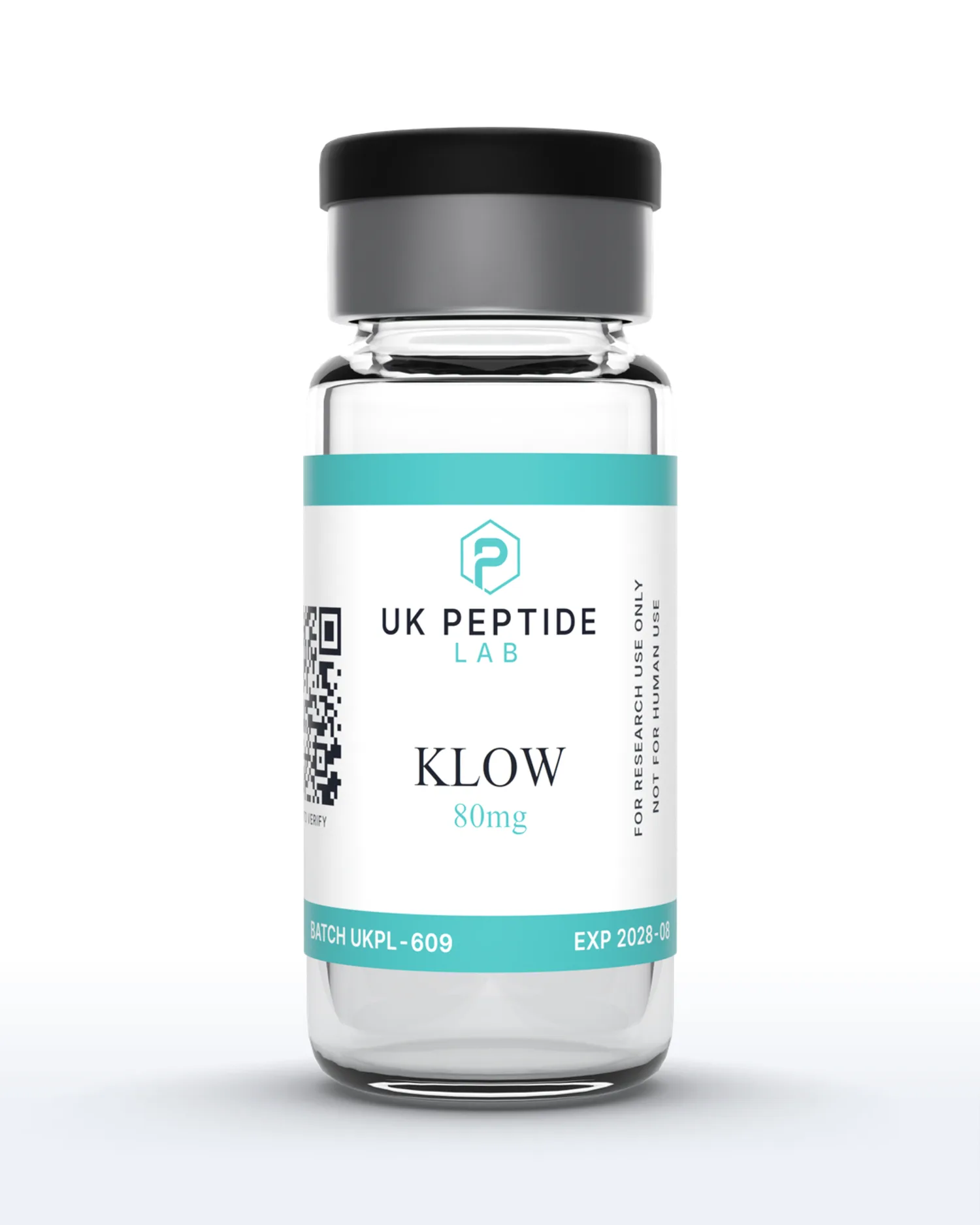
KLOW
80mg
KLOW is a pre-blended four-peptide research vial containing KPV 10mg, BPC-157 10mg, TB-500 10mg and GHK-Cu 50mg, supplied as a single lyophilised powder for one-step reconstitution. KPV (Lysine-Proline-Valine, the active C-terminal tripeptide of alpha-melanocyte-stimulating hormone) is investigated for melanocortin-pathway anti-inflammatory effects in mucosal and gut-barrier research. BPC-157 (Body Protection Compound, 15-residue pentadecapeptide) and TB-500 (synthetic fragment of thymosin beta-4) are extensively co-investigated in soft-tissue, angiogenesis and cell-migration research. GHK-Cu (glycyl-L-histidyl-L-lysine copper complex) is studied for collagen synthesis and copper-mediated tissue remodelling. KLOW pairs the GLOW regenerative trio with KPV's mucosal-research angle, covering both peripheral connective-tissue and barrier-immunity research models. Third-party tested, individual component purity reported on the lab certificate.
Published research on KLOW is indexed on PubMed. See our full UK buyer's guide for KLOW.
Intended Use: Strictly for in-vitro laboratory research. Not for use in humans or animals. Not to be used in foods, drugs, or medical diagnostics. This product has not been evaluated by the MHRA or FDA. Buyer assumes full responsibility for safe handling and regulatory compliance.
>99%
Purity
LAB
Certified
SAME
Day Ship
Quantity
Qualifies for free UK delivery · Royal Mail Tracked 24
Damaged or lost? Free reshipment guaranteed
Bacteriostatic Water 10ml
Required to reconstitute lyophilised peptides.
Research Use Only
This product is intended strictly for research and laboratory use only. Not for human consumption, medical use, or diagnostic purposes.
Certificate of Analysis
Third-party tested
Lyophilised Stability
24 months
Sealed at -20°C, light-protected
Reconstituted Stability
Up to 3 months
Stored at 2-8°C after mixing
Cold-Chain Shipping
Always
Dry-cold pack, Royal Mail Tracked 24
Important Notice
All compounds are sold individually and do not include research supplies. Products are provided in lyophilised (powder) form and require proper reconstitution before use in research settings.
Related Products
KLOW Price (UK)
KLOW 80mg is £69.99 per vial, supplied from stock in the UK with a third-party HPLC certificate published on this page. This vial clears the £45 threshold on its own, so UK Royal Mail Tracked 24 delivery is free. Orders placed before 2pm on a working day are dispatched the same day.
| Vial | Price | Cost per mg | Availability |
|---|---|---|---|
| KLOW 80mgThis page | £69.99 | £0.87 | In stock |
Prices are in GBP and shown per vial as supplied, lyophilised, for in-vitro laboratory research only. Cost per mg is given so researchers can compare vial sizes on a like-for-like basis. Stock and pricing on this table are read live from our inventory, so they match the basket. See our FAQ for delivery and payment options, and quality & testing for how each batch is verified.
Product Specifications
Research Overview
KLOW is a supplier designation for a pre-blended four-component research vial rather than a single molecule. The KLOW 80mg vial supplied here contains KPV 10mg, BPC-157 10mg, TB-500 10mg and GHK-Cu 50mg co-lyophilised together, which is the GLOW three-peptide composition with KPV added. As with any blend, the position to state plainly is that the combination itself has not been studied: no published work has examined these four compounds co-administered, and no synergy among them has been demonstrated. The evidence base is four separate single-compound literatures. KPV is the tripeptide Lys-Pro-Val, 342.4 g/mol, the C-terminal fragment of alpha-melanocyte-stimulating hormone corresponding to residues 11 to 13. Its mechanistic literature is unusual in that the selectivity is transporter-mediated rather than receptor-mediated. Dalmasso and colleagues (Gastroenterology, 2008, PMID 18061177) reported that KPV is taken up through the di- and tripeptide transporter PepT1, which is normally expressed in the small intestine and induced in the colon during inflammation, and that uptake was associated with reduced NF-κB activation in human epithelial and immune cell lines. Viennois and colleagues (Cell Mol Gastroenterol Hepatol, 2016, PMID 27458604) reported that the effect was lost in PepT1-knockout mice, making the transporter the gating step. Mandrika and colleagues (Biochem Pharmacol, 2001, PMID 11239505) examined melanocortin peptides on NF-κB DNA binding in RAW 264.7 macrophage-like cells and reported evidence for dual mechanisms of action, and Kannengiesser and colleagues (Inflamm Bowel Dis, 2008, PMID 18092346) reported effects in murine colitis models that were partly independent of MC1R. Note one recurring literature trap: the dimer (CKPV)₂ is a chemically different molecule with its own clinical record, and results attributed to it do not transfer to bare KPV, on which no human trials exist. The BPC-157, TB-500 and GHK-Cu components carry the mechanistic literatures set out on the GLOW page. Researchers comparing klow peptides between suppliers should note this is one pre-blended vial taking a single reconstitution, not a multi-vial kit. Supplied strictly for in-vitro laboratory research use only. No therapeutic, cosmetic or appearance claim is made or implied.
Product Specifications
Laboratory Handling
- Store lyophilised vials at -20°C, sealed, dry and protected from light. Bring the vial to room temperature before opening so condensation does not settle on the lyophilised cake.
- Handle the whole vial according to its most fragile component. GHK-Cu is a photolabile copper(II) peptide complex, so keep the entire blend light-protected through storage, reconstitution and aliquoting, and use amber or foil-wrapped vessels for aliquots.
- Reconstitute with bacteriostatic water or sterile water for injection, directing the stream slowly down the inner glass wall and not onto the powder. Swirl gently until fully dissolved. Never shake or vortex, the 43-residue thymosin beta 4 chain is shear sensitive and agitation reduces recovery of intact peptide.
- Use glass or high-grade polypropylene labware and avoid prolonged contact with stainless steel or other chelating surfaces, which can strip Cu(II) from the tripeptide. Strong chelators, phosphate-rich buffers and reducing agents in an experimental medium will compete for the copper centre and change the species actually present.
- Expect a blue to blue-violet tint in the reconstituted solution from the Cu(II) centre of the GHK-Cu component. Visible absorption in the 500 to 600 nm region is the standard bench check on complex integrity; a colourless solution indicates the complex has been disrupted rather than simply diluted.
- KPV is a tripeptide and the smallest species in the vial at 342.4 g/mol, so it is the component most readily lost to adsorption and to filtration or dialysis steps with a molecular weight cut-off. Account for that when preparing working dilutions or clarifying a stock.
- Hold reconstituted solution at 2-8°C and prepare single-use aliquots rather than repeatedly accessing one stock. Freeze-thaw cycling degrades peptide backbones and can additionally disrupt the copper coordination sphere.
- The four components cannot be separated once dissolved. Any design requiring a single-compound control, an independent concentration per compound, or component-level attribution of an observed effect must use the individual KPV, BPC-157, TB-500 and GHK-Cu vials.
- Maintain aseptic technique throughout. Swab the stopper of both the KLOW vial and the bacteriostatic water vial with 70% isopropyl alcohol before every needle entry and use a fresh sterile syringe for each transfer.
Frequently Asked Questions
What is KLOW?
KLOW is a supplier designation for a pre-blended four-component research vial, not a single chemical entity. The KLOW 80mg vial contains KPV 10mg (Lys-Pro-Val, the C-terminal tripeptide of alpha-melanocyte-stimulating hormone at residues 11 to 13, 342.4 g/mol, CAS 64790-08-5), BPC-157 10mg (pentadecapeptide GEPPPGKPADDAGLV, 1419.53 g/mol, CAS 137525-51-0), TB-500 10mg (synthetic thymosin beta 4, 43 residues, 4963.4 g/mol, CAS 77591-33-4) and GHK-Cu 50mg (glycyl-L-histidyl-L-lysine copper(II) complex, 403.9 g/mol, CAS 89030-95-5), co-lyophilised in one container. Compositionally it is the GLOW three-peptide blend with KPV added, which is where the K in the name comes from. The four components enter solution together at a fixed ratio on a single reconstitution and cannot subsequently be separated. The combination has not been studied as a combination; the evidence base is four separate single-compound literatures. Supplied as lyophilised powder for in-vitro research use only, not a licensed medicine, and no therapeutic, cosmetic or appearance claim is made or implied.
KLOW vs GLOW
KLOW is GLOW plus KPV. GLOW is 70mg total, BPC-157 10mg with TB-500 10mg and GHK-Cu 50mg; KLOW is 80mg total, the same three at the same masses plus KPV 10mg. The relevant difference is mechanistic rather than quantitative. BPC-157, TB-500 and GHK-Cu are studied respectively for VEGFR2-associated angiogenic signalling, G-actin sequestration and cell motility, and copper delivery with matrix metalloproteinase and collagen-synthesis endpoints in fibroblast culture. KPV is the outlier: Dalmasso et al. (Gastroenterology, 2008) reported that it is taken up through the di- and tripeptide transporter PepT1, which is expressed in the small intestine and induced in the colon during inflammation, with reduced NF-κB activation in human epithelial and immune cell lines, and Viennois et al. (Cell Mol Gastroenterol Hepatol, 2016) reported the effect was lost in PepT1-knockout mice. Its selectivity is therefore transporter-mediated and site-dependent, not receptor-subtype selectivity, and Mandrika et al. (Biochem Pharmacol, 2001) reported evidence for mechanisms partly separate from classical melanocortin receptor and cAMP signalling. Choose KLOW when a barrier or mucosal inflammation model is part of the design, GLOW when it is not, and individual vials whenever a single-compound control is required. Both are supplied here as one pre-blended vial, where some suppliers sell them as five- and six-vial kits.
KLOW Research Applications
Every application below belongs to one component in isolation; nothing has been published on the four together. KPV research sits largely in mucosal and intestinal inflammation models with NF-κB signalling as the recurring endpoint. Dalmasso et al. (Gastroenterology, 2008) reported PepT1-mediated uptake in human epithelial and immune cell lines with reduced NF-κB activation and attenuated experimental colitis in mice; Viennois et al. (Cell Mol Gastroenterol Hepatol, 2016) reported that the effect was absent in PepT1-knockout mice, establishing the transporter as the gating step; Kannengiesser et al. (Inflamm Bowel Dis, 2008) reported activity in murine IBD models that was partly independent of MC1R; and Mandrika et al. (Biochem Pharmacol, 2001) examined melanocortin peptides on NF-κB DNA binding and nitric oxide production in RAW 264.7 macrophage-like cells and reported evidence for dual mechanisms of action. There are no human trials of bare KPV, and the (CKPV)₂ dimer that does have an investigational record is a chemically different molecule whose results do not transfer. The remaining three components carry the literatures described on the GLOW and single-vial pages: BPC-157 in angiogenesis, focal adhesion signalling via FAK and paxillin, and gastrointestinal mucosal models; TB-500 in G-actin sequestration, endothelial and keratinocyte migration, and cardiac and corneal repair models, with randomised placebo-controlled human data existing only for thymosin beta 4 as a topical ophthalmic formulation; GHK-Cu in copper transport, matrikine signalling and matrix metalloproteinase-2 expression in fibroblast culture. KLOW is also used simply as a convenience preparation where four compounds are wanted in one solution and component-level resolution is not required.
Reconstitution Guide
Allow vials to reach room temperature, then sterilise the rubber stopper of both the peptide vial and the bacteriostatic water vial with an alcohol swab. Slowly draw your bacteriostatic water into a sterile insulin syringe, then inject it gently down the inner glass wall of the peptide vial, never directly onto the lyophilised powder. Once added, gently swirl the vial in a slow circular motion until fully dissolved. Never shake or vortex. The solution should be clear and colourless. Label the vial with the reconstitution date and store immediately. Three blend-specific points apply. Never shake or vortex, the 43-residue thymosin beta 4 component is shear sensitive. The reconstituted solution will not be colourless: expect a blue to blue-violet tint from the Cu(II) centre of the GHK-Cu component, and treat a colourless or green-tinged solution as evidence the copper complex has been disrupted rather than merely diluted, with visible absorption around 500 to 600 nm as the standard check. Finally, KPV at 342.4 g/mol is the smallest species in the vial and the one most readily lost to surface adsorption or to any filtration or dialysis step with a molecular weight cut-off, so plan working dilutions accordingly. Reconstitute away from direct light in glass or high-grade polypropylene labware, avoiding prolonged contact with chelating or metallic surfaces.
See our full peptide reconstitution guide and reconstitution calculator for step-by-step protocol.
Storage Instructions
Lyophilised vials should be stored at -20°C, protected from light and moisture, and remain stable for up to 24 months. Once reconstituted with bacteriostatic water, store the solution at 2-8°C (standard refrigerator) and use within approximately 3 months. For storage beyond that, prepare single-use aliquots at -20°C, where reconstituted peptide remains stable for up to 6 months. Avoid repeated freeze-thaw cycles and always handle under sterile laboratory conditions. As with any copper(II) peptide blend, the whole vial must be handled to the standard of its most fragile component, so keep both lyophilised vials and reconstituted solution shielded from UV and fluorescent light and use amber or foil-wrapped vessels for aliquots. Freeze-thaw cycling can disrupt the copper coordination sphere in addition to degrading the peptide backbones, making single-use aliquots preferable to repeated access of one stock.
Frequently Asked Questions
Research References
- PepT1-mediated tripeptide KPV uptake reduces intestinal inflammation (Dalmasso et al., Gastroenterology, 2008)
- Critical role of PepT1 in promoting colitis-associated cancer and therapeutic benefits of the PepT1-mediated tripeptide KPV in a murine model (Viennois et al., Cell Mol Gastroenterol Hepatol, 2016)
- Melanocortin-derived tripeptide KPV has anti-inflammatory potential in murine models of inflammatory bowel disease (Kannengiesser et al., Inflamm Bowel Dis, 2008)
- Effects of melanocortin peptides on NF-kappaB DNA binding and nitric oxide production in RAW 264.7 cells, evidence for dual mechanisms of action (Mandrika et al., Biochem Pharmacol, 2001)
- Therapeutic potential of pro-angiogenic BPC157 is associated with VEGFR2 activation and up-regulation (Hsieh et al., J Mol Med, 2017)
- The actin binding site on thymosin beta4 promotes angiogenesis (Philp et al., FASEB J, 2003)
- The tripeptide-copper complex GHK-Cu stimulates matrix metalloproteinase-2 expression by fibroblast cultures (Siméon et al., Life Sci, 2000)
Related Research Compounds
KLOW
80mg · £69.99