
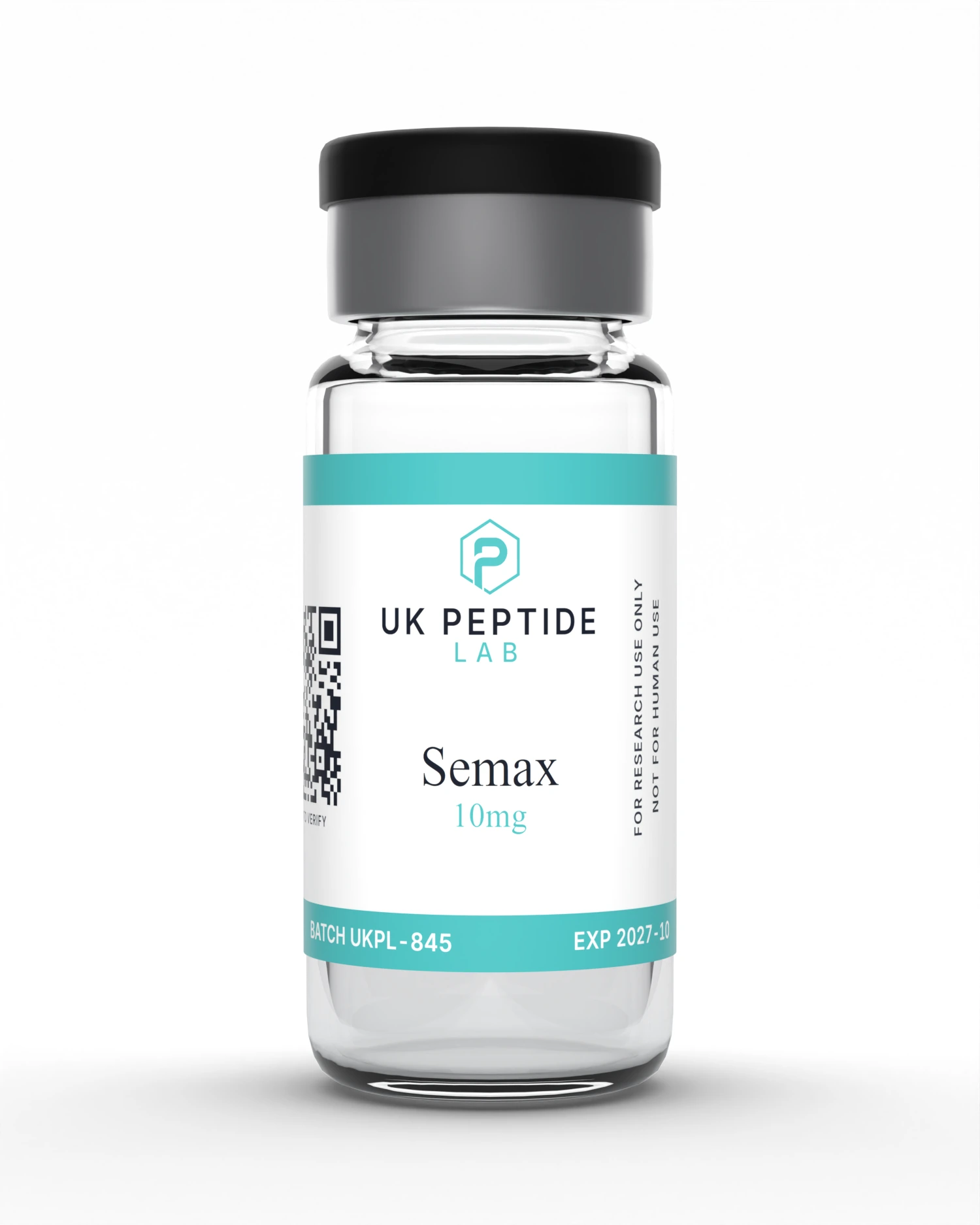
Semax
10mg
Semax is a synthetic analogue of ACTH fragment 4-10, a heptapeptide with the sequence Met-Glu-His-Phe-Pro-Gly-Pro. Research has examined its nootropic, neuroprotective and neurorestorative properties, including effects on BDNF expression and cognitive function. Semax can cross the blood-brain barrier, making it a key compound in neuroscience and cognitive research. Supplied as lyophilised powder, third-party tested, lab certificate published on this page.
Published research on Semax is indexed on PubMed. See our full UK buyer's guide for Research Peptides.
Intended Use: Strictly for in-vitro laboratory research. Not for use in humans or animals. Not to be used in foods, drugs, or medical diagnostics. This product has not been evaluated by the MHRA or FDA. Buyer assumes full responsibility for safe handling and regulatory compliance.
99.94%
Purity
LAB
Certified
SAME
Day Ship
Quantity
Add £20.01 more for free UK delivery
Damaged or lost? Free reshipment guaranteed
Bacteriostatic Water 10ml
Required to reconstitute lyophilised peptides.
Research Use Only
This product is intended strictly for research and laboratory use only. Not for human consumption, medical use, or diagnostic purposes.
Certificate of Analysis
Third-party tested
Lyophilised Stability
24 months
Sealed at -20°C, light-protected
Reconstituted Stability
Up to 3 months
Stored at 2-8°C after mixing
Cold-Chain Shipping
Always
Dry-cold pack, Royal Mail Tracked 24
Important Notice
All compounds are sold individually and do not include research supplies. Products are provided in lyophilised (powder) form and require proper reconstitution before use in research settings.
Related Products
Semax Price (UK)
Semax is supplied in 2 vial sizes, priced from £18.99 for 5mg to £24.99 for 10mg. Every size ships from our UK facility with the same third-party HPLC certificate published on this page. UK delivery is £4.50 by Royal Mail Tracked 24, or free once your basket reaches £45 (£20.01 away at this price). Orders placed before 2pm on a working day are dispatched the same day.
| Vial | Price | Cost per mg | Availability |
|---|---|---|---|
| Semax 10mgThis page | £24.99 | £2.50Best value | In stock |
| Semax 5mg | £18.99 | £3.80 | In stock |
Prices are in GBP and shown per vial as supplied, lyophilised, for in-vitro laboratory research only. Cost per mg is given so researchers can compare vial sizes on a like-for-like basis. Stock and pricing on this table are read live from our inventory, so they match the basket. See our FAQ for delivery and payment options, and quality & testing for how each batch is verified.
Research Overview
Semax is a synthetic heptapeptide derived from the adrenocorticotropic hormone (ACTH) fragment 4-10, with the sequence Met-Glu-His-Phe-Pro-Gly-Pro. Developed by the Institute of Molecular Genetics of the Russian Academy of Sciences, Semax has been approved as a pharmaceutical agent in Russia and Ukraine for neurological applications. Research focuses on its ability to modulate brain-derived neurotrophic factor (BDNF) and nerve growth factor (NGF) expression, conferring neuroprotective properties particularly relevant to ischaemic brain injury research. Studies have documented its effects on dopaminergic and serotonergic neurotransmitter systems, suggesting broad neuromodulatory activity beyond simple ACTH fragment effects. Semax has been clinically documented in stroke rehabilitation literature, where its neuroprotective and neurorestorative properties have been examined in post-ischaemic recovery models. The peptide crosses the blood-brain barrier efficiently, enabling central nervous system activity following peripheral administration. Researchers in neuroscience and cognitive pharmacology consider Semax a significant tool for studying neuroplasticity, neurotrophic factor regulation, and cognitive enhancement mechanisms in preclinical and clinical contexts.
Structurally Semax is ACTH(4-10) carrying a Pro-Gly-Pro extension at the C-terminus, and that tripeptide tail is the functionally important part of the design rather than an inert addition. PGP resists aminopeptidase cleavage, which is what gives the molecule a usable duration where the bare ACTH fragment has almost none. Critically, Semax retains the neurotropic activity of the parent fragment while being devoid of its corticotropic activity, so it does not drive adrenal steroidogenesis the way ACTH itself does. That separation of activities is the single most important pharmacological fact about the compound.
The neurotrophic mechanism is the most studied. Dolotov and colleagues reported increased BDNF and TrkB expression in rat hippocampus following administration, and the wider literature describes effects on NGF signalling alongside modulation of dopaminergic and serotonergic transmission. Semax is registered as a pharmaceutical in Russia, where it is used in stroke and cognitive indications.
The limitation should be stated rather than glossed over. Almost the entire evidence base is Russian-language and originates from a small number of affiliated institutions, and independent replication in Western laboratories is sparse. Very few placebo-controlled trials are indexed in the major English-language databases. Semax holds no marketing authorisation in the UK, the EU or the US, and is supplied here as a lyophilised research chemical for in-vitro laboratory use only.
Product Specifications
Laboratory Handling
- Store lyophilised vials at -20°C for maximum stability. Reconstituted solution should be kept at 2-8°C and used within 4 weeks.
- Reconstitute with bacteriostatic water using gentle swirling. Avoid vortexing or vigorous shaking.
- Handle under aseptic conditions. Use sterile syringes and alcohol-swabbed vial stoppers during reconstitution.
- Avoid repeated freeze-thaw cycles. Prepare single-use aliquots from reconstituted stock for best experimental reproducibility.
Frequently Asked Questions
What is Semax?
Semax is a synthetic heptapeptide with the sequence Met-Glu-His-Phe-Pro-Gly-Pro (MEHFPGP), molecular weight approximately 813.9 g/mol. Structurally it joins the Met-Glu-His-Phe core of the ACTH(4-10) fragment to a C-terminal Pro-Gly-Pro extension, a deliberate design choice made to protect the fragment from rapid aminopeptidase and carboxypeptidase degradation, which is what separates it from the short-lived native sequence. It was developed at the Institute of Molecular Genetics of the Russian Academy of Sciences and is registered as a nasal preparation in the Russian Federation, but it holds no marketing authorisation from the MHRA, EMA or FDA. The mechanistic literature centres on upregulation of brain-derived neurotrophic factor (BDNF), nerve growth factor (NGF) and their receptors, principally trkB. An honest reading of the evidence base: the overwhelming majority of the published work, including the clinical studies behind the Russian registration, originates from Russian groups, and independent replication in Western randomised controlled trials has not been published. Supplied as lyophilised powder for in-vitro research use only.
Semax vs Adamax and Other ACTH-Derived Analogues
Semax belongs to a small family of regulatory peptides built on one design strategy: take a short biologically active fragment of a native peptide and stabilise it with a C-terminal Pro-Gly-Pro. Semax is the founding member, applying that strategy to the ACTH(4-10) message region via its Met-Glu-His-Phe core. Adamax is a later analogue from the same design lineage, reported in the Russian preclinical literature in the same neurotrophin-expression and neuroprotection models; peer-reviewed characterisation outside that literature remains minimal, so findings for the two should not be treated as interchangeable. The more instructive comparator is Selank, which applies the identical Pro-Gly-Pro stabilisation to a completely different parent, the immunoglobulin-derived tetrapeptide tuftsin. The pairing explains why the two are so often studied side by side: same stabilisation chemistry, different message fragment, largely non-overlapping endpoints, with Semax dominant in neurotrophin and cerebral ischaemia models and Selank in anxiety, GABAergic and immune models. Even the bare Pro-Gly-Pro tripeptide has its own literature as a control, since the stabilising tail is not biologically inert.
Semax Research Applications
Semax is studied across preclinical neuroscience and cognitive pharmacology. The most cited strand is neurotrophin work: upregulation of BDNF protein and trkB signalling in rat hippocampus, and mapping of neurotrophin gene expression across brain regions following administration. A second strand is cerebral ischaemia, where Semax has been examined in rat middle cerebral artery occlusion models and in transcriptome-wide expression studies of the ischaemic brain, with reported effects on neurotrophin, vascular and immune-response gene clusters. Further reported endpoints include modulation of dopaminergic and serotonergic transmission, inhibition of enkephalin-degrading enzymes, and attention and memory performance in rodent behavioural tasks. Researchers should note that effect sizes and endpoints vary considerably between laboratories and that essentially all primary data come from one national research tradition, which makes independent replication a genuinely useful experimental contribution.
Reconstitution Guide
Allow vials to reach room temperature, then sterilise the rubber stopper of both the peptide vial and the bacteriostatic water vial with an alcohol swab. Slowly draw your bacteriostatic water into a sterile insulin syringe, then inject it gently down the inner glass wall of the peptide vial, never directly onto the lyophilised powder. Once added, gently swirl the vial in a slow circular motion until fully dissolved. Never shake or vortex. The N-terminal methionine is the oxidation-sensitive residue in this sequence, so keep stopper-open time and headspace air to a minimum and reconstitute away from strong light. The solution should be clear and colourless. Label the vial with the reconstitution date and refrigerate immediately.
See our full peptide reconstitution guide and reconstitution calculator for step-by-step protocol.
Storage Instructions
Lyophilised vials should be stored at -20°C, protected from light and moisture, and remain stable for up to 24 months. Once reconstituted with bacteriostatic water, store the solution at 2-8°C and use within approximately 4 weeks. For longer storage, prepare single-use aliquots at -20°C. Methionine oxidation is the degradation route to watch in this sequence, and it is accelerated by dissolved oxygen, light and repeated freeze-thaw cycling, so minimise headspace, keep aliquots single-use, and handle under sterile laboratory conditions throughout.
Frequently Asked Questions
Research References
Related Research Compounds
Research Guides
Semax
10mg · £24.99