
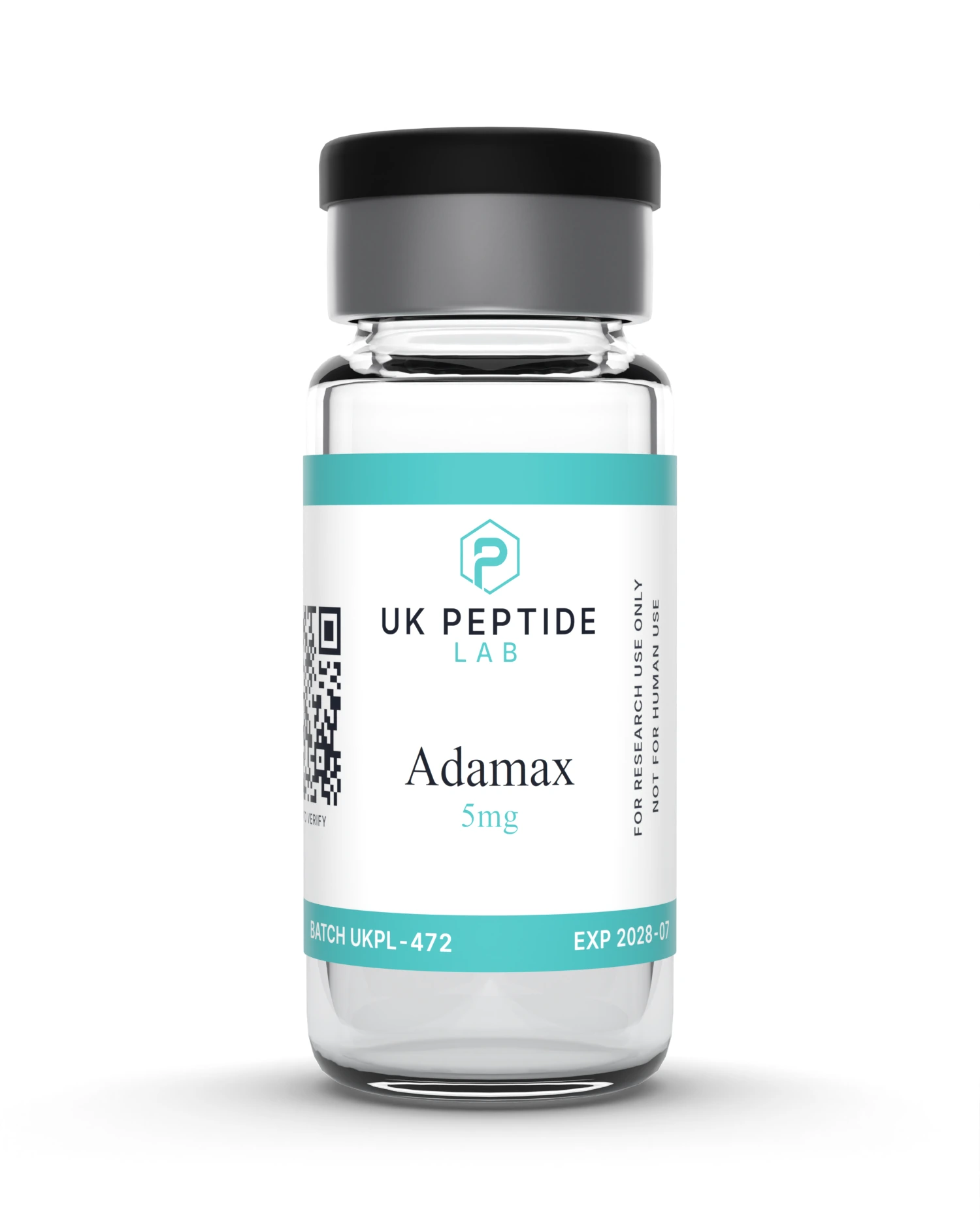
Adamax
5mg
Adamax is a synthetic analogue of Semax, extending the ACTH(4-10)-derived heptapeptide sequence with two additional residues and an acetylated N-terminus, giving Ac-Met-Glu-His-Phe-Pro-Gly-Pro-Ala-Gly. N-terminal acetylation is a standard strategy for reducing aminopeptidase cleavage, and the extended sequence distinguishes it from Semax itself. Note that although the compound is frequently marketed as adamantane-modified, the molecular formula reported for it, C50H69N11O11S, contains no adamantane group, and no CAS number has been formally assigned: several conflicting registry numbers circulate between suppliers, one of which is in fact the registry number for Semax. Independent published research on this specific analogue is minimal. Supplied as lyophilised powder for research use only.
Published research on Adamax is indexed on PubMed.
Intended Use: Strictly for in-vitro laboratory research. Not for use in humans or animals. Not to be used in foods, drugs, or medical diagnostics. This product has not been evaluated by the MHRA or FDA. Buyer assumes full responsibility for safe handling and regulatory compliance.
99.2%
Purity
LAB
Certified
SAME
Day Ship
Quantity
Add £5.01 more for free UK delivery
Damaged or lost? Free reshipment guaranteed
Bacteriostatic Water 10ml
Required to reconstitute lyophilised peptides.
Research Use Only
This product is intended strictly for research and laboratory use only. Not for human consumption, medical use, or diagnostic purposes.
Certificate of Analysis
Third-party tested
Lyophilised Stability
24 months
Sealed at -20°C, light-protected
Reconstituted Stability
Up to 3 months
Stored at 2-8°C after mixing
Cold-Chain Shipping
Always
Dry-cold pack, Royal Mail Tracked 24
Important Notice
All compounds are sold individually and do not include research supplies. Products are provided in lyophilised (powder) form and require proper reconstitution before use in research settings.
Related Products

Adamax Price (UK)
Adamax 5mg is £39.99 per vial, supplied from stock in the UK with a third-party HPLC certificate published on this page. UK delivery is £4.50 by Royal Mail Tracked 24, or free once your basket reaches £45 (£5.01 away at this price). Orders placed before 2pm on a working day are dispatched the same day.
| Vial | Price | Cost per mg | Availability |
|---|---|---|---|
| Adamax 5mgThis page | £39.99 | £8.00 | Low stock |
Prices are in GBP and shown per vial as supplied, lyophilised, for in-vitro laboratory research only. Cost per mg is given so researchers can compare vial sizes on a like-for-like basis. Stock and pricing on this table are read live from our inventory, so they match the basket. See our FAQ for delivery and payment options, and quality & testing for how each batch is verified.
Product Specifications
Research Overview
Adamax, often described simply as a Semax analogue, is a synthetic N-acetylated nonapeptide built on the Semax scaffold, with the sequence Ac-Met-Glu-His-Phe-Pro-Gly-Pro-Ala-Gly and a stated molecular weight of 1032.2 g/mol. Its parent compound, Semax, is the heptapeptide Met-Glu-His-Phe-Pro-Gly-Pro, the ACTH(4-7) fragment of adrenocorticotropin extended by the C-terminal tripeptide Pro-Gly-Pro. Adamax modifies that scaffold at both ends, carrying an N-terminal acetyl group and a C-terminal Ala-Gly extension, and it has no CAS registry number of its own. The most important fact about Adamax is what the literature does not contain: there is essentially no published, peer-reviewed pharmacology on the compound itself. No binding studies, no in-vitro characterisation, no animal work and no toxicology on Adamax appear in the indexed literature, and this page states that plainly rather than borrowing evidence by implication. Everything said mechanistically about it is inference from the parent Semax literature. That parent literature is real and specific: Dolotov and colleagues reported in 2006 that Semax binds specifically in rat basal forebrain and increases levels of brain-derived neurotrophic factor protein there (parent compound Semax literature, PubMed 16635254), and in the same year that Semax regulates BDNF and trkB expression in the rat hippocampus (parent compound Semax literature, PubMed 16996037). Whether any of that transfers to the acetylated, extended analogue is unknown. The questions a laboratory might reasonably ask of Adamax, whether N-acetylation alters proteolytic stability relative to Semax, whether the C-terminal extension changes receptor engagement or membrane behaviour, whether parent-compound BDNF findings reproduce with the analogue, are exactly that: open questions, and they are unanswered in print. Researchers who need a characterised compound should study Semax itself; Adamax is for laboratories explicitly interested in analogue-versus-parent comparisons, run with the analogue treated as the unknown. Adamax is not a licensed medicine in the United Kingdom or anywhere else. It is supplied as lyophilised powder strictly for in-vitro laboratory research use only and is not for human consumption.
Product Specifications
Laboratory Handling
- Store lyophilised vials at -20°C, protected from light and moisture. Reconstituted solution should be held at 2-8°C.
- Reconstitute with bacteriostatic water introduced slowly down the inner glass wall, never directly onto the lyophilised cake. Swirl gently until dissolved, never shake or vortex.
- The N-terminal region carries a methionine residue, which is oxidation-prone. Minimise exposure of the reconstituted solution to air and light, and keep vials capped between draws.
- Work aseptically with sterile syringes and alcohol-swabbed stoppers, aliquot reconstituted stock into single-use volumes, and avoid repeated freeze-thaw cycles. Label each aliquot with the reconstitution date.
Frequently Asked Questions
What is Adamax?
Adamax is a synthetic N-acetylated nonapeptide built on the Semax scaffold, sequence Ac-Met-Glu-His-Phe-Pro-Gly-Pro-Ala-Gly, stated molecular weight 1032.2 g/mol, with no CAS registry number of its own. The parent compound, Semax, is the heptapeptide Met-Glu-His-Phe-Pro-Gly-Pro, the ACTH(4-7) fragment of adrenocorticotropin extended by Pro-Gly-Pro; Adamax adds an N-terminal acetyl group and a C-terminal Ala-Gly extension to that scaffold. The defining fact about Adamax is that it has essentially no published peer-reviewed pharmacology of its own: no binding studies, no in-vitro characterisation, no animal work, no toxicology. Everything known mechanistically comes from the parent Semax literature, which is labelled as such wherever it is cited here. Supplied as lyophilised powder for in-vitro research use only, not a licensed medicine.
Adamax vs Semax
Semax is the characterised compound. Dolotov and colleagues reported in 2006 that Semax binds specifically and increases brain-derived neurotrophic factor protein levels in rat basal forebrain (parent compound Semax literature, PubMed 16635254), and that it regulates BDNF and trkB expression in the rat hippocampus (parent compound Semax literature, PubMed 16996037). Adamax is the uncharacterised analogue: an acetyl group at the N-terminus and an Ala-Gly extension at the C-terminus, with no published pharmacology of its own. Why might a laboratory study the analogue at all? The honest answers are hypotheses. N-terminal acetylation is a standard chemical strategy for slowing aminopeptidase degradation, so a stability difference relative to Semax is a plausible, testable, and untested proposition. C-terminal modification could alter receptor engagement or membrane behaviour, in either direction, which is equally untested. Whether the parent compound's BDNF findings reproduce with the analogue is unknown. Every one of those sentences is speculation until someone runs the comparison, and that comparison, analogue versus parent under identical conditions, is the only research design in which Adamax has a clear rationale. Researchers wanting an evidenced compound should choose Semax.
Adamax Research Applications
There are no published research applications specific to Adamax, and we will not pretend otherwise. What exists is a set of open experimental questions inherited from its relationship to Semax, whose rodent literature reports specific binding and increased BDNF protein in basal forebrain and regulation of BDNF and trkB expression in hippocampus (parent compound Semax literature, PubMed 16635254 and 16996037). Plausible study designs for the analogue, all speculative until run, include comparative proteolytic stability assays against Semax in serum or tissue homogenate, side-by-side neurotrophin endpoint assays in neuronal culture to test whether parent-compound findings transfer, and analytical characterisation work, since a compound without a CAS number or literature benefits from every laboratory that documents its behaviour rigorously. Adamax suits laboratories explicitly interested in analogue-versus-parent questions, with the analogue treated as the unknown arm of the experiment.
Reconstitution Guide
Allow vials to reach room temperature, then sterilise the rubber stopper of both the peptide vial and the bacteriostatic water vial with an alcohol swab. Slowly draw your bacteriostatic water into a sterile insulin syringe, then inject it gently down the inner glass wall of the peptide vial, never directly onto the lyophilised powder. Once added, gently swirl the vial in a slow circular motion until fully dissolved. Never shake or vortex. The solution should be clear and colourless. One note is specific to this sequence: it carries a methionine residue, which is oxidation-prone, so minimise the solution's exposure to air and light and keep the vial capped between draws. Label the vial with the reconstitution date and store immediately.
See our full peptide reconstitution guide and reconstitution calculator for step-by-step protocol.
Storage Instructions
Lyophilised vials should be stored at -20°C, protected from light and moisture, and remain stable for up to 24 months. Once reconstituted with bacteriostatic water, store the solution at 2-8°C (standard refrigerator) and use within approximately 4 weeks. For storage beyond that, prepare single-use aliquots at -20°C. Avoid repeated freeze-thaw cycles, and protect the reconstituted solution from light and unnecessary air exposure, since methionine oxidation is the most likely degradation route. Handle under sterile laboratory conditions throughout.
Frequently Asked Questions
Research References
- Semax, an analog of ACTH(4-10) with cognitive effects, regulates BDNF and trkB expression in the rat hippocampus (2006) (parent compound Semax literature)
- Semax binds specifically and increases levels of brain-derived neurotrophic factor protein in rat basal forebrain (2006) (parent compound Semax literature)
Related Research Compounds
Adamax
5mg · £39.99