
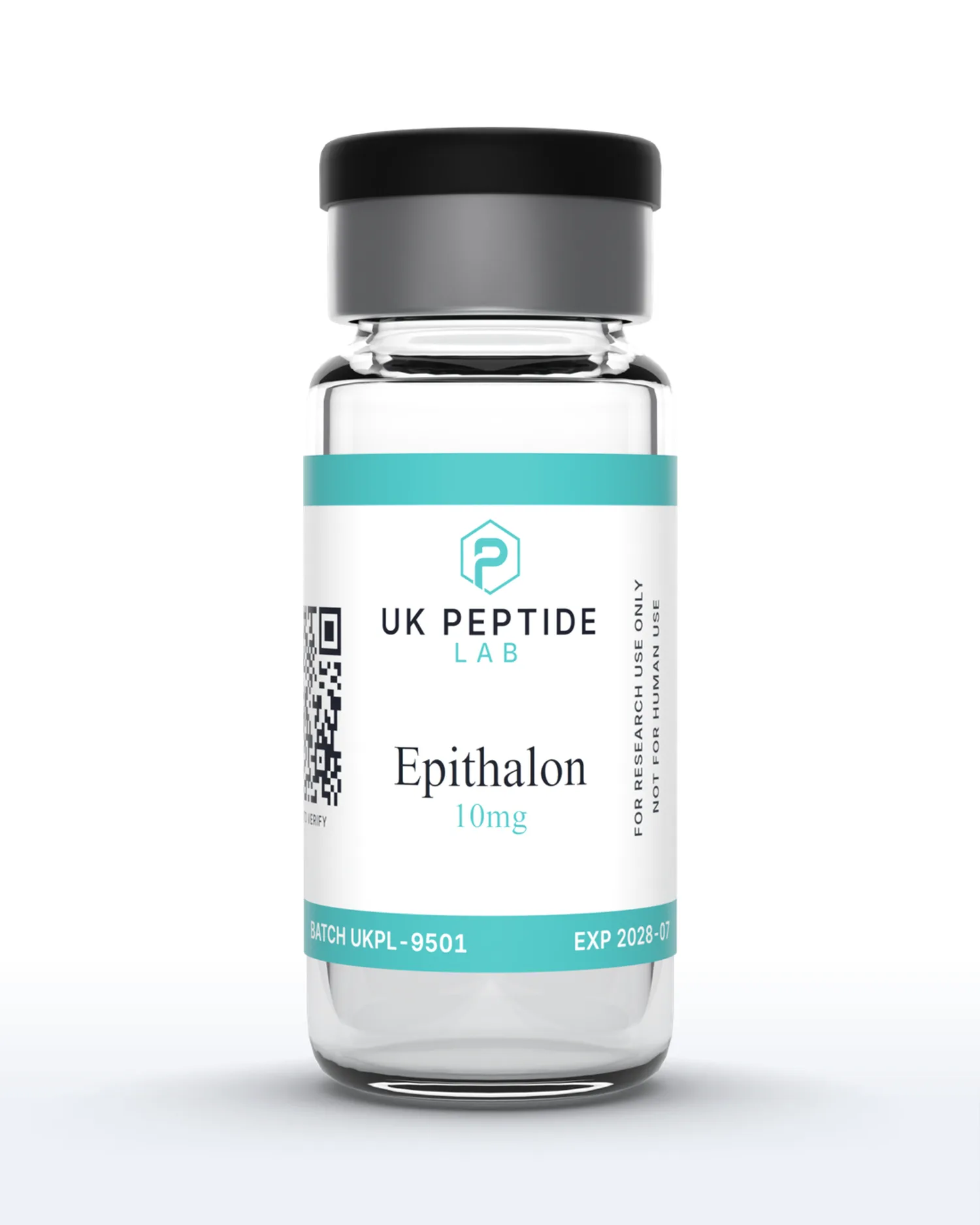
Epithalon
10mg
Epithalon is a synthetic tetrapeptide with the sequence Ala-Glu-Asp-Gly, developed from research into endogenous peptide bioregulators. Studies have examined its reported effects on telomerase activity, telomere length and the circadian regulation of melatonin and cortisol secretion in animal models, and it is among the most widely referenced peptide bioregulators in ageing research literature. Supplied as lyophilised powder, supplier-tested, with the certificate published on this page and independent third-party verification pending.
Published research on Epithalon is indexed on PubMed.
Intended Use: Strictly for in-vitro laboratory research. Not for use in humans or animals. Not to be used in foods, drugs, or medical diagnostics. This product has not been evaluated by the MHRA or FDA. Buyer assumes full responsibility for safe handling and regulatory compliance.
98.5%
Purity
LAB
Certified
SAME
Day Ship
Quantity
Add £20.01 more for free UK delivery
Damaged or lost? Free reshipment guaranteed
Bacteriostatic Water 10ml
Required to reconstitute lyophilised peptides.
Research Use Only
This product is intended strictly for research and laboratory use only. Not for human consumption, medical use, or diagnostic purposes.
Certificate of Analysis
Third-party tested
Lyophilised Stability
24 months
Sealed at -20°C, light-protected
Reconstituted Stability
Up to 3 months
Stored at 2-8°C after mixing
Cold-Chain Shipping
Always
Dry-cold pack, Royal Mail Tracked 24
Important Notice
All compounds are sold individually and do not include research supplies. Products are provided in lyophilised (powder) form and require proper reconstitution before use in research settings.
Related Products
Epithalon Price (UK)
Epithalon 10mg is £24.99 per vial, supplied from stock in the UK with a third-party HPLC certificate published on this page. UK delivery is £4.50 by Royal Mail Tracked 24, or free once your basket reaches £45 (£20.01 away at this price). Orders placed before 2pm on a working day are dispatched the same day.
| Vial | Price | Cost per mg | Availability |
|---|---|---|---|
| Epithalon 10mgThis page | £24.99 | £2.50 | In stock |
Prices are in GBP and shown per vial as supplied, lyophilised, for in-vitro laboratory research only. Cost per mg is given so researchers can compare vial sizes on a like-for-like basis. Stock and pricing on this table are read live from our inventory, so they match the basket. See our FAQ for delivery and payment options, and quality & testing for how each batch is verified.
Product Specifications
Research Overview
Epithalon, also written Epitalon, is a synthetic tetrapeptide with the sequence Ala-Glu-Asp-Gly (AEDG), molecular formula C₁₄H₂₂N₄O₉, molecular weight 390.35 g/mol and CAS number 307297-39-8. It was developed at the St. Petersburg Institute of Bioregulation and Gerontology by the group of Vladimir Khavinson as a synthetic tetrapeptide modelled on the active component of Epithalamin, a polypeptide preparation extracted from bovine pineal glands. The design is deliberately minimal — a four-residue peptide small enough to enter cells without a transporter — which sits at the centre of the research programme's proposal that short peptide bioregulators interact with DNA regulatory regions and influence gene expression.
The best-characterised strand of research is the telomere work. Khavinson, Bondarev and Butyugov (Bull Exp Biol Med, 2003) reported that addition of the peptide to cultures of telomerase-negative human fetal fibroblasts induced expression of the telomerase catalytic subunit, restored measurable telomerase activity, and increased mean telomere length by roughly one third. Companion work from the same group reported increased proliferative activity in retinal and pigmented epithelial cells. Recent independent in-vitro studies in additional human cell lines have reported telomere elongation through both telomerase upregulation and the alternative lengthening of telomeres pathway, with longer incubations required in normal cells than in telomerase-positive lines — a slow, early replication effort rather than a settled finding.
A second strand covers ageing and lifespan. Anisimov and colleagues (Biogerontology, 2003) treated female Swiss-derived SHR mice and reported no change in mean lifespan alongside a 13.3% extension of the lifespan of the last 10% of survivors and a 12.3% extension of maximum lifespan, and the same group reported inhibition of dimethylhydrazine-induced colon carcinogenesis in rats (Cancer Lett, 2002). The pineal and circadian strand runs mostly through the parent preparation Epithalamin, from which Epithalon was designed: Korkushko and colleagues (Bull Exp Biol Med, 2004) reported that epithalamin raised nocturnal plasma melatonin and partially restored its circadian rhythm in elderly subjects.
The honest position, stated plainly: the evidence base is predominantly Russian-language, originates largely from one affiliated research cluster, rests on small sample sizes, and has sparse independent Western replication. Epithalon holds no marketing authorisation in any jurisdiction and is not an approved medicine. UK Peptide Lab supplies it as lyophilised powder, supplier-tested, batch UKPL-9501 at 98.5% purity by HPLC with the certificate published on the product page. Supplied for in-vitro laboratory research use only, not for human consumption.
Product Specifications
Laboratory Handling
- Store lyophilised vials at -20°C, protected from light and moisture. Reconstituted solution should be held at 2-8°C and used within 4 weeks.
- Reconstitute with bacteriostatic water introduced slowly down the inner glass wall, never directly onto the lyophilised cake. Swirl gently until fully dissolved; never shake or vortex.
- The tetrapeptide contains no methionine, cysteine or tryptophan, so it carries no strongly oxidation-prone residues — aseptic technique is the limiting factor in solution life. Minimise stopper-open time and re-seal promptly.
- Work under aseptic conditions with sterile syringes and alcohol-swabbed stoppers. Aliquot reconstituted stock into single-use volumes and avoid repeated freeze-thaw cycles.
Frequently Asked Questions
What is Epithalon?
Epithalon, also written Epitalon, is a synthetic tetrapeptide with the sequence Ala-Glu-Asp-Gly (AEDG), molecular formula C₁₄H₂₂N₄O₉, molecular weight 390.35 g/mol, CAS 307297-39-8. It was developed at the St. Petersburg Institute of Bioregulation and Gerontology by the group of Vladimir Khavinson as a synthetic tetrapeptide modelled on the active component of Epithalamin, a polypeptide preparation extracted from bovine pineal glands that had been studied in elderly populations since the 1980s. The chemistry is deliberately minimal: a four-residue peptide small enough to enter cells without a transporter, which is central to the programme's proposal that short peptides interact with DNA regulatory regions and shift gene expression. The literature that matters for experimental design is the telomerase work, where Khavinson, Bondarev and Butyugov (Bull Exp Biol Med, 2003) reported that the peptide induced telomerase expression and telomere elongation in cultured human fibroblasts, and the ageing-biomarker work of Anisimov and colleagues (Biogerontology, 2003) in mice. The caveats are structural rather than incidental — most primary data come from one affiliated research cluster, much of it in Russian-language journals — and are set out in full below. Supplied as lyophilised powder for in-vitro research use only, and it holds no marketing authorisation anywhere.
Epithalon vs Pinealon
The two compounds are the closest comparators in this catalogue: synthetic short-peptide bioregulators from the same St. Petersburg research programme, with the same proposed mode of action and the same shape of evidence base. Epithalon is the tetrapeptide Ala-Glu-Asp-Gly, designed from the pineal polypeptide preparation Epithalamin, and its literature runs through telomerase activation and telomere elongation in cell culture (Khavinson, Bondarev and Butyugov, Bull Exp Biol Med, 2003), ageing biomarkers and lifespan in mice (Anisimov et al., Biogerontology, 2003), and the pineal axis, where the parent preparation was shown to raise nocturnal melatonin in elderly subjects (Korkushko et al., Bull Exp Biol Med, 2004). Pinealon is the tripeptide Glu-Asp-Arg, and its literature is weighted instead towards neuroprotection, antioxidant endpoints and gene-expression models. What the two share matters more for experimental design than what separates them: both belong to a compact, largely self-referential literature in which primary data originate from one research cluster, replication outside it is sparse, and effect claims run broad relative to the underlying evidence. They are not interchangeable tool compounds — a protocol built on the telomere literature needs Epithalon, one built on the neuroprotection literature needs Pinealon — and any cross-application between them is an assumption, not a finding.
Epithalon Research Applications
Epithalon is used in in-vitro and animal models along the two lines of research it was built around. The telomere line: telomerase activity assays and telomere length measurement in cultured human fibroblasts and epithelial cells, following Khavinson, Bondarev and Butyugov (Bull Exp Biol Med, 2003), who reported induction of the telomerase catalytic subunit, enzymatic activity and telomere elongation in human fetal fibroblasts; recent independent work has extended this to further human cell lines and to the alternative lengthening of telomeres pathway, with longer incubations required in normal cells than in telomerase-positive lines. The ageing line: lifespan, survival-curve and biomarker studies in rodents, following Anisimov and colleagues (Biogerontology, 2003), who reported no change in mean lifespan but a 13.3% extension of the lifespan of the last 10% of survivors in female Swiss-derived SHR mice, and (Cancer Lett, 2002) an inhibitory effect in a dimethylhydrazine-induced colon carcinogenesis model. The circadian line is largely inherited from Epithalamin, the parent pineal preparation, in which Korkushko and colleagues (Bull Exp Biol Med, 2004) reported partial restoration of the nocturnal melatonin rhythm in elderly subjects. The honest boundary: the human evidence is small, the preponderance of primary data originates from one affiliated research cluster and is published in Russian-language journals, replication by independent Western laboratories is sparse, and no marketing authorisation exists in any jurisdiction. Material supplied here is for in-vitro laboratory research only.
Reconstitution Guide
Allow vials to reach room temperature, then sterilise the rubber stopper of both the peptide vial and the bacteriostatic water vial with an alcohol swab. Slowly draw your bacteriostatic water into a sterile insulin syringe, then inject it gently down the inner glass wall of the peptide vial, never directly onto the lyophilised powder. Once added, gently swirl the vial in a slow circular motion until fully dissolved. Never shake or vortex. Epithalon is a short tetrapeptide containing no methionine, cysteine or tryptophan, so it lacks the oxidation-prone residues that dictate handling precautions for longer sequences, and it dissolves readily to a clear, colourless solution. Aseptic technique, not chemistry, is the limiting factor here: work efficiently, minimise stopper-open time, and label the vial with the reconstitution date before refrigerating immediately.
See our full peptide reconstitution guide and reconstitution calculator for step-by-step protocol.
Storage Instructions
Lyophilised vials should be stored at -20°C, protected from light and moisture, and remain stable for up to 24 months. Once reconstituted with bacteriostatic water, store the solution at 2-8°C (standard refrigerator) and use within approximately 4 weeks, preparing single-use aliquots at -20°C for longer storage. The sequence carries no labile residues, so in practice the in-use limit is set by sterility rather than chemical degradation — an argument for aliquoting rather than repeatedly puncturing one stock vial. Handle under sterile laboratory conditions throughout.
Frequently Asked Questions
Research References
Related Research Compounds
Epithalon
10mg · £24.99