
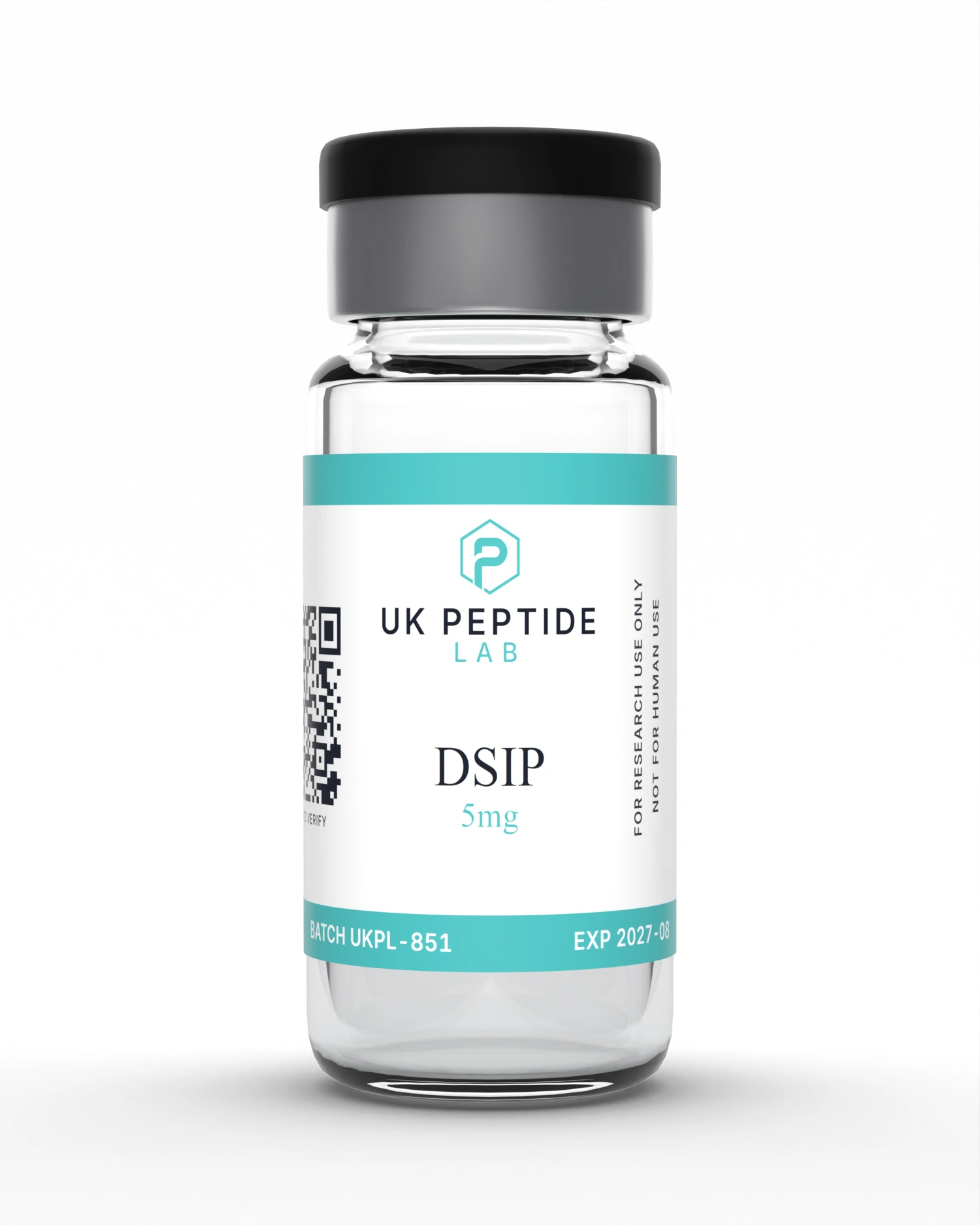
DSIP
5mg
DSIP (Delta Sleep-Inducing Peptide) is a nine amino acid neuropeptide first identified in 1977 from cerebral venous blood during induced sleep studies. Research has examined its role in sleep regulation, stress modulation and neuroendocrine activity, including effects on circadian rhythm and interactions with the hypothalamic-pituitary axis. A compound of interest in sleep physiology and stress-response research. Supplied as lyophilised powder, third-party tested, lab certificate published on this page.
Published research on DSIP is indexed on PubMed. See our full UK buyer's guide for DSIP.
Intended Use: Strictly for in-vitro laboratory research. Not for use in humans or animals. Not to be used in foods, drugs, or medical diagnostics. This product has not been evaluated by the MHRA or FDA. Buyer assumes full responsibility for safe handling and regulatory compliance.
99.07%
Purity
LAB
Certified
SAME
Day Ship
Quantity
Add £29.01 more for free UK delivery
Damaged or lost? Free reshipment guaranteed
Bacteriostatic Water 10ml
Required to reconstitute lyophilised peptides.
Research Use Only
This product is intended strictly for research and laboratory use only. Not for human consumption, medical use, or diagnostic purposes.
Certificate of Analysis
Third-party tested
Lyophilised Stability
24 months
Sealed at -20°C, light-protected
Reconstituted Stability
Up to 3 months
Stored at 2-8°C after mixing
Cold-Chain Shipping
Always
Dry-cold pack, Royal Mail Tracked 24
Important Notice
All compounds are sold individually and do not include research supplies. Products are provided in lyophilised (powder) form and require proper reconstitution before use in research settings.
Related Products
DSIP Price (UK)
DSIP 5mg is £15.99 per vial, supplied from stock in the UK with a third-party HPLC certificate published on this page. UK delivery is £4.50 by Royal Mail Tracked 24, or free once your basket reaches £45 (£29.01 away at this price). Orders placed before 2pm on a working day are dispatched the same day.
| Vial | Price | Cost per mg | Availability |
|---|---|---|---|
| DSIP 5mgThis page | £15.99 | £3.20 | In stock |
Prices are in GBP and shown per vial as supplied, lyophilised, for in-vitro laboratory research only. Cost per mg is given so researchers can compare vial sizes on a like-for-like basis. Stock and pricing on this table are read live from our inventory, so they match the basket. See our FAQ for delivery and payment options, and quality & testing for how each batch is verified.
Research Overview
DSIP (Delta Sleep-Inducing Peptide) is a neuropeptide consisting of nine amino acids with the sequence Trp-Ala-Gly-Gly-Asp-Ala-Ser-Gly-Glu. First identified in 1977 from cerebral venous blood of rabbits during electrically induced sleep by Swiss researchers Schoenenberger and Monnier, DSIP has since been studied for its role in sleep architecture regulation, stress response modulation, and neuroendocrine activity. Research has examined DSIP's effects on circadian rhythm regulation, its interactions with the hypothalamic-pituitary axis, and its potential influence on cortisol and ACTH levels during stress responses. Studies have documented effects on delta wave sleep patterns, from which the peptide derives its name. DSIP research extends beyond sleep physiology into areas including opioid receptor modulation, withdrawal symptom attenuation, and free radical scavenging activity. The peptide's stability in serum and its ability to cross the blood-brain barrier make it a practical research tool in sleep physiology and chronobiology. Its effects on reducing corticotropin levels suggest involvement in stress-adaptive pathways, adding complexity to its pharmacological profile beyond simple sleep induction.
DSIP was isolated by Schoenenberger and Monnier, who reported recovering it from the cerebral venous blood of rabbits during electrically induced sleep and published the characterisation in 1977. The sequence is Trp-Ala-Gly-Gly-Asp-Ala-Ser-Gly-Glu, an unusually acidic nonapeptide.
It is worth being direct about the state of the evidence, because DSIP is a compound where the name promises more than the literature delivers. No specific DSIP receptor has ever been identified, the original sleep-induction findings have proved difficult to replicate consistently, and its status as a genuine endogenous sleep factor remains contested nearly fifty years after its description. Much of the subsequent work has instead concerned effects some distance from sleep, including opioid withdrawal models, stress and corticotropin responses, and antioxidant activity.
That uncertainty is precisely why it remains an interesting research tool rather than a settled one, and it is stated plainly here rather than papered over with confident mechanism claims. DSIP is not an approved medicine in any jurisdiction and is supplied as lyophilised powder for in-vitro laboratory research only.
Product Specifications
Laboratory Handling
- Store lyophilised vials at -20°C. Reconstituted DSIP should be refrigerated at 2-8°C and used within 4 weeks.
- Reconstitute with bacteriostatic water using gentle swirling. Avoid shaking or vortexing the peptide solution.
- Handle under aseptic laboratory conditions using sterile equipment throughout reconstitution and aliquoting.
- Avoid repeated freeze-thaw cycles. Prepare measured aliquots from reconstituted stock for consistent experimental use.
Frequently Asked Questions
What is DSIP?
DSIP (Delta Sleep-Inducing Peptide) is a nonapeptide with the sequence Trp-Ala-Gly-Gly-Asp-Ala-Ser-Gly-Glu (WAGGDASGE), molecular weight 848.8 g/mol, CAS 62568-57-4. It was isolated in 1977 by Schoenenberger and Monnier from the cerebral venous blood of rabbits in which slow-wave sleep had been induced by electrical stimulation of the intralaminar thalamus, and named for the delta-wave EEG activity that transfusion of the dialysate appeared to promote in recipient animals. Nearly five decades on, DSIP remains one of the most genuinely unresolved compounds in peptide research: no receptor has ever been identified, the gene encoding it has never been found in any genome, and attempts to confirm its endogenous existence by modern analytical methods have not succeeded. Replication of the original sleep findings has been inconsistent, with both positive and null results in animal and human EEG studies. It is precisely this contradictory record that keeps DSIP in use as a research subject. Supplied as lyophilised powder for in-vitro research use only.
DSIP vs Conventional Sleep-Pathway Peptides
The instructive contrast is between DSIP and the sleep-relevant peptide systems whose biology is actually established. Orexin-A and orexin-B act at defined receptors, OX1R and OX2R, their loss causes narcolepsy, and antagonists at those receptors are licensed medicines; melanin-concentrating hormone has mapped receptors and characterised REM-promoting circuitry; galanin and growth hormone releasing hormone have documented roles in sleep-active hypothalamic neurons. Against every one of those systems DSIP fails the basic tests: no receptor has been identified despite decades of searching, no precursor gene exists in any sequenced genome, and its presence in tissue has depended on immunoassays whose specificity was later questioned rather than on mass-spectrometric confirmation. Human studies through the 1980s and 1990s reported improved sleep in some trials and no effect in others, and the field never converged. Researchers should therefore treat DSIP not as a validated sleep-pathway ligand but as an open analytical and pharmacological question, and any experimental design should include the controls that the historical literature often lacked.
DSIP Research Applications
DSIP is studied across sleep physiology and chronobiology, where the original delta-wave EEG claims continue to be tested in rodent models, and in a scattered secondary literature that grew up around the peptide in the 1980s and 1990s: hypothalamic-pituitary axis interactions including reported effects on cortisol, ACTH and somatostatin secretion, stress-response paradigms, opioid receptor pathway interactions including reported modulation of opioid withdrawal in animal models, and free-radical scavenging and membrane-stabilising activity in oxidative stress models. A further strand uses DSIP itself as the analytical target, applying modern LC-MS methods to the still-open question of whether the peptide exists endogenously at all. Because the primary literature is old, methodologically uneven and contradictory, DSIP is best treated as a compound for hypothesis-testing and replication work rather than as a tool with an established mechanism.
Reconstitution Guide
Allow vials to reach room temperature, then sterilise the rubber stopper of both the peptide vial and the bacteriostatic water vial with an alcohol swab. Slowly draw your bacteriostatic water into a sterile insulin syringe, then inject it gently down the inner glass wall of the peptide vial, never directly onto the lyophilised powder. Once added, gently swirl the vial in a slow circular motion until fully dissolved. Never shake or vortex. The N-terminal tryptophan is the oxidation- and light-sensitive residue in this sequence, so reconstitute away from direct sunlight and fluorescent lighting; it also provides a usable chromophore for concentration checks by UV absorbance at 280 nm. The solution should be clear and colourless. Label the vial with the reconstitution date and refrigerate immediately.
See our full peptide reconstitution guide and reconstitution calculator for step-by-step protocol.
Storage Instructions
Lyophilised vials should be stored at -20°C, protected from light and moisture, and remain stable for up to 24 months. Once reconstituted with bacteriostatic water, store the solution at 2-8°C in a light-protected container and use within approximately 4 weeks, preparing single-use aliquots at -20°C for longer storage. Tryptophan oxidation is the degradation route to monitor, resolving as a new RP-HPLC peak after extended or light-exposed storage, and repeated freeze-thaw cycling accelerates it, so keep aliquots single-use and amber or foil-wrapped. Handle under sterile laboratory conditions throughout.
Frequently Asked Questions
Research References
Related Research Compounds
Research Guides
DSIP
5mg · £15.99