
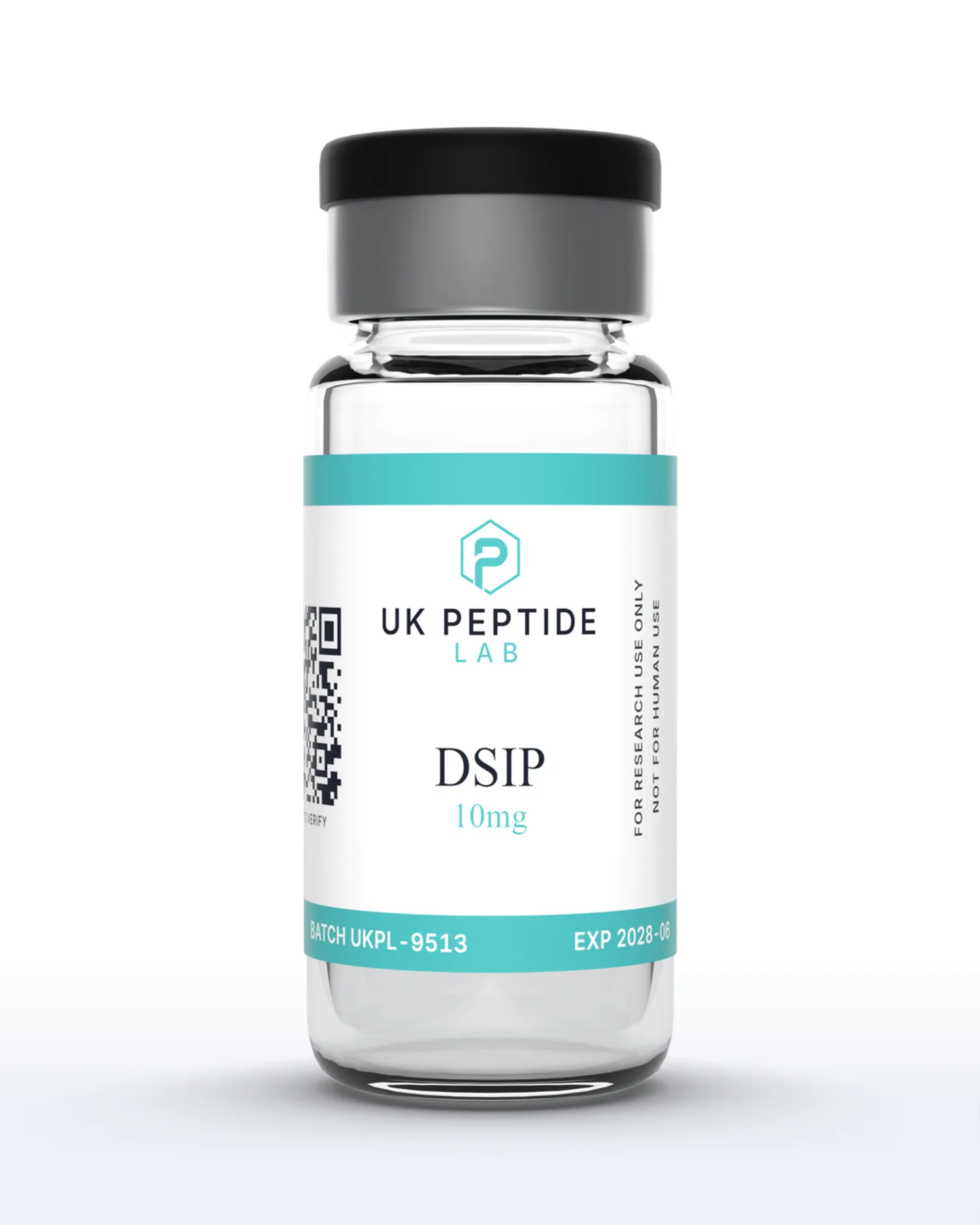
DSIP
10mg
Delta sleep-inducing peptide (DSIP) is a nonapeptide (Trp-Ala-Gly-Gly-Asp-Ala-Ser-Gly-Glu) first isolated from rabbit cerebral venous blood. Research has examined its reported effects on sleep architecture, stress hormone regulation and circadian rhythms, with human evidence remaining limited. This 10mg presentation is the higher-mass research format of our 5mg vial. Supplied as lyophilised powder, supplier-tested, with the certificate published on this page and independent third-party verification pending.
Published research on DSIP is indexed on PubMed.
Intended Use: Strictly for in-vitro laboratory research. Not for use in humans or animals. Not to be used in foods, drugs, or medical diagnostics. This product has not been evaluated by the MHRA or FDA. Buyer assumes full responsibility for safe handling and regulatory compliance.
TBC
Purity
LAB
Certified
SAME
Day Ship
Quantity
Add £17.01 more for free UK delivery
Damaged or lost? Free reshipment guaranteed
Bacteriostatic Water 10ml
Required to reconstitute lyophilised peptides.
Research Use Only
This product is intended strictly for research and laboratory use only. Not for human consumption, medical use, or diagnostic purposes.
Certificate of Analysis
Third-party tested
Lyophilised Stability
24 months
Sealed at -20°C, light-protected
Reconstituted Stability
Up to 3 months
Stored at 2-8°C after mixing
Cold-Chain Shipping
Always
Dry-cold pack, Royal Mail Tracked 24
Important Notice
All compounds are sold individually and do not include research supplies. Products are provided in lyophilised (powder) form and require proper reconstitution before use in research settings.
Related Products
DSIP Price (UK)
DSIP is supplied in 2 vial sizes, priced from £15.99 for 5mg to £27.99 for 10mg. Every size ships from our UK facility with the same third-party HPLC certificate published on this page. UK delivery is £4.50 by Royal Mail Tracked 24, or free once your basket reaches £45 (£17.01 away at this price). Orders placed before 2pm on a working day are dispatched the same day.
| Vial | Price | Cost per mg | Availability |
|---|---|---|---|
| DSIP 5mg | £15.99 | £3.20 | In stock |
| DSIP 10mgThis page | £27.99 | £2.80Best value | In stock |
Prices are in GBP and shown per vial as supplied, lyophilised, for in-vitro laboratory research only. Cost per mg is given so researchers can compare vial sizes on a like-for-like basis. Stock and pricing on this table are read live from our inventory, so they match the basket. See our FAQ for delivery and payment options, and quality & testing for how each batch is verified.
Product Specifications
Research Overview
Delta sleep-inducing peptide (DSIP) is a nonapeptide first isolated from rabbit cerebral venous blood, and it is the compound behind UK Peptide Lab's DSIP 10mg vial. The sequence is Trp-Ala-Gly-Gly-Asp-Ala-Ser-Gly-Glu, an unusually acidic nine-residue peptide with a molecular weight of 848.8 g/mol, molecular formula C₃₅H₄₈N₁₀O₁₅ and CAS number 62568-57-4. It was isolated by the Schoenenberger and Monnier group in Basel and reported in 1977, when the team showed that material recovered from rabbits during electrically induced slow-wave sleep enhanced delta and spindle electroencephalogram activity after intraventricular infusion (Schoenenberger and Monnier, Proc Natl Acad Sci U S A, 1977). This 10mg presentation is the higher-mass research format of our 5mg vial: the same compound, supplied at twice the peptide mass per vial, for laboratories running extended assay series.
Research has examined DSIP across three main strands: sleep architecture, stress hormone regulation and circadian rhythms. The earliest sleep work reported enhanced delta-wave sleep in several species, and Graf and Kastin's review of the field (Neurosci Biobehav Rev, 1984) catalogued those early reports alongside effects on circadian and locomotor patterns and on circulating hormone levels. On the neuroendocrine side, in-vitro work reported that DSIP inhibited corticotropin-releasing factor-induced ACTH secretion from rat anterior pituitary tissue, placing it in the hypothalamic-pituitary-adrenal literature (Okajima and Hertting, Horm Metab Res, 1986).
The honest caveat belongs up front, because DSIP is a compound whose name promises more than the literature delivers. No specific DSIP receptor has ever been identified, no gene encoding the peptide has been found in any sequenced genome, and the original sleep-induction findings have proved difficult to replicate consistently; Kovalzon and Strekalova summarised the field in the Journal of Neurochemistry in 2006 under the title 'a still unresolved riddle'. Human evidence remains limited. Early human studies reported effects on disturbed sleep (Schneider-Helmert and Schoenenberger, Neuropsychobiology, 1983), but a double-blind matched-pairs study in 16 chronic insomniac patients found weak, partly confounded effects and concluded that short-term treatment was unlikely to offer major therapeutic benefit (Bes et al., Neuropsychobiology, 1992).
DSIP is not an approved medicine in any jurisdiction and is supplied as lyophilised powder for in-vitro laboratory research use only, with no dosing information and no human-use claims. The 10mg vial is supplier-tested, with the certificate published on this page, and independent third-party verification is pending.
Product Specifications
Laboratory Handling
- Store lyophilised vials at -20°C, protected from light and moisture. Reconstituted DSIP should be kept at 2-8°C and used within approximately 4 weeks.
- Reconstitute with bacteriostatic water using gentle swirling, injecting the diluent slowly down the inner glass wall. Avoid shaking or vortexing the peptide solution.
- The N-terminal tryptophan is the oxidation- and light-sensitive residue: work away from direct sunlight, keep solutions cold, and minimise headspace and stopper-open time.
- Handle under aseptic laboratory conditions. With twice the peptide mass per vial, prepare single-use aliquots at reconstitution so repeated freeze-thaw cycles do not degrade the remaining stock.
Frequently Asked Questions
What is DSIP?
DSIP 10mg is the higher-mass research format of our DSIP 5mg vial: the same delta sleep-inducing peptide, presented at twice the mass per vial for extended in-vitro assay series. The compound is a nonapeptide with the sequence Trp-Ala-Gly-Gly-Asp-Ala-Ser-Gly-Glu, molecular weight 848.8 g/mol and CAS 62568-57-4. It was isolated by Schoenenberger and Monnier from rabbit cerebral venous blood and reported in 1977 (Proc Natl Acad Sci U S A), named for the delta-wave EEG enhancement its intraventricular infusion appeared to produce in recipient animals. The biology remains genuinely open: no receptor has ever been identified, no gene encoding the peptide has been found in any sequenced genome, and whether DSIP exists endogenously at all is still disputed, with the field's reviewers describing it as a 'still unresolved riddle' (Kovalzon and Strekalova, J Neurochem, 2006). Researchers choose the 10mg vial when a single presentation must supply a longer series of assays, keeping the number of reconstitution events, and therefore vial-to-vial variability, to a minimum. Supplied as lyophilised powder for in-vitro research use only.
DSIP 10mg vs DSIP 5mg: Choosing the Research Format
The two presentations contain the identical compound: the same nonapeptide sequence, the same CAS number and the same lyophilised form, so chemistry, stability and handling considerations are shared. The difference is logistical. The 5mg vial suits pilot work, single assays and laboratories screening the compound for the first time; the 10mg vial doubles the peptide mass in one container, which means fewer reconstitution events and fewer vials to track across a long series of experiments, and it reduces the contribution of vial-to-vial variation to any observed effect. The larger format also leaves more headroom for the replication work this literature badly needs: the historical DSIP studies are methodologically uneven, and well-controlled repeats of the sleep, stress-hormone and circadian experiments are the natural use of a higher-mass presentation. Both formats are supplied for in-vitro laboratory research only.
DSIP Research Applications
DSIP 10mg is used across sleep physiology, chronobiology and neuroendocrine research. In sleep work the peptide is tested against the original delta-wave EEG claims, generally in rodent models; in neuroendocrine work it appears in hypothalamic-pituitary-adrenal axis experiments, following in-vitro reports that DSIP inhibits corticotropin-releasing factor-induced ACTH secretion from rat anterior pituitary tissue (Okajima and Hertting, Horm Metab Res, 1986); and in chronobiology it is applied to the circadian and locomotor rhythm paradigms catalogued by Graf and Kastin (Neurosci Biobehav Rev, 1984). A further strand uses DSIP itself as the analytical target, applying LC-MS methods to the open question of whether the peptide occurs endogenously at all (Kovalzon and Strekalova, J Neurochem, 2006). Because the primary literature is old, uneven and contradictory, DSIP is best treated as a compound for hypothesis-testing and replication work rather than as a tool with an established mechanism.
Reconstitution Guide
Allow the vial to reach room temperature, then sterilise the stoppers of both the peptide vial and the bacteriostatic water vial with an alcohol swab. Draw the water into a sterile syringe and inject it slowly down the inner glass wall of the peptide vial, never directly onto the lyophilised cake, then swirl gently in a slow circular motion until the solution is clear and colourless. Never shake or vortex. The N-terminal tryptophan is the oxidation- and light-sensitive residue in this sequence, so reconstitute away from direct sunlight and fluorescent lighting; it also provides a usable chromophore for concentration checks by UV absorbance at 280 nm. Because this vial presents twice the peptide mass of the 5mg format, plan stock and aliquot volumes once, at reconstitution, so a single vial serves the whole series. Label the vial with the reconstitution date and refrigerate immediately.
See our full peptide reconstitution guide and reconstitution calculator for step-by-step protocol.
Storage Instructions
Store lyophilised vials at -20°C, protected from light and moisture, for up to 24 months. Once reconstituted with bacteriostatic water, store the solution at 2-8°C in a light-protected container and use within approximately 4 weeks. For longer use, prepare single-use aliquots at -20°C at the time of reconstitution; with twice the peptide mass per vial, aliquot discipline matters more, since repeatedly thawing a 10mg vial degrades the tryptophan in the entire remaining stock. Tryptophan oxidation is the degradation route to monitor, resolving as a new RP-HPLC peak after extended or light-exposed storage. Handle under sterile laboratory conditions throughout.
Frequently Asked Questions
Research References
Related Research Compounds
DSIP
10mg · £27.99