
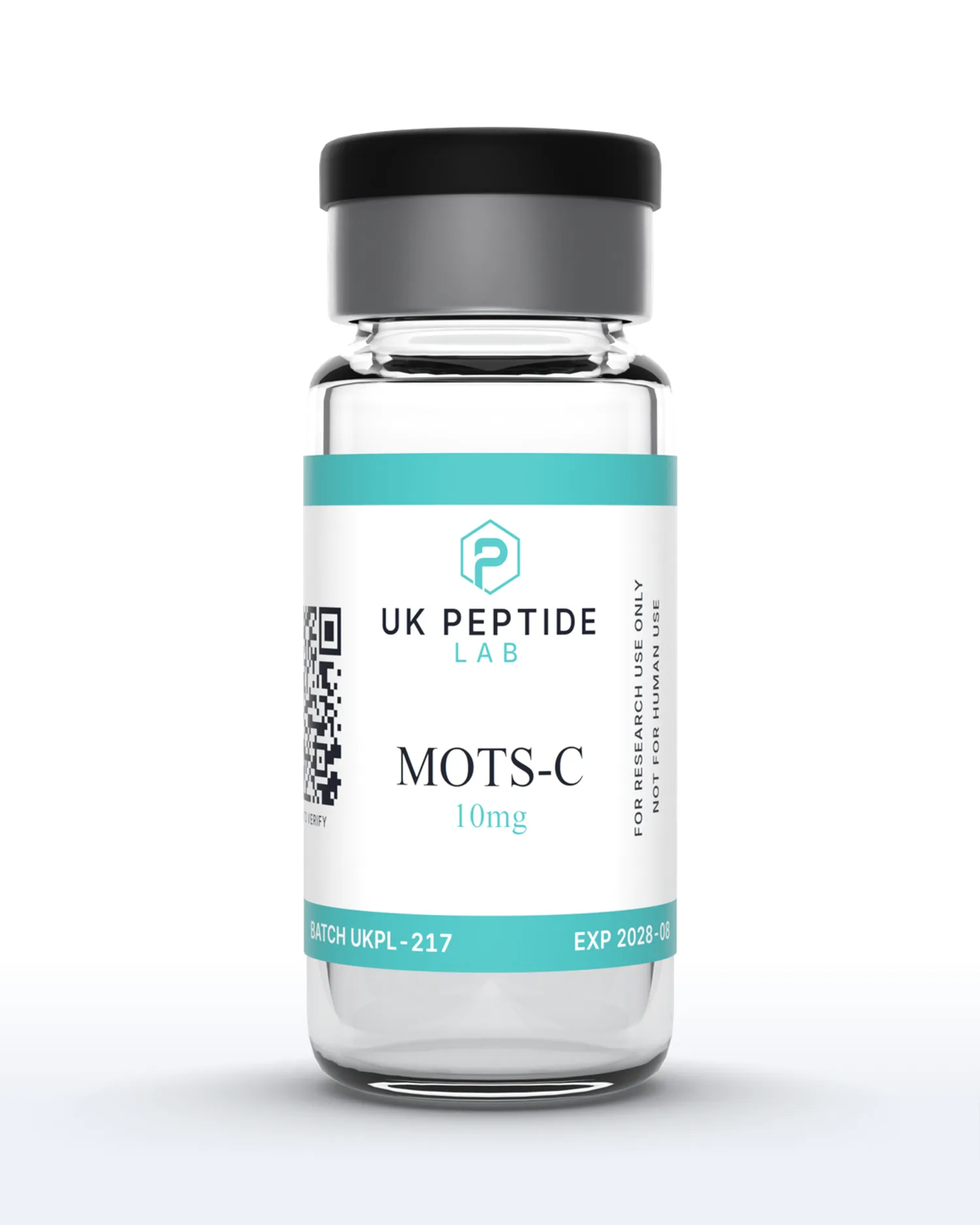
MOTS-C
10mg
MOTS-C is a 16 amino acid mitochondrial-derived peptide encoded within the mitochondrial 12S rRNA region. Research has studied its role in metabolic regulation, including AMPK pathway activation and effects on glucose and fatty acid metabolism. As one of the first characterised mitochondrial-derived peptides, it has become a reference compound in metabolic and mitochondrial research. Lyophilised powder, third-party tested.
Published research on MOTS-C is indexed on PubMed. See our full UK buyer's guide for MOTS-C.
Intended Use: Strictly for in-vitro laboratory research. Not for use in humans or animals. Not to be used in foods, drugs, or medical diagnostics. This product has not been evaluated by the MHRA or FDA. Buyer assumes full responsibility for safe handling and regulatory compliance.
98.46%
Purity
LAB
Certified
SAME
Day Ship
Quantity
Add £20.01 more for free UK delivery
Damaged or lost? Free reshipment guaranteed
Bacteriostatic Water 10ml
Required to reconstitute lyophilised peptides.
Research Use Only
This product is intended strictly for research and laboratory use only. Not for human consumption, medical use, or diagnostic purposes.
Certificate of Analysis
Third-party tested
Lyophilised Stability
24 months
Sealed at -20°C, light-protected
Reconstituted Stability
Up to 3 months
Stored at 2-8°C after mixing
Cold-Chain Shipping
Always
Dry-cold pack, Royal Mail Tracked 24
Important Notice
All compounds are sold individually and do not include research supplies. Products are provided in lyophilised (powder) form and require proper reconstitution before use in research settings.
Related Products

MOTS-C Price (UK)
MOTS-C is supplied in 2 vial sizes, priced from £24.99 for 10mg to £69.99 for 40mg. Every size ships from our UK facility with the same third-party HPLC certificate published on this page. UK delivery is £4.50 by Royal Mail Tracked 24, or free once your basket reaches £45 (£20.01 away at this price). Orders placed before 2pm on a working day are dispatched the same day.
| Vial | Price | Cost per mg | Availability |
|---|---|---|---|
| MOTS-C 10mgThis page | £24.99 | £2.50 | In stock |
| MOTS-C 40mg | £69.99 | £1.75Best value | In stock |
Prices are in GBP and shown per vial as supplied, lyophilised, for in-vitro laboratory research only. Cost per mg is given so researchers can compare vial sizes on a like-for-like basis. Stock and pricing on this table are read live from our inventory, so they match the basket. See our FAQ for delivery and payment options, and quality & testing for how each batch is verified.
Product Specifications
Research Overview
MOTS-C is a 16 amino acid mitochondrial derived peptide encoded by a short open reading frame within the 12S rRNA (MT-RNR1) region of mitochondrial DNA, with the sequence Met-Arg-Trp-Gln-Glu-Met-Gly-Tyr-Ile-Phe-Tyr-Pro-Arg-Lys-Leu-Arg (MRWQEMGYIFYPRKLR). The name abbreviates mitochondrial open reading frame of the twelve S rRNA type-c, and the compound appears in most primary literature as MOTS-c. It was characterised by Lee and colleagues in Cell Metabolism in 2015, which identified the coding sORF as a 51 base pair frame carrying a strong Kozak sequence and reported skeletal muscle as the apparent primary target tissue. At the time of that paper, humanin was the only other peptide whose short open reading frame had been mapped to the mitochondrial genome, making MOTS-C the second characterised member of the mitochondrial derived peptide (MDP) family and the first assigned a defined metabolic mechanism. Mechanistically, MOTS-C acts on the folate-methionine cycle and the de novo purine biosynthesis pathway tethered to it. Metabolomic and microarray profiling showed depletion of 5-methyltetrahydrofolate and methionine with a corresponding rise in homocysteine, blockade of de novo purine synthesis, and accumulation of endogenous AICAR (5-aminoimidazole-4-carboxamide ribonucleotide), an AMP mimetic that activates AMP-activated protein kinase (AMPK). MOTS-C therefore functions as a retrograde mitochondrial-to-nuclear signalling molecule rather than a classical cell-surface receptor ligand. Kim et al. (Cell Metabolism, 2018) demonstrated that under metabolic stress such as glucose restriction, MOTS-C translocates from its extranuclear pool into the nucleus, co-precipitates with NRF2, and binds antioxidant response element (ARE) sequences to regulate stress-adaptive nuclear gene expression. Reynolds et al. (Nature Communications, 2021) reported that endogenous MOTS-C expression rises in human skeletal muscle following exercise. For researchers, MOTS-C is the reference compound for mitokine biology, AMPK activation driven from upstream nucleotide metabolism, and mitochondrial-nuclear crosstalk. Supplied as lyophilised powder for research use only.
Product Specifications
Laboratory Handling
- Store lyophilised vials at -20°C, protected from light and moisture. Allow the vial to reach room temperature before opening so condensation does not settle on the powder.
- Reconstitute with bacteriostatic water, injecting slowly down the inner glass wall of the vial rather than directly onto the lyophilised cake. Swirl gently until fully dissolved, never shake or vortex.
- Handle under aseptic conditions. Swab the stopper of both the MOTS-C vial and the bacteriostatic water vial with alcohol before each needle entry, and use a fresh sterile syringe for every transfer.
- Store the reconstituted solution at 2-8°C and prepare single-use aliquots at -20°C for longer-term storage. Avoid repeated freeze-thaw cycles, which reduce peptide integrity.
- The MOTS-C sequence carries two methionine residues, a tryptophan and two tyrosines, all oxidation-sensitive side chains. Minimise headspace air exposure, protect from light, and do not leave dilute solutions standing at room temperature.
- The site reconstitution guide and reconstitution calculator cover the full aseptic workflow and dilution arithmetic for lyophilised research peptides.
Frequently Asked Questions
What is MOTS-C?
MOTS-C is a 16 amino acid mitochondrial derived peptide encoded by a short open reading frame within the 12S rRNA (MT-RNR1) region of mitochondrial DNA, sequence MRWQEMGYIFYPRKLR. The name abbreviates mitochondrial open reading frame of the twelve S rRNA type-c, and the literature generally writes it MOTS-c. Characterised by Lee and colleagues in Cell Metabolism in 2015, it was the second peptide whose short open reading frame was mapped to the mitochondrial genome after humanin, and the first assigned a defined metabolic mechanism. Supplied as lyophilised powder for in-vitro research use only.
MOTS-C vs Humanin and the Mitochondrial Derived Peptide Family
Mitochondrial derived peptides (MDPs) are encoded inside mitochondrial DNA rather than the nuclear genome, and are studied as retrograde signals carrying information outward from the mitochondrion. Humanin came first, a 24 residue peptide from the 16S rRNA region investigated mainly for cytoprotective and anti-apoptotic signalling. MOTS-C came second, from the 12S rRNA region, and is mechanistically distinct: it acts on the folate-methionine cycle and de novo purine biosynthesis, raising endogenous AICAR and thereby activating AMPK, and under metabolic stress it translocates into the nucleus and binds antioxidant response element sequences. The SHLP series (SHLP1 to SHLP6) followed from the 16S region. Researchers select MOTS-C when the endpoint is metabolic regulation, AMPK activation driven from upstream nucleotide metabolism, or mitochondrial-nuclear crosstalk; humanin when the endpoint is cytoprotection or apoptosis.
MOTS-C Research Applications
MOTS-C is studied in metabolic and mitochondrial research models covering AMPK signalling, folate-methionine cycle flux, de novo purine biosynthesis and AICAR accumulation, glucose and fatty acid metabolism, skeletal muscle bioenergetics, PGC-1α expression, and mitochondrial-to-nuclear retrograde signalling including NRF2 association and antioxidant response element binding. It also serves as the reference compound in the wider mitokine and mitochondrial derived peptide literature, and in analytical method development where a low molecular weight mtDNA-encoded peptide is needed as a standard.
Reconstitution Guide
Allow vials to reach room temperature, then sterilise the rubber stopper of both the peptide vial and the bacteriostatic water vial with an alcohol swab. Slowly draw your bacteriostatic water into a sterile insulin syringe, then inject it gently down the inner glass wall of the peptide vial, never directly onto the lyophilised powder. Once added, gently swirl the vial in a slow circular motion until fully dissolved. Never shake or vortex. The solution should be clear and colourless. Label the vial with the reconstitution date and store immediately.
See our full peptide reconstitution guide and reconstitution calculator for step-by-step protocol.
Storage Instructions
Lyophilised vials should be stored at -20°C, protected from light and moisture, and remain stable for up to 24 months. Once reconstituted with bacteriostatic water, store the solution at 2-8°C (standard refrigerator) and use within approximately 3 months. For storage beyond that, prepare single-use aliquots at -20°C, where reconstituted peptide remains stable for up to 6 months. Avoid repeated freeze-thaw cycles and always handle under sterile laboratory conditions.
Frequently Asked Questions
Research References
- The mitochondrial-derived peptide MOTS-c promotes metabolic homeostasis and reduces obesity and insulin resistance (Cell Metab, 2015)
- The mitochondrial-encoded peptide MOTS-c translocates to the nucleus to regulate nuclear gene expression in response to metabolic stress (Cell Metab, 2018)
- MOTS-c is an exercise-induced mitochondrial-encoded regulator of age-dependent physical decline and muscle homeostasis (Nat Commun, 2021)
Related Research Compounds
Research Guides
MOTS-C
10mg · £24.99