Metabolic Research
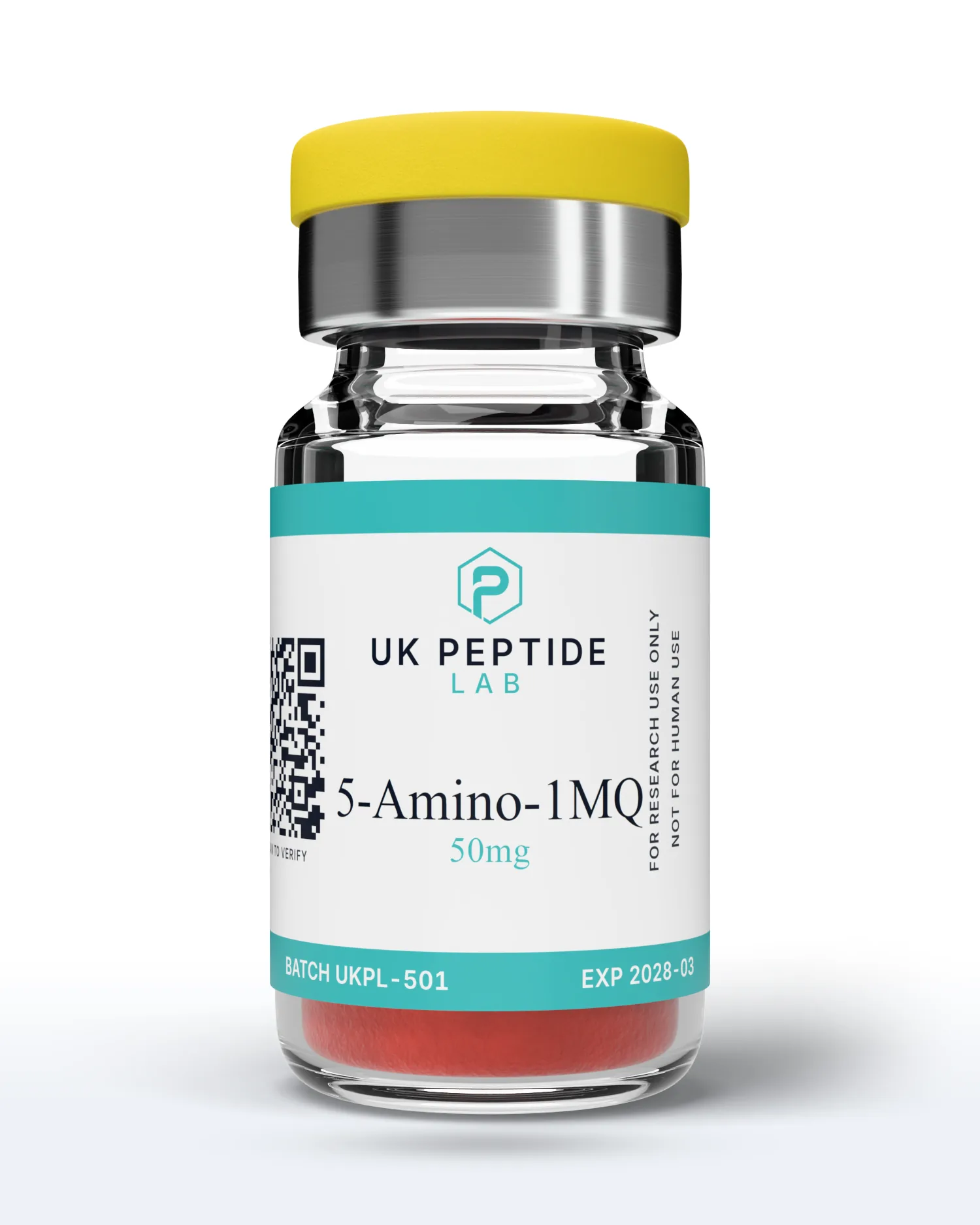
5-Amino-1MQ
50mg
NNMT inhibitor. NAD+ salvage and metabolic research.
98.75% purity · Third-party tested · Batch UKPL-501 · View certificate
- Same-day dispatch before 3pm, Mon to Fri
- Add £14.01 more for free UK delivery
- Cold-chain shipping. Always. Dry-cold pack, Royal Mail Tracked 24
- Lost, damaged or wrong? Replaced free if you tell us within 48 hours.
- Research use only. For in-vitro laboratory research. Not for use in humans or animals, or in food, drugs or diagnostics. Not evaluated by the MHRA or FDA. The buyer is responsible for handling and regulatory compliance.
Bulk Pricing
Counted across your basket, any mix of products.
| Vials in basket | Discount | Per vial |
|---|---|---|
| 1 | None | £54.99 |
| 3-4 | 5% | £52.24 |
| 5-9 | 8% | £50.59 |
| 10-50 | 12% | £48.39 |
Bacteriostatic Water 10ml
Required to reconstitute lyophilised peptides.
What is 5-Amino-1MQ?
5-Amino-1MQ (5-amino-1-methylquinolinium iodide) is a small-molecule inhibitor of nicotinamide N-methyltransferase (NNMT), not a peptide. It is supplied as a lyophilised powder in 10mg and 50mg vials.
Full description
The active species is the quaternary cation C₁₀H₁₁N₂⁺ (159.21 g/mol), supplied as the iodide salt. Its target, NNMT, is a cytosolic enzyme that methylates nicotinamide to 1-methylnicotinamide using S-adenosyl-L-methionine (SAM). 5-Amino-1MQ binds the nicotinamide substrate site. Neelakantan et al. (J Med Chem, 2017) screened several N-methylated scaffolds and found quinoliniums the most promising, with IC₅₀ values around 1 µM. The reported IC₅₀ for 5-Amino-1MQ is 1.2 µM.
5-Amino-1MQ Research Applications
- Enzyme assays: NNMT inhibition measured by 1-methylnicotinamide formation or S-adenosylhomocysteine release.
- Cell target engagement: in differentiated 3T3-L1 adipocytes, 5-Amino-1MQ lowered intracellular 1-methylnicotinamide with an EC₅₀ of about 2.3 µM (Neelakantan et al., 2018).
- Selectivity panels: no inhibition of DNMT1, and no calculable IC₅₀ against PRMT3 or COMT (Neelakantan et al., 2018).
- Rodent metabolism: in-vivo NNMT work in adipose tissue and liver follows antisense Nnmt knockdown in mice (Kraus et al., Nature, 2014).
Study details
Because it competes at the nicotinamide site, not the SAM cofactor site, 5-Amino-1MQ is also the substrate-competitive reference against which bisubstrate and covalent NNMT inhibitors are benchmarked.
5-Amino-1MQ vs NAD+ Precursors (NAD+, NMN, NR)
The two approach the same pathway from opposite ends. NAD+, NMN and nicotinamide riboside add material to the NAD+ salvage route. 5-Amino-1MQ removes a drain on it. By blocking NNMT, it stops nicotinamide being methylated to 1-methylnicotinamide and spares the SAM that reaction would spend. In cultured adipocytes, NNMT inhibitors lowered intracellular 1-methylnicotinamide and raised NAD+ and SAM (Neelakantan et al., Biochem Pharmacol, 2018). 5-Amino-1MQ did not inhibit NAMPT, an NAD+ salvage enzyme, at up to 100 µM.
The evidence differs too. The precursor literature includes human pharmacokinetic work, while every in-vivo 5-Amino-1MQ study is in rodents.
Research Overview
Kraus et al. (Nature, 2014) found Nnmt was the gene most strongly reciprocally regulated in white adipose tissue of mice with adipose-specific Glut4 knockout or overexpression. NNMT expression was raised in white adipose tissue and liver of obese and diabetic mice. NNMT inhibition raised adipose SAM and NAD+ and changed histone H3 lysine 4 methylation and polyamine flux. That work made NNMT a target for chemical probes.
Neelakantan et al. (Biochem Pharmacol, 2018) then addressed permeability. In a PAMPA assay, 1-methylquinolinium and 1-methylnicotinamide showed no passive permeability, while 5-Amino-1MQ was classed as highly permeable. In Caco-2 cells its efflux ratio was 1.33, so no efflux was detected. No NNMT inhibitor is approved anywhere.
Product Specifications
- Chemical Class
- Small-molecule quaternary quinolinium salt, not a peptide
- IUPAC Name
- 5-Amino-1-methylquinolin-1-ium iodide
- Molecular Formula
- C₁₀H₁₁IN₂ (iodide salt)
- Molecular Weight
- 286.11 g/mol
- Free Cation
- C₁₀H₁₁N₂⁺, 159.21 g/mol
- CAS Number
- 42464-96-0
- Molecular Target
- Nicotinamide N-methyltransferase (NNMT), reported IC₅₀ 1.2 ± 0.1 μM
- Purity
- 98.75% by HPLC
- Batch
- UKPL-501
- Storage
- -20°C dry, 2-8°C in solution, protect from light
- Appearance
- Red to orange-red lyophilised powder
- Form
- Lyophilised powder
Certificate of Analysis
Third-party tested
- Batch
- UKPL-501
- Purity
- 98.75%
- Specification
- ≥98.0%
- Method
- HPLC-UV/MS
- Tested
- Mar 2026
Need the certificate for an earlier batch? Request an older CoA
Storage and Reconstitution
Store the dry powder sealed at -20°C, away from light and moisture. Keep solutions at 2-8°C in amber or foil-wrapped vessels and freeze single-use aliquots for longer storage. Iodide salts are light-sensitive, so re-check identity if a stored solid or solution turns yellow.
Vials are sold on their own, without bacteriostatic water for mixing or other supplies.
How to reconstitute and handle
5-Amino-1MQ is a salt, not a peptide, so gentle handling is for sterility only. Let the vial reach room temperature, add bacteriostatic water or your assay buffer, and swirl or invert until fully dissolved. As a permanently charged cation it needs no organic cosolvent for aqueous work, though DMSO stocks are common in cell screens. Label the solution with its concentration and state whether it refers to the iodide salt (286.11 g/mol) or the free cation (159.21 g/mol).
- Apparent potency depends on the nicotinamide concentration in the assay, so report substrate and SAM concentrations alongside any IC₅₀.
- Handle under standard laboratory chemical hygiene and swab stoppers with alcohol before each needle entry.
For the full method, see the peptide reconstitution guide and the reconstitution calculator.
Research References
- Structure-Activity Relationship for Small Molecule Inhibitors of Nicotinamide N-Methyltransferase (Neelakantan et al., J Med Chem, 2017)
- Selective and membrane-permeable small molecule inhibitors of nicotinamide N-methyltransferase (Neelakantan et al., Biochem Pharmacol, 2018)
- Nicotinamide N-methyltransferase knockdown protects against diet-induced obesity (Kraus et al., Nature, 2014)
Published research on 5-Amino-1MQ is indexed on PubMed. See our full UK buyer's guide for 5-Amino-1MQ.
5-Amino-1MQ Price (UK)
5-Amino-1MQ is for sale in 2 vial sizes, priced from £29.99 for 10mg to £54.99 for 50mg. Every size ships from our UK facility, each with its own batch certificate. UK delivery is £4.50 by Royal Mail Tracked 24, free over £69.
| Vial | Price | Cost per mg | Availability |
|---|---|---|---|
| 5-Amino-1MQ 50mgThis page | £54.99 | £1.10Best value | In stock |
| 5-Amino-1MQ 10mg | £29.99 | £3.00 | In stock |
Prices are in GBP per vial and match the basket. See the FAQ for delivery and payment options, and quality & testing for how each batch is checked.
Frequently Asked Questions
Is 5-Amino-1MQ a peptide?
No. 5-Amino-1MQ has no amino acids and no peptide bonds, although it is sold alongside research peptides and searched as 5 amino 1mq peptide. It is the quaternary quinolinium salt 5-amino-1-methylquinolin-1-ium iodide, C₁₀H₁₁IN₂, 286.11 g/mol. Molar calculations, solubility and identity testing follow small-molecule conventions.
What does NNMT do, and why is it inhibited in research?
NNMT moves a methyl group from S-adenosyl-L-methionine onto nicotinamide, making 1-methylnicotinamide and S-adenosylhomocysteine. The reaction spends SAM, the cell's main methyl donor, and diverts nicotinamide away from NAD+ salvage. Kraus et al. (Nature, 2014) linked NNMT to adipose SAM, NAD+ and histone methylation in mice, which made it a research target.
How potent and how selective is 5-Amino-1MQ?
Its reported IC₅₀ against NNMT is 1.2 µM, in the low-micromolar range. Neelakantan et al. (Biochem Pharmacol, 2018) found no inhibition of DNMT1, no calculable IC₅₀ against PRMT3, COMT or SIRT1, and no NAMPT inhibition up to 100 µM. Because it competes at the nicotinamide site, apparent potency in any assay depends on the substrate concentration.
Why does 5-Amino-1MQ work in cells when 1-methylquinolinium does not?
Membrane permeability. In the PAMPA assay of Neelakantan et al. (Biochem Pharmacol, 2018), 1-methylquinolinium and 1-methylnicotinamide showed no passive permeability. 5-Amino-1MQ was highly permeable, showed no efflux in Caco-2 cells, and lowered intracellular 1-methylnicotinamide in 3T3-L1 adipocytes with an EC₅₀ near 2.3 µM.
Has 5-Amino-1MQ been studied in humans?
No. No human trial of 5-Amino-1MQ has been published, and no NNMT inhibitor holds a marketing authorisation anywhere. The in-vivo literature is rodent work, and the cell work is mostly cultured adipocytes. It is supplied strictly as a research chemical for in-vitro use.
Where can I buy 5 amino 1mq in the UK?
UK Peptide Lab sells 5-Amino-1MQ online in 10mg and 50mg vials, dispatched from the UK. The batch on this listing, UKPL-501, has a published third-party certificate. Orders placed before 3pm on a working day are dispatched the same day, with free UK delivery over £69.
How do I dissolve and store 5-Amino-1MQ 50mg?
Add bacteriostatic water or your assay buffer and swirl or invert until dissolved. The permanently charged cation needs no organic cosolvent for aqueous work. Store the dry solid at -20°C away from light and moisture, keep solutions at 2-8°C, and freeze single-use aliquots for longer storage.
Is 5 amino 1mq a peptide, and does that change how it is tested?
It is not a peptide, and yes, testing differs. Identity is checked against a small-molecule mass and HPLC retention, not a peptide sequence mass. The impurities to look for are synthetic by-products and residual solvent, not deletion sequences. Batch UKPL-501 measured 98.75% purity by HPLC, and its certificate describes a red lyophilised powder.
What is 5-Amino-1MQ used for in research?
It is a selective chemical probe for NNMT. Typical uses are enzyme inhibition assays, target-engagement studies in cultured adipocytes, methyltransferase selectivity panels and rodent NNMT studies. No human trials have been published.
Related Products