
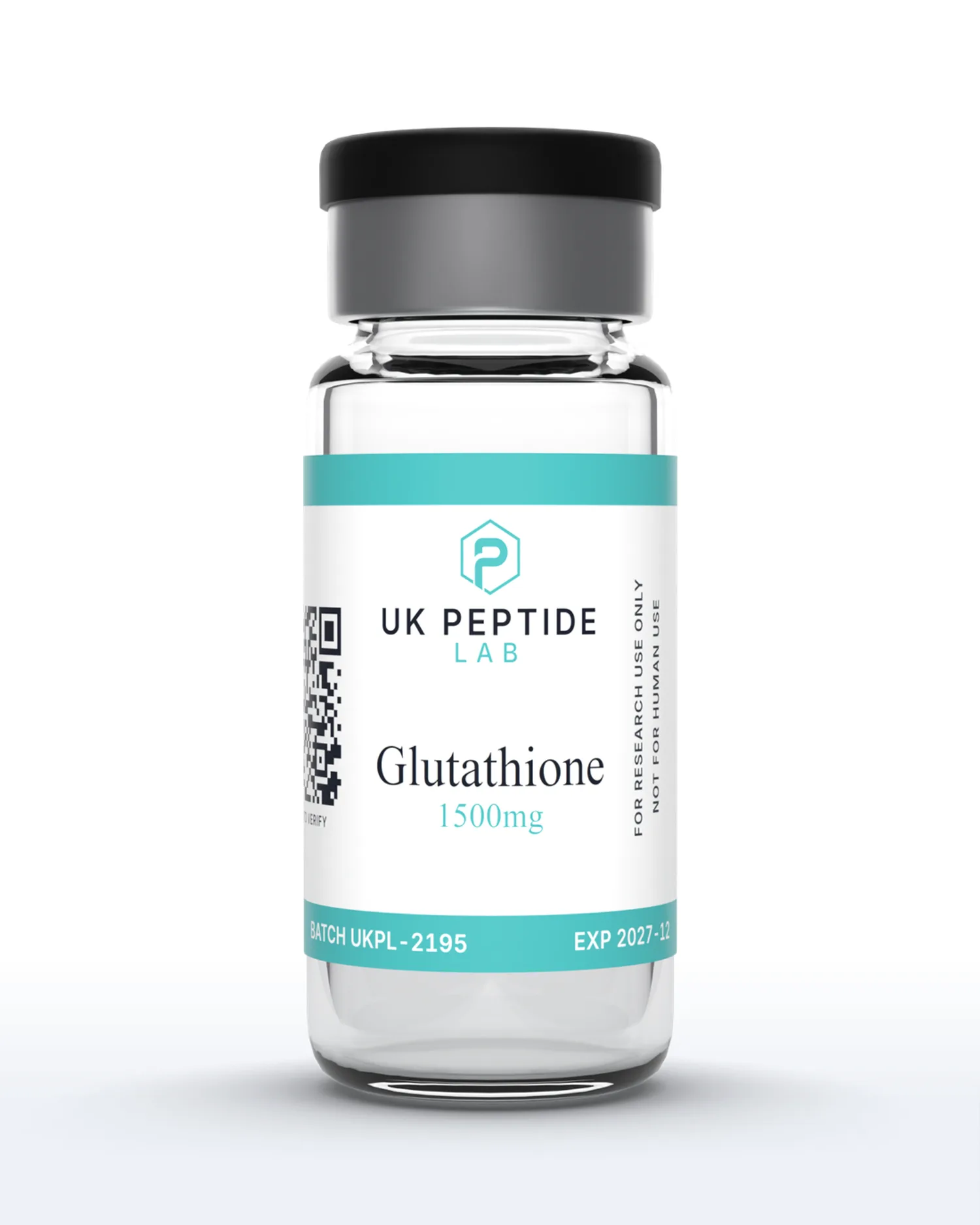
Glutathione
1500mg
Glutathione (GSH, γ-L-glutamyl-L-cysteinyl-glycine) is a tripeptide composed of glutamate, cysteine and glycine, and the most abundant non-protein thiol in mammalian cells. It is synthesised intracellularly via a two-step ATP-dependent pathway and is present at millimolar concentrations in most tissues, with highest levels in the liver. Research has investigated its central role as the principal endogenous antioxidant, an electrophile scavenger, and the substrate for glutathione peroxidase and glutathione S-transferase enzymes in oxidative stress, detoxification and phase II xenobiotic conjugation pathways. The reduced (GSH) to oxidised (GSSG) ratio is one of the most widely measured redox parameters in cell biology research. Supplied as lyophilised powder, 1500mg per vial, third-party tested with certificate of analysis published on this page.
Published research on Glutathione is indexed on PubMed. See our full UK buyer's guide for Glutathione.
Intended Use: Strictly for in-vitro laboratory research. Not for use in humans or animals. Not to be used in foods, drugs, or medical diagnostics. This product has not been evaluated by the MHRA or FDA. Buyer assumes full responsibility for safe handling and regulatory compliance.
99.119%
Purity
LAB
Certified
SAME
Day Ship
Quantity
Add £10.01 more for free UK delivery
Damaged or lost? Free reshipment guaranteed
Bacteriostatic Water 10ml
Required to reconstitute lyophilised peptides.
Research Use Only
This product is intended strictly for research and laboratory use only. Not for human consumption, medical use, or diagnostic purposes.
Certificate of Analysis
Third-party tested
Lyophilised Stability
24 months
Sealed at -20°C, light-protected
Reconstituted Stability
Up to 3 months
Stored at 2-8°C after mixing
Cold-Chain Shipping
Always
Dry-cold pack, Royal Mail Tracked 24
Important Notice
All compounds are sold individually and do not include research supplies. Products are provided in lyophilised (powder) form and require proper reconstitution before use in research settings.
Related Products
Glutathione Price (UK)
Glutathione 1500mg is £34.99 per vial, supplied from stock in the UK with a third-party HPLC certificate published on this page. UK delivery is £4.50 by Royal Mail Tracked 24, or free once your basket reaches £45 (£10.01 away at this price). Orders placed before 2pm on a working day are dispatched the same day.
| Vial | Price | Cost per mg | Availability |
|---|---|---|---|
| Glutathione 1500mgThis page | £34.99 | £0.023 | In stock |
Prices are in GBP and shown per vial as supplied, lyophilised, for in-vitro laboratory research only. Cost per mg is given so researchers can compare vial sizes on a like-for-like basis. Stock and pricing on this table are read live from our inventory, so they match the basket. See our FAQ for delivery and payment options, and quality & testing for how each batch is verified.
Product Specifications
Research Overview
Glutathione (gamma-L-glutamyl-L-cysteinyl-glycine; GSH) is the principal low-molecular-weight thiol antioxidant of mammalian cells, with the molecular formula C₁₀H₁₇N₃O₆S, a molecular weight of 307.32 g/mol and CAS number 70-18-8. It is a tripeptide in which cysteine is flanked by glutamate and glycine, and, unusually, glutamate is joined to cysteine through its gamma-carboxyl group rather than the alpha-carboxyl used in an ordinary peptide bond. That gamma-glutamyl linkage is functionally important: it makes GSH resistant to the peptidases that would otherwise degrade a normal tripeptide, so intracellular GSH is cleaved only by gamma-glutamyl transpeptidase on the extracellular face of the plasma membrane. Biosynthesis is a two-step, ATP-dependent pathway (Meister and Anderson, Annual Review of Biochemistry, 1983): glutamate-cysteine ligase condenses glutamate and cysteine to gamma-glutamylcysteine, and glutathione synthetase then adds glycine. Because the first enzyme is both feedback-inhibited by GSH and limited by cysteine supply, cysteine availability is the dominant control point for synthesis (Lu, Biochimica et Biophysica Acta, 2013). Glutathione functions as a cellular redox buffer: it cycles between the reduced thiol form (GSH) and the oxidised disulfide (GSSG) through NADPH-dependent glutathione reductase, and healthy cells maintain a GSH:GSSG ratio of roughly 100:1. It acts as a direct radical scavenger, as the obligate electron donor for the glutathione peroxidases that reduce hydrogen peroxide and lipid peroxides, and as a substrate for the glutathione S-transferases that conjugate electrophiles and xenobiotics for export (Forman, Zhang and Rinna, Molecular Aspects of Medicine, 2009). Sies (Free Radical Biology and Medicine, 1999) framed these combined roles as a general cellular defence system against oxidative challenge, and the same review literature documents a well-replicated decline in tissue GSH with age. For experimental work the key practical point is that reduced GSH is air-oxidisable: dissolved GSH dimerises to GSSG on exposure to oxygen, so any assay of the reduced form must protect the thiols, by acid precipitation, alkylation or a reducing environment, if the GSH:GSSG couple is the measurement of interest.
Product Specifications
Laboratory Handling
- Store lyophilised vials at -20°C, protected from light and moisture. Reconstituted solution should be kept at 2-8°C and used within 4 weeks.
- Reconstitute with bacteriostatic water, injecting the solvent slowly down the inner glass wall rather than onto the powder, then swirl gently until fully dissolved. Do not shake or vortex.
- Reduced glutathione (GSH) is air-oxidisable: in solution it dimerises to glutathione disulfide (GSSG) on exposure to oxygen, most rapidly at neutral to alkaline pH. Keep dissolved GSH cold, minimise headspace and, where the GSH:GSSG ratio matters, prepare solutions fresh or work under inert atmosphere.
- GSH absorbs only weakly in the near-UV, so quantitative work normally relies on thiol derivatisation (for example DTNB, Ellman's reagent) or on HPLC with fluorescence detection, with acid precipitation used to preserve the reduced form before measurement.
Frequently Asked Questions
What is Glutathione?
Glutathione (GSH) is a tripeptide, gamma-L-glutamyl-L-cysteinyl-glycine, and the most abundant low-molecular-weight thiol antioxidant in mammalian cells. Its three residues are glutamate, cysteine and glycine, and the glutamate is attached through its gamma-carboxyl group, an unusual linkage that protects the molecule from ordinary peptidases. GSH is synthesised in the cytoplasm by two ATP-dependent enzymes, glutamate-cysteine ligase and glutathione synthetase, with cysteine availability as the rate-limiting step. It cycles between the reduced thiol (GSH) and the oxidised disulfide (GSSG) via NADPH-dependent glutathione reductase, and this couple is the principal redox buffer of the cell.
Reduced glutathione (GSH) vs oxidised glutathione (GSSG)
GSH is the reduced, sulfhydryl-bearing form and GSSG is the oxidised disulfide produced when two GSH molecules are coupled through their cysteine sulfur. They are not different compounds so much as two sides of the same redox couple, interconverted by glutathione reductase at the expense of NADPH. In healthy cells the reduced form predominates by roughly 100:1, and the GSH:GSSG ratio is a standard readout of redox status. Practically, the reduced form is air-oxidisable and must be protected from oxygen during handling and assay, while GSSG is the more stable species and absorbs more strongly in the UV.
Glutathione Research Applications
Glutathione is used across redox biology and toxicology. Typical applications include oxidative-stress challenge models where GSH depletion is the readout, glutathione peroxidase and glutathione reductase activity assays, glutathione S-transferase conjugation studies with model electrophiles, measurements of the GSH:GSSG ratio as an index of cellular redox state, and studies of protein S-glutathionylation as a post-translational modification. Because the reduced form is labile in solution, assays routinely derivatise the free thiol (for example with DTNB) or use HPLC with fluorescence detection after acid precipitation to preserve GSH.
Reconstitution Guide
Allow the vial to reach room temperature, then sterilise the rubber stopper with an alcohol swab. Draw the chosen volume of bacteriostatic water into a sterile syringe and inject it slowly down the inner glass wall, never directly onto the powder. Swirl gently until the powder fully dissolves; do not shake or vortex. Reduced glutathione is air-sensitive in solution, so reconstitute only what is needed, minimise headspace, and use the solution promptly.
See our full peptide reconstitution guide and reconstitution calculator for step-by-step protocol.
Storage Instructions
Store lyophilised vials at -20°C, protected from light and moisture. Once reconstituted with bacteriostatic water, store at 2-8°C and use within approximately 4 weeks. Reduced glutathione oxidises to GSSG in solution on exposure to air, so keep dissolved GSH cold, minimise air contact and, for work where the GSH:GSSG ratio matters, prepare fresh solutions or aliquot and freeze immediately. Avoid repeated freeze-thaw cycles.
Frequently Asked Questions
Research References
- Glutathione (Meister and Anderson, Annu Rev Biochem, 1983)
- Glutathione: overview of its protective roles, measurement and biosynthesis (Forman et al., Mol Aspects Med, 2009)
- Glutathione and its role in cellular functions (Sies, Free Radic Biol Med, 1999)
- Glutathione synthesis (Lu, Biochim Biophys Acta, 2013)
Related Research Compounds
Research Guides
Glutathione
1500mg · £34.99