
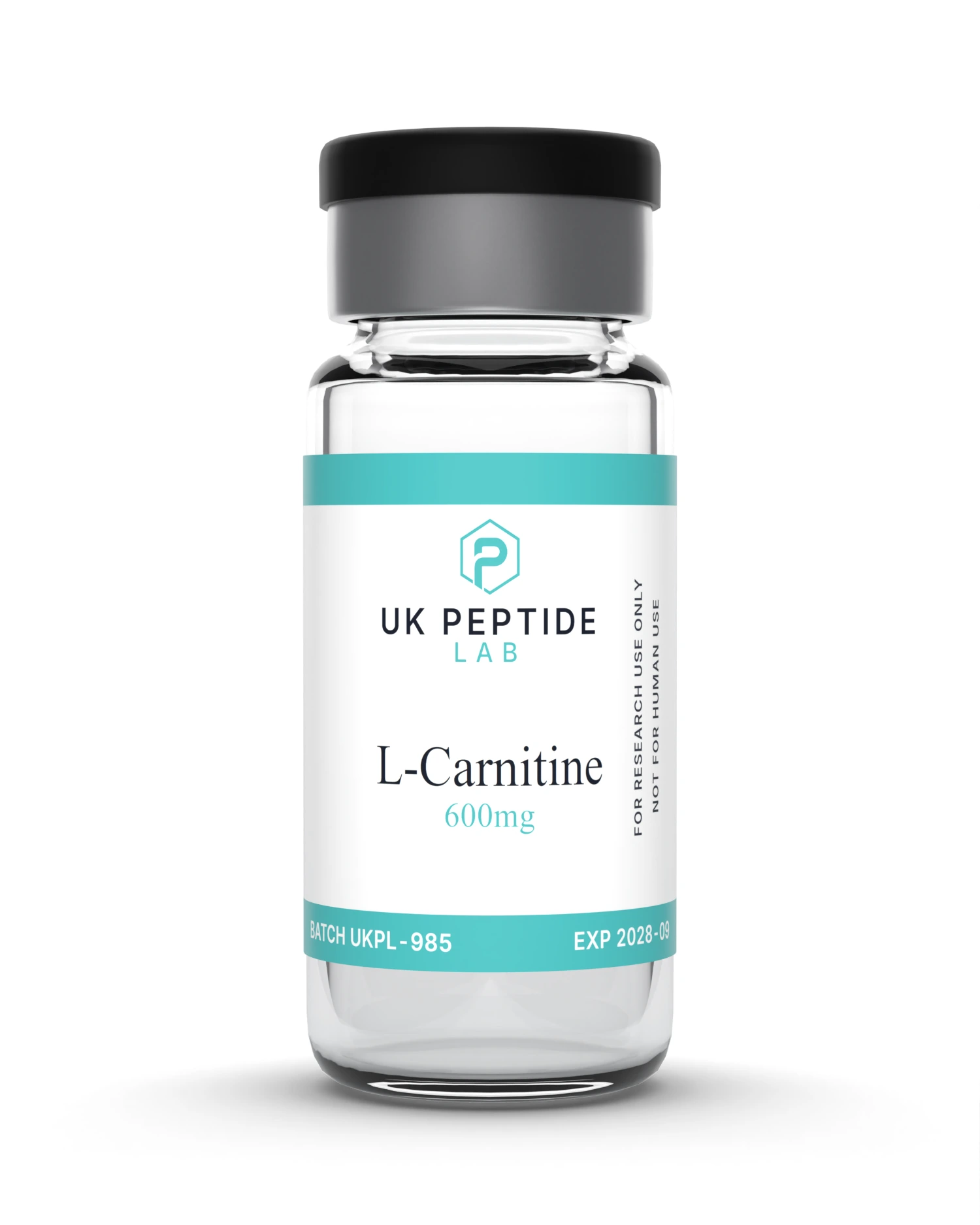
L-Carnitine
600mg
L-Carnitine is a quaternary ammonium compound derived from the amino acids lysine and methionine, biosynthesised in the liver and kidneys. Research has investigated its role in fatty acid transport across the inner mitochondrial membrane via the carnitine shuttle, as well as effects on mitochondrial bioenergetics and oxidative metabolism. Supplied as powder for research use only.
Published research on L-Carnitine is indexed on PubMed.
Intended Use: Strictly for in-vitro laboratory research. Not for use in humans or animals. Not to be used in foods, drugs, or medical diagnostics. This product has not been evaluated by the MHRA or FDA. Buyer assumes full responsibility for safe handling and regulatory compliance.
≥98%
Purity
—
No CoA
SAME
Day Ship
Quantity
Add £15.01 more for free UK delivery
Damaged or lost? Free reshipment guaranteed
Bacteriostatic Water 10ml
Required to reconstitute lyophilised peptides.
Research Use Only
This product is intended strictly for research and laboratory use only. Not for human consumption, medical use, or diagnostic purposes.
Certificate of Analysis
Third-party tested
Lyophilised Stability
24 months
Sealed at -20°C, light-protected
Reconstituted Stability
Up to 3 months
Stored at 2-8°C after mixing
Cold-Chain Shipping
Always
Dry-cold pack, Royal Mail Tracked 24
Important Notice
All compounds are sold individually and do not include research supplies. Products are provided in lyophilised (powder) form and require proper reconstitution before use in research settings.
Related Products
L-Carnitine Price (UK)
L-Carnitine 600mg is £29.99 per vial, supplied from stock in the UK with a third-party HPLC certificate published on this page. UK delivery is £4.50 by Royal Mail Tracked 24, or free once your basket reaches £45 (£15.01 away at this price). Orders placed before 2pm on a working day are dispatched the same day.
| Vial | Price | Cost per mg | Availability |
|---|---|---|---|
| L-Carnitine 600mgThis page | £29.99 | £0.050 | In stock |
Prices are in GBP and shown per vial as supplied, lyophilised, for in-vitro laboratory research only. Cost per mg is given so researchers can compare vial sizes on a like-for-like basis. Stock and pricing on this table are read live from our inventory, so they match the basket. See our FAQ for delivery and payment options, and quality & testing for how each batch is verified.
Product Specifications
Research Overview
L-Carnitine is a quaternary ammonium compound, (R)-3-hydroxy-4-(trimethylazaniumyl)butanoate, with a molecular weight of 161.20 g/mol. Unlike the other compounds in this catalogue it is not a peptide. It is endogenously biosynthesised in the liver and kidneys from lysine and methionine through a four-step pathway proceeding via trimethyllysine and gamma-butyrobetaine, the final hydroxylation being catalysed by gamma-butyrobetaine dioxygenase.
Its central role in metabolic research is as the obligate carrier in the carnitine shuttle, the mechanism by which long-chain fatty acids cross the inner mitochondrial membrane. Long-chain acyl-CoA cannot pass that membrane directly. Carnitine palmitoyltransferase 1, sitting on the outer mitochondrial membrane, transfers the acyl group onto carnitine to form acylcarnitine; carnitine-acylcarnitine translocase moves it across the inner membrane; carnitine palmitoyltransferase 2 regenerates acyl-CoA on the matrix side, where beta-oxidation proceeds. CPT1 is the rate-limiting step of the entire pathway and is allosterically inhibited by malonyl-CoA, which is what couples fatty acid oxidation to fatty acid synthesis.
Cellular uptake depends on OCTN2, the sodium-dependent transporter encoded by SLC22A5. Loss-of-function mutations in that gene cause primary systemic carnitine deficiency, and that genetic model is a large part of why the carnitine shuttle is as well characterised as it is. A second research literature concerns the microbial metabolism of dietary carnitine rather than carnitine itself: Koeth and colleagues (Nat Med, 2013) reported that gut microbiota convert carnitine to trimethylamine, which is oxidised hepatically to trimethylamine-N-oxide, and examined the association of that metabolite with atherosclerosis in animal models. It is noted here because it is a genuine part of the compound's research picture rather than a footnote to it.
Supplied as powder for in-vitro laboratory research only. L-Carnitine is not a licensed medicine in the UK in this presentation and is not supplied for human consumption, veterinary use, or any therapeutic purpose.
Product Specifications
Laboratory Handling
- L-Carnitine is markedly hygroscopic. Keep the container sealed and allow it to reach room temperature before opening, or condensation will form on the cold powder and it will cake.
- Freely soluble in water, so bacteriostatic water reconstitutes it readily. Add slowly and swirl rather than shaking.
- Store the sealed container cool, dry and away from light. This is not a lyophilised peptide and does not require -20°C storage as supplied.
- Weigh under low-humidity conditions where possible and record the mass promptly, since atmospheric moisture uptake will bias gravimetric measurement.
Frequently Asked Questions
What is L-Carnitine?
L-Carnitine is a quaternary ammonium compound, chemical name (R)-3-hydroxy-4-(trimethylazaniumyl)butanoate, molecular formula C₇H₁₅NO₃, molecular weight 161.2 g/mol, CAS 541-15-1. It is not a peptide: it is a small zwitterionic metabolite biosynthesised in the liver and kidneys from lysine and methionine, and its biology is among the best characterised of any compound in this catalogue. Its established role is fatty-acid transport into mitochondria via the carnitine shuttle: carnitine palmitoyltransferase I conjugates long-chain acyl groups to carnitine at the outer mitochondrial membrane, carnitine-acylcarnitine translocase carries the acylcarnitine across the inner membrane, and carnitine palmitoyltransferase II releases the acyl-CoA for beta-oxidation in the matrix. That shuttle is the rate-limiting entry step for long-chain fatty-acid oxidation. Supplied as powder for in-vitro research use only.
L-Carnitine Research Applications
L-Carnitine is used as a defined substrate and pathway probe in mitochondrial bioenergetics research: carnitine palmitoyltransferase activity assays, acylcarnitine profiling by tandem mass spectrometry, fatty-acid oxidation flux measurement in cell and isolated-mitochondria preparations, and models of carnitine shuttle deficiency. It also appears in oxidative metabolism and skeletal muscle energetics work, and as a reference standard in the analytical methods that underpin newborn screening for fatty-acid oxidation disorders. It is supplied here for laboratory research only, and no claim is made about supplementation in humans.
Reconstitution Guide
L-Carnitine is a small, highly water-soluble zwitterion rather than a peptide, so the peptide handling rules about shear exist here for aseptic reasons only. Allow the vial to reach room temperature, sterilise the stopper of both the compound vial and the bacteriostatic water vial with an alcohol swab, then add the bacteriostatic water down the inner glass wall and swirl or invert until fully dissolved, which is rapid at bench concentrations. The solution should be clear and colourless. The compound is hygroscopic in solid form, so keep stopper-open time short and reseal promptly. Label the vial with the preparation date and concentration and refrigerate.
See our full peptide reconstitution guide and reconstitution calculator for step-by-step protocol.
Storage Instructions
Store the dry powder sealed at room temperature or below, protected from moisture, which is the main threat to a hygroscopic solid; refrigeration of the unopened vial is acceptable but condensation on opening a cold vial should be avoided. Once in solution, store at 2-8°C and use within approximately 4 weeks, or prepare single-use aliquots at -20°C for longer storage. There is no secondary structure to lose and no oxidation-prone thiol or thioether, so stability handling is simpler than for the peptides in this catalogue; standard aseptic technique governs the useful life of the solution.
Frequently Asked Questions
Related Research Compounds
L-Carnitine
600mg · £29.99