
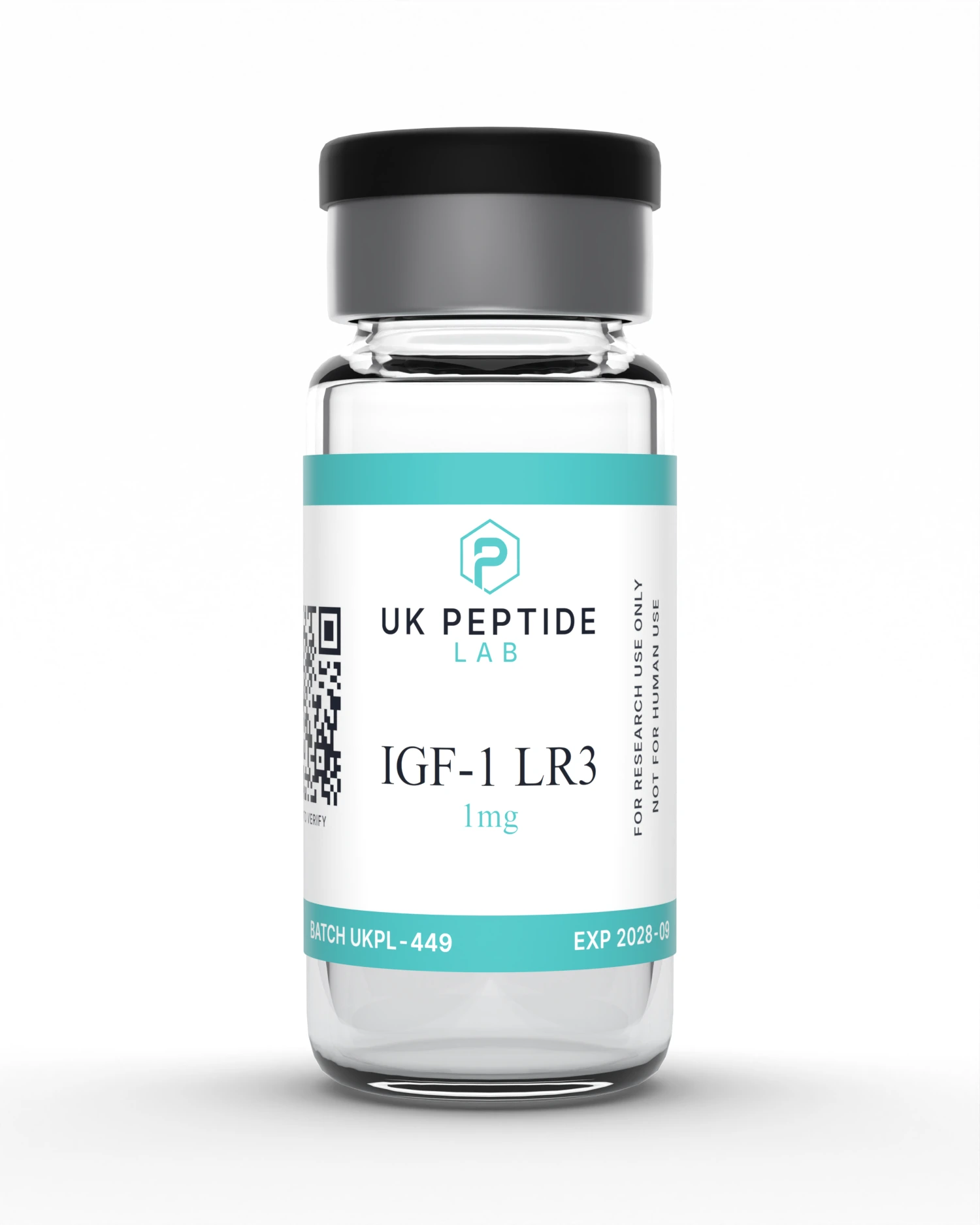
IGF-1 LR3
1mg
IGF-1 LR3 (Long Arg3) is an 83 amino acid analogue of recombinant human insulin-like growth factor 1, modified with an N-terminal extension and an arginine-for-glutamic-acid substitution at position 3. The modifications reduce binding to IGF binding proteins, extending its biological half-life relative to native IGF-1. Research has examined its role in cell growth signalling and IGF-1 receptor activation. Lyophilised powder, third-party tested.
Published research on IGF-1 LR3 is indexed on PubMed. See our full UK buyer's guide for IGF-1 LR3.
Intended Use: Strictly for in-vitro laboratory research. Not for use in humans or animals. Not to be used in foods, drugs, or medical diagnostics. This product has not been evaluated by the MHRA or FDA. Buyer assumes full responsibility for safe handling and regulatory compliance.
98.134%
Purity
LAB
Certified
SAME
Day Ship
Quantity
Qualifies for free UK delivery · Royal Mail Tracked 24
Damaged or lost? Free reshipment guaranteed
Bacteriostatic Water 10ml
Required to reconstitute lyophilised peptides.
Research Use Only
This product is intended strictly for research and laboratory use only. Not for human consumption, medical use, or diagnostic purposes.
Certificate of Analysis
Third-party tested
Lyophilised Stability
24 months
Sealed at -20°C, light-protected
Reconstituted Stability
Up to 3 months
Stored at 2-8°C after mixing
Cold-Chain Shipping
Always
Dry-cold pack, Royal Mail Tracked 24
Important Notice
All compounds are sold individually and do not include research supplies. Products are provided in lyophilised (powder) form and require proper reconstitution before use in research settings.
Related Products
IGF-1 LR3 Price (UK)
IGF-1 LR3 1mg is £49.99 per vial, supplied from stock in the UK with a third-party HPLC certificate published on this page. This vial clears the £45 threshold on its own, so UK Royal Mail Tracked 24 delivery is free. Orders placed before 2pm on a working day are dispatched the same day.
| Vial | Price | Cost per mg | Availability |
|---|---|---|---|
| IGF-1 LR3 1mgThis page | £49.99 | £49.99 | In stock |
Prices are in GBP and shown per vial as supplied, lyophilised, for in-vitro laboratory research only. Cost per mg is given so researchers can compare vial sizes on a like-for-like basis. Stock and pricing on this table are read live from our inventory, so they match the basket. See our FAQ for delivery and payment options, and quality & testing for how each batch is verified.
Product Specifications
Research Overview
IGF-1 LR3, written in the primary literature as Long-[Arg3]-IGF-I or LR3IGF-I, is an 83 residue recombinant analogue of human insulin-like growth factor 1. It differs from the native 70 residue growth factor in two respects: glutamate at position 3 is replaced by arginine, and a hydrophobic 13 residue extension (MFPAMPLLSLFVN) is fused to the N-terminus. The analogue was characterised by Francis and colleagues in the Journal of Molecular Endocrinology in 1992. The extension is not a rationally designed pharmacophore, it is a residual fragment of the methionyl porcine growth hormone fusion partner used to express the protein in Escherichia coli, characterised in a companion paper in the same journal and year. Both modifications sit in the region that IGF binding proteins recognise, and the functional consequence is a large loss of IGFBP affinity while type 1 IGF receptor binding is largely preserved. Ballard and colleagues (Growth Regulation, 1993) reported that native IGF-I binds IGFBP-3 with approximately one thousand times the affinity of LR3IGF-I. Since the great majority of circulating IGF-I is normally sequestered in IGFBP complexes, an analogue that escapes that buffering behaves very differently in any system containing binding proteins, and that is the reason the IGF 1 LR3 variant exists as a reagent at all. The three disulfide bridges of the IGF-I core are retained, which is why the molecular formula carries nine sulfur atoms, six from cysteine and three from methionine. The best established application of this IGF 1 peptide is industrial rather than physiological: LONG R3 IGF-I is a standard growth factor supplement in serum-free CHO and HEK293 culture, where Morris and Schmid (Biotechnology Progress, 2000) compared it directly against insulin. Published in-vivo work is confined to rodent, pig and non-human primate models. There are no published human clinical trials of IGF-1 LR3, and it holds no marketing authorisation in any jurisdiction. Supplied as lyophilised powder for in-vitro research use only.
Product Specifications
Laboratory Handling
- Store lyophilised vials at -20°C, sealed and protected from light and moisture. Allow the vial to reach room temperature before opening so condensation does not settle on the cake.
- Reconstitute with bacteriostatic water or sterile water for injection, injecting slowly down the inner glass wall rather than directly onto the lyophilised powder. Swirl gently until dissolved. Never shake or vortex.
- Treat this as a folded protein, not a short synthetic peptide. At roughly 9.1 kDa with three disulfide bridges, IGF-1 LR3 is vulnerable to shear and to air-liquid interface denaturation, which is why agitation is the single most common cause of a cloudy or aggregated preparation.
- Expect surface adsorption losses at low concentration. Dilute working solutions of an 83 residue growth factor lose measurable material to untreated polypropylene and glass, so use low-binding labware and prepare dilutions immediately before use rather than storing them.
- The sequence carries three methionine residues, two of them in the N-terminal extension, all oxidation-sensitive. Minimise headspace air, protect from light, and do not leave dilute solutions standing at room temperature.
- Store the reconstituted solution at 2-8°C and prepare single-use aliquots at -20°C for longer holding. Avoid repeated freeze-thaw cycles, which promote aggregation in disulfide-bonded proteins.
- Handle under aseptic conditions, swabbing the stopper of both vials with alcohol before each needle entry. The site reconstitution guide and reconstitution calculator cover the full aseptic workflow and dilution arithmetic.
Frequently Asked Questions
What is IGF-1 LR3?
IGF-1 LR3 is an 83 residue recombinant analogue of human insulin-like growth factor 1, written in the literature as Long-[Arg3]-IGF-I or LR3IGF-I. It differs from the native 70 residue growth factor by an arginine-for-glutamate substitution at position 3 and a hydrophobic 13 residue N-terminal extension, MFPAMPLLSLFVN, which is itself a residual fragment of the methionyl porcine growth hormone fusion partner used to express the protein in Escherichia coli. Both changes sit in the region that IGF binding proteins recognise, so the analogue binds IGFBPs far more weakly than IGF-I while retaining high affinity at the type 1 IGF receptor. Characterised by Francis and colleagues in the Journal of Molecular Endocrinology in 1992. Supplied as lyophilised powder for in-vitro research use only.
IGF-1 LR3 vs Native IGF-1 and the IGF Binding Protein Problem
Native IGF-I does not circulate free. The great majority of it is held in complexes with IGF binding proteins, principally IGFBP-3, which act as a reservoir and a brake on receptor access. That makes native IGF-I awkward as an experimental tool, because in any system containing serum or secreted IGFBPs the concentration a researcher adds is not the concentration the receptor sees. IGF-1 LR3 was engineered to remove that variable. Ballard and colleagues (Growth Regulation, 1993) reported that IGF-I binds IGFBP-3 with roughly one thousand times the affinity of LR3IGF-I, and Wilson and colleagues (2000) found that, unlike IGF-I, the Long R3 variant did not raise serum IGFBP-3 in adolescent monkeys. The trade-off is that the analogue is a poor model of native IGF-I physiology precisely because it bypasses the buffering system that governs it. Researchers select IGF-1 LR3 when the question is receptor pharmacology or serum-free culture performance, and native IGF-I when the question is how the binding protein axis itself behaves.
IGF-1 LR3 Research Applications
The most established application of IGF-1 LR3 is as a growth factor supplement in serum-free mammalian cell culture, where Morris and Schmid (Biotechnology Progress, 2000) compared LongR3 against insulin in CHO lines expressing recombinant proteins, and where it is widely used as an insulin replacement at much lower concentrations. As a research reagent it is used to probe type 1 IGF receptor activation, downstream PI3K and MAPK signalling, IGF binding protein biology, and the specific question of how much native IGF-I behaviour reflects IGFBP sequestration rather than receptor pharmacology. Published in-vivo work is confined to rodent, pig and non-human primate models, including intestinal growth studies in rats and comparative hypoglycaemic potency work in pigs and marmosets. There are no human clinical trials of IGF-1 LR3.
Reconstitution Guide
Allow vials to reach room temperature, then sterilise the rubber stopper of both the peptide vial and the bacteriostatic water vial with an alcohol swab. Slowly draw your bacteriostatic water into a sterile insulin syringe, then inject it gently down the inner glass wall of the peptide vial, never directly onto the lyophilised powder. Once added, gently swirl the vial in a slow circular motion until fully dissolved. Never shake or vortex. The solution should be clear and colourless. Label the vial with the reconstitution date and store immediately. Because IGF-1 LR3 is a folded protein of roughly 9.1 kDa carrying three disulfide bridges rather than a short synthetic peptide, agitation is the main practical hazard: shear and air-liquid interface exposure drive aggregation, so swirl only and never shake. Expect adsorption losses in dilute working solutions and use low-binding labware.
See our full peptide reconstitution guide and reconstitution calculator for step-by-step protocol.
Storage Instructions
Lyophilised vials should be stored at -20°C, protected from light and moisture, and remain stable for up to 24 months. Once reconstituted with bacteriostatic water, store the solution at 2-8°C (standard refrigerator) and use within approximately 3 months. For storage beyond that, prepare single-use aliquots at -20°C, where reconstituted peptide remains stable for up to 6 months. Avoid repeated freeze-thaw cycles and always handle under sterile laboratory conditions. Note additionally that the three methionine residues in the sequence, two of them in the N-terminal extension, make dilute standing solution vulnerable to oxidation, and that freeze-thaw cycling promotes aggregation in disulfide-bonded proteins more readily than in short peptides. Prepare single-use aliquots.
Frequently Asked Questions
Research References
- Novel recombinant fusion protein analogues of insulin-like growth factor (IGF)-I indicate the relative importance of IGF-binding protein and receptor binding for enhanced biological potency (J Mol Endocrinol, 1992)
- Effects of interactions between IGFBPs and IGFs on the plasma clearance and in vivo biological activities of IGFs and IGF analogs (Growth Regul, 1993)
- Effects of insulin and LongR3 on serum-free Chinese hamster ovary cell cultures expressing two recombinant proteins (Biotechnol Prog, 2000)
IGF-1 LR3
1mg · £49.99