
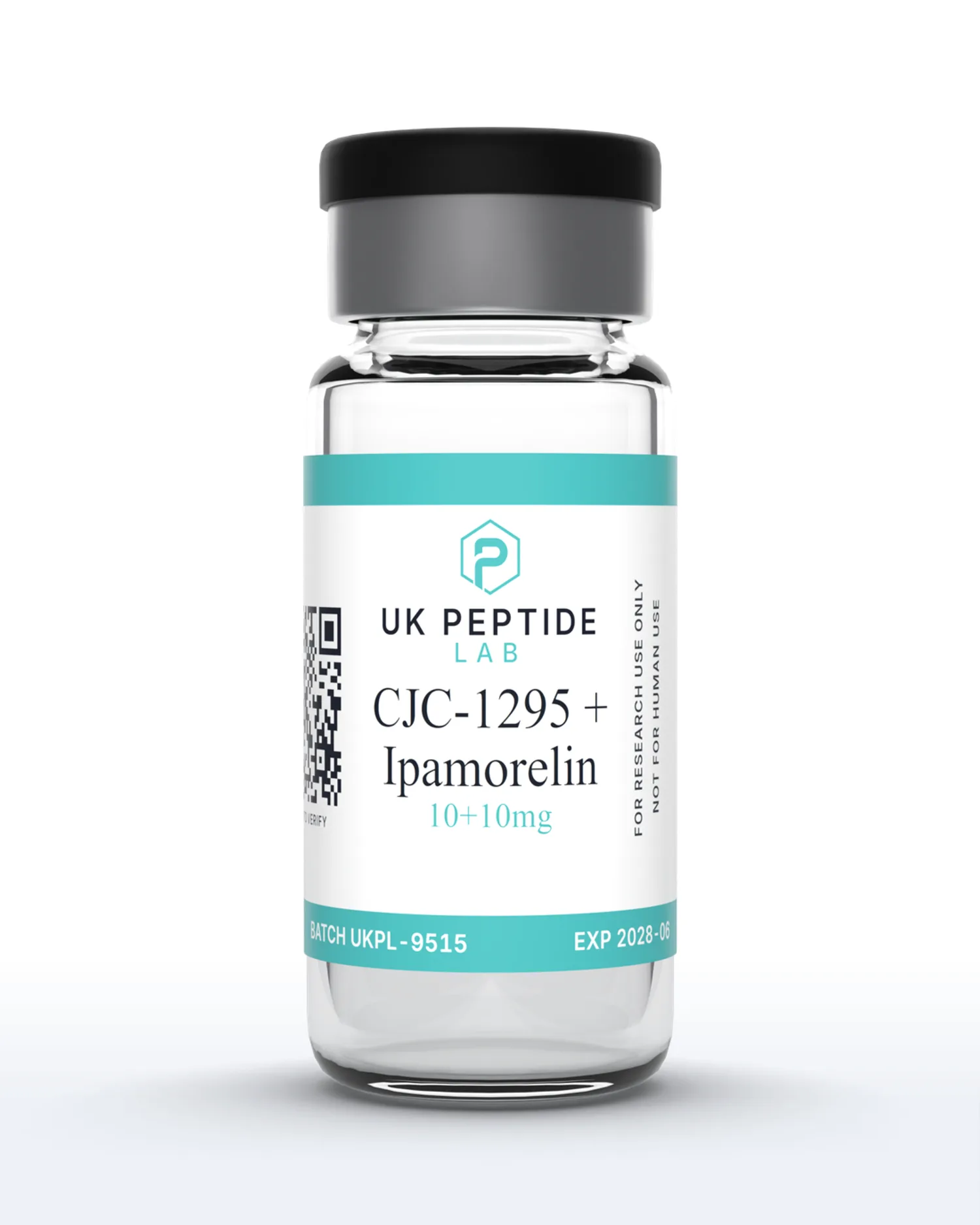
CJC-1295 + Ipamorelin
10+10mg
This blend pairs CJC-1295, a modified GHRH(1-29) analogue, with ipamorelin (Aib-His-D-2-Nal-D-Phe-Lys-NH2), a selective ghrelin-receptor agonist, in a 10+10mg presentation. The two classes are frequently co-studied for their complementary signalling at the GHRH and ghrelin receptors. Supplied as lyophilised powder, supplier-tested, with the certificate published on this page and independent third-party verification pending.
Published research on CJC-1295 + Ipamorelin is indexed on PubMed.
Intended Use: Strictly for in-vitro laboratory research. Not for use in humans or animals. Not to be used in foods, drugs, or medical diagnostics. This product has not been evaluated by the MHRA or FDA. Buyer assumes full responsibility for safe handling and regulatory compliance.
TBC
Purity
LAB
Certified
SAME
Day Ship
Quantity
Qualifies for free UK delivery · Royal Mail Tracked 24
Damaged or lost? Free reshipment guaranteed
Bacteriostatic Water 10ml
Required to reconstitute lyophilised peptides.
Research Use Only
This product is intended strictly for research and laboratory use only. Not for human consumption, medical use, or diagnostic purposes.
Certificate of Analysis
Third-party tested
Lyophilised Stability
24 months
Sealed at -20°C, light-protected
Reconstituted Stability
Up to 3 months
Stored at 2-8°C after mixing
Cold-Chain Shipping
Always
Dry-cold pack, Royal Mail Tracked 24
Important Notice
All compounds are sold individually and do not include research supplies. Products are provided in lyophilised (powder) form and require proper reconstitution before use in research settings.
Related Products
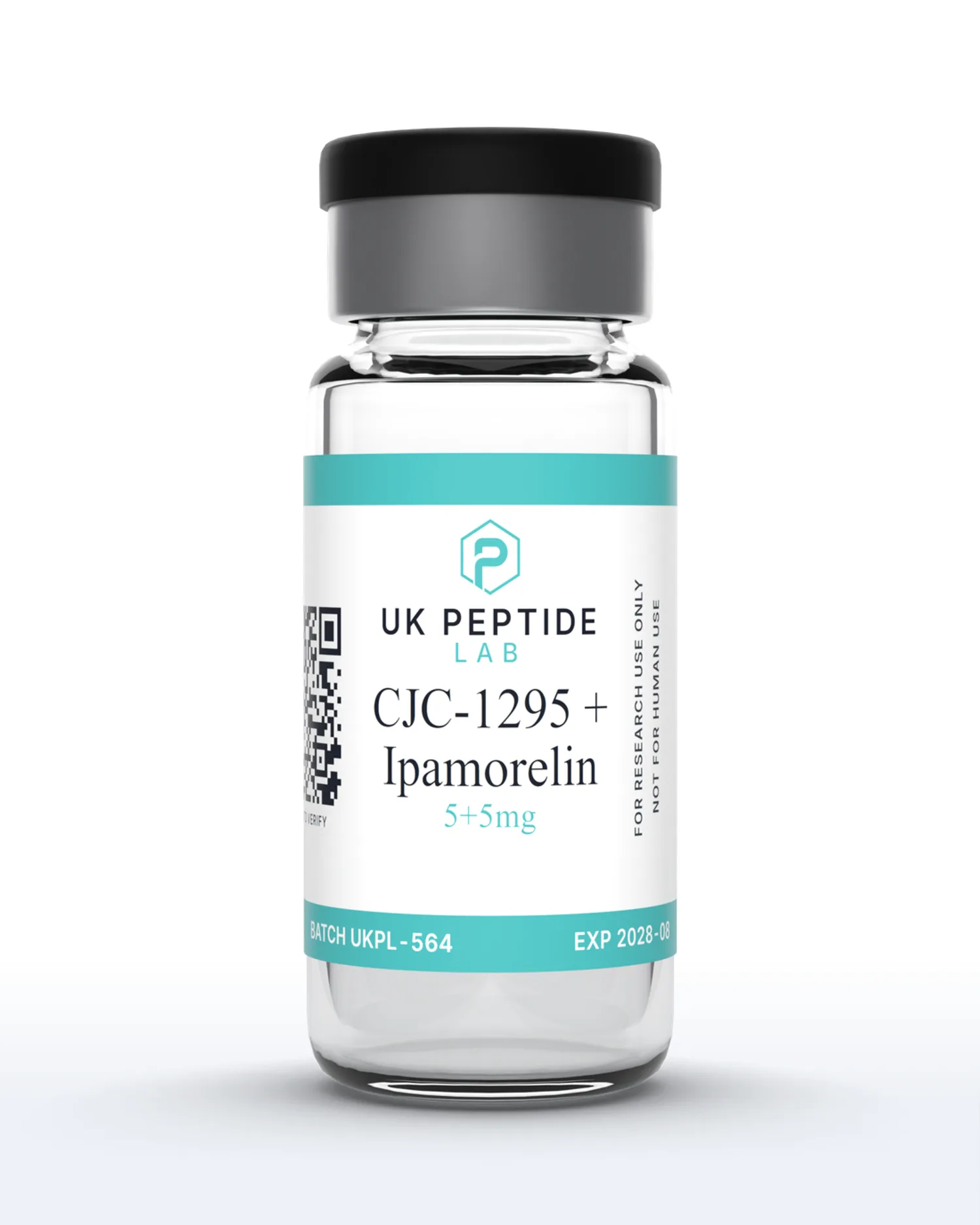
CJC-1295 + Ipamorelin Price (UK)
CJC-1295 + Ipamorelin is supplied in 2 vial sizes, priced from £42.99 for 5+5mg to £59.99 for 10+10mg. Every size ships from our UK facility with the same third-party HPLC certificate published on this page. This vial clears the £45 threshold on its own, so UK Royal Mail Tracked 24 delivery is free. Orders placed before 2pm on a working day are dispatched the same day.
| Vial | Price | Cost per mg | Availability |
|---|---|---|---|
| CJC-1295 + Ipamorelin 5+5mg | £42.99 | £4.30 | In stock |
| CJC-1295 + Ipamorelin 10+10mgThis page | £59.99 | £3.00Best value | In stock |
Prices are in GBP and shown per vial as supplied, lyophilised, for in-vitro laboratory research only. Cost per mg is given so researchers can compare vial sizes on a like-for-like basis. Stock and pricing on this table are read live from our inventory, so they match the basket. See our FAQ for delivery and payment options, and quality & testing for how each batch is verified.
Product Specifications
Research Overview
This is a single lyophilised vial co-formulating two growth hormone secretagogues at higher mass than the original format: CJC-1295 10mg and Ipamorelin 10mg, 20mg of total peptide per vial. CJC-1295 is a modified GHRH(1-29) analogue (CAS 863288-34-0, 3647.8 g/mol) that signals at the GHRH receptor on the pituitary somatotroph, while Ipamorelin is a pentapeptide (Aib-His-D-2-Nal-D-Phe-Lys-NH₂, CAS 170851-70-4, 711.85 g/mol) acting as a selective agonist at the ghrelin receptor GHS-R1a. The two receptors converge on the same cell through different second-messenger pathways, which is why the two classes are frequently co-studied for complementary signalling rather than treated as alternatives to one another.
The pairing rests on two separate single-agent literatures plus a general synergy literature. On the GHRH side, the defining human pharmacology is Teichman and colleagues (J Clin Endocrinol Metab, 2006), who reported dose-dependent increases in plasma growth hormone and IGF-I after CJC-1295 in healthy adults. On the ghrelin side, Raun and colleagues (Eur J Endocrinol, 1998) characterised Ipamorelin as the first growth hormone secretagogue with selectivity for growth hormone release approaching that of GHRH itself, without the ACTH and cortisol elevation seen with earlier compounds in the class. The receptor itself was cloned and shown to be the target of the synthetic secretagogues by Howard and colleagues (Science, 1996). Class-level combination designs trace to Bowers and colleagues (J Clin Endocrinol Metab, 1990), who showed a GHRP acting with GHRH produced a greater combined response than either alone.
The 10+10mg presentation differs from the 5+5mg vial in mass per vial, not in chemistry. Both carry the components at a fixed 1:1 mass ratio, which is far from equimolar: the GHRH analogue is the larger molecule, so each vial holds roughly 14 µmol of ipamorelin against 2.7 µmol of CJC-1295. Doubling the mass doubles both sides of that ratio, leaving the stoichiometry unchanged; what the larger format changes is laboratory logistics, one vial covering longer replicate series with one batch and one certificate. The honest caveat is unchanged as well: no controlled study of this specific blend has been published. Supplied as lyophilised powder for in-vitro laboratory research only.
Product Specifications
Laboratory Handling
- Store the lyophilised vial at -20°C, protected from light and moisture. Hold reconstituted solution at 2-8°C and use within approximately 4 weeks.
- Reconstitute with bacteriostatic water introduced slowly down the inner glass wall, never onto the lyophilised cake. Swirl gently, never shake or vortex; the GHRH-class component is the shear-sensitive partner.
- Both components are in the same vial and go into solution together, so the blend cannot be separated after reconstitution. The equal-mass mix is far from equimolar, roughly 14 µmol of ipamorelin to 2.7 µmol of CJC-1295 per vial.
- Work under aseptic conditions with sterile syringes and alcohol-swabbed stoppers. Avoid repeated freeze-thaw cycles and aliquot reconstituted stock for reproducibility.
Frequently Asked Questions
What is CJC-1295 + Ipamorelin?
This is the higher-mass presentation of our pre-blended growth hormone secretagogue vial, co-formulating CJC-1295 10mg and Ipamorelin 10mg. CJC-1295 is a modified GHRH(1-29) analogue (CAS 863288-34-0, 3647.8 g/mol) acting at the GHRH receptor, and Ipamorelin is a pentapeptide (Aib-His-D-2-Nal-D-Phe-Lys-NH₂, CAS 170851-70-4, 711.85 g/mol) acting as a selective agonist at the ghrelin receptor GHS-R1a. The two receptors sit on the same anterior pituitary somatotroph but engage different second-messenger systems, which is why the pairing is the standard two-receptor design in growth hormone release research. The equal-mass blend is far from equimolar: because the GHRH analogue is the much larger molecule, 10mg of it is roughly 2.7 µmol against roughly 14 µmol of ipamorelin, a five-fold molar excess on the ghrelin side. That stoichiometry is a property of the 1:1 mass ratio itself and is unchanged from the 5+5mg format; the 10+10mg vial doubles total peptide to 20mg per vial rather than altering the ratio. Supplied as lyophilised powder for in-vitro laboratory research use only.
CJC-1295 + Ipamorelin 10+10mg vs the 5+5mg Presentation
The 10+10mg and 5+5mg vials are the same blend at different mass, and the distinction matters more for laboratory logistics than for chemistry. Both formats carry the components at a fixed 1:1 mass ratio, which resolves to the same roughly five-fold molar excess of ipamorelin at reconstitution, so an experiment designed around the 5+5mg vial transfers to the 10+10mg vial without any change in stoichiometry. What changes is the mass per vial: 20mg of total peptide rather than 10mg, fewer vials needed across a replicate series, fewer reconstitution events and one certificate of analysis covering a larger quantity. The scientific case for the pairing is identical in both formats: CJC-1295 drives the GHRH-receptor axis and ipamorelin drives the ghrelin-receptor axis, converging on the same somatotroph through different signalling, the design characterised at the class level by Bowers and colleagues (J Clin Endocrinol Metab, 1990) for GHRH and GHRP synergy. The honest caveat stands for both presentations: no controlled study of this specific blend has been published, and combination claims trace to the two single-agent literatures plus the general synergy literature. Designs needing independent concentrations, a single-agent control arm, or attribution of an effect to one receptor require the individual vials, which we stock separately.
CJC-1295 + Ipamorelin Research Applications
The 10+10mg presentation suits preclinical endocrine designs that run both compounds together across a longer series: dual-receptor somatotroph stimulation, pulsatile growth hormone release kinetics where a GHRH-receptor input and a ghrelin-receptor input are applied together, and downstream IGF-1 axis work. Its practical value over the 5+5mg format is procedural: one vial covers more experimental sessions, one batch number and one certificate apply across a replicate series, and the fixed 1:1 mass ratio removes ratio preparation error. The component literatures remain the reference points: GHRH-receptor pharmacology for the CJC-1295 side, including the human data reported by Teichman and colleagues (J Clin Endocrinol Metab, 2006), and selective GHS-R1a agonism with a clean ACTH, cortisol and prolactin profile for the ipamorelin side (Raun et al., Eur J Endocrinol, 1998). Researchers needing to vary the GHRH-to-GHS ratio, run either compound alone as a control, or assign an observed response to one receptor should use the individual vials instead.
Reconstitution Guide
Treat the vial as a single 20mg preparation with one fill volume set by the concentration your protocol specifies. Allow the vial and the bacteriostatic water to reach room temperature, then sterilise both rubber stoppers with an alcohol swab. Inject the bacteriostatic water slowly down the inner glass wall of the vial, never directly onto the lyophilised powder, and swirl gently in a slow circular motion until fully dissolved. Never shake or vortex; the GHRH-class component is the shear-sensitive partner and agitation reduces recovery of intact peptide. The solution should be clear and colourless. Remember that the components cannot be separated after reconstitution and that the equal-mass blend is far from equimolar: roughly 14 µmol of ipamorelin against 2.7 µmol of CJC-1295 in this presentation. Label the vial with the fill volume, concentration and reconstitution date, and refrigerate immediately.
See our full peptide reconstitution guide and reconstitution calculator for step-by-step protocol.
Storage Instructions
Lyophilised vials should be stored at -20°C, protected from light and moisture, and remain stable for up to 24 months. Once reconstituted with bacteriostatic water, store the solution at 2-8°C and use within approximately 4 weeks, preparing single-use aliquots at -20°C for anything longer. Because both components share one reconstitution date in a co-formulated vial, the less stable component governs the whole preparation: the GHRH-class analogue is the fragile partner, while the D-amino-acid-stabilised ipamorelin is comparatively robust. Aliquot at reconstitution rather than repeatedly puncturing one stock, and handle under sterile laboratory conditions throughout.
Frequently Asked Questions
Research References
- Prolonged stimulation of growth hormone (GH) and insulin-like growth factor I secretion by CJC-1295, a long-acting analog of GH-releasing hormone, in healthy adults (Teichman et al., J Clin Endocrinol Metab, 2006)
- Ipamorelin, the first selective growth hormone secretagogue (Raun et al., Eur J Endocrinol, 1998)
- Growth hormone (GH)-releasing peptide stimulates GH release in normal men and acts synergistically with GH-releasing hormone (Bowers et al., J Clin Endocrinol Metab, 1990)
- A receptor in pituitary and hypothalamus that functions in growth hormone release (Howard et al., Science, 1996)
Related Research Compounds
CJC-1295 + Ipamorelin
10+10mg · £59.99