
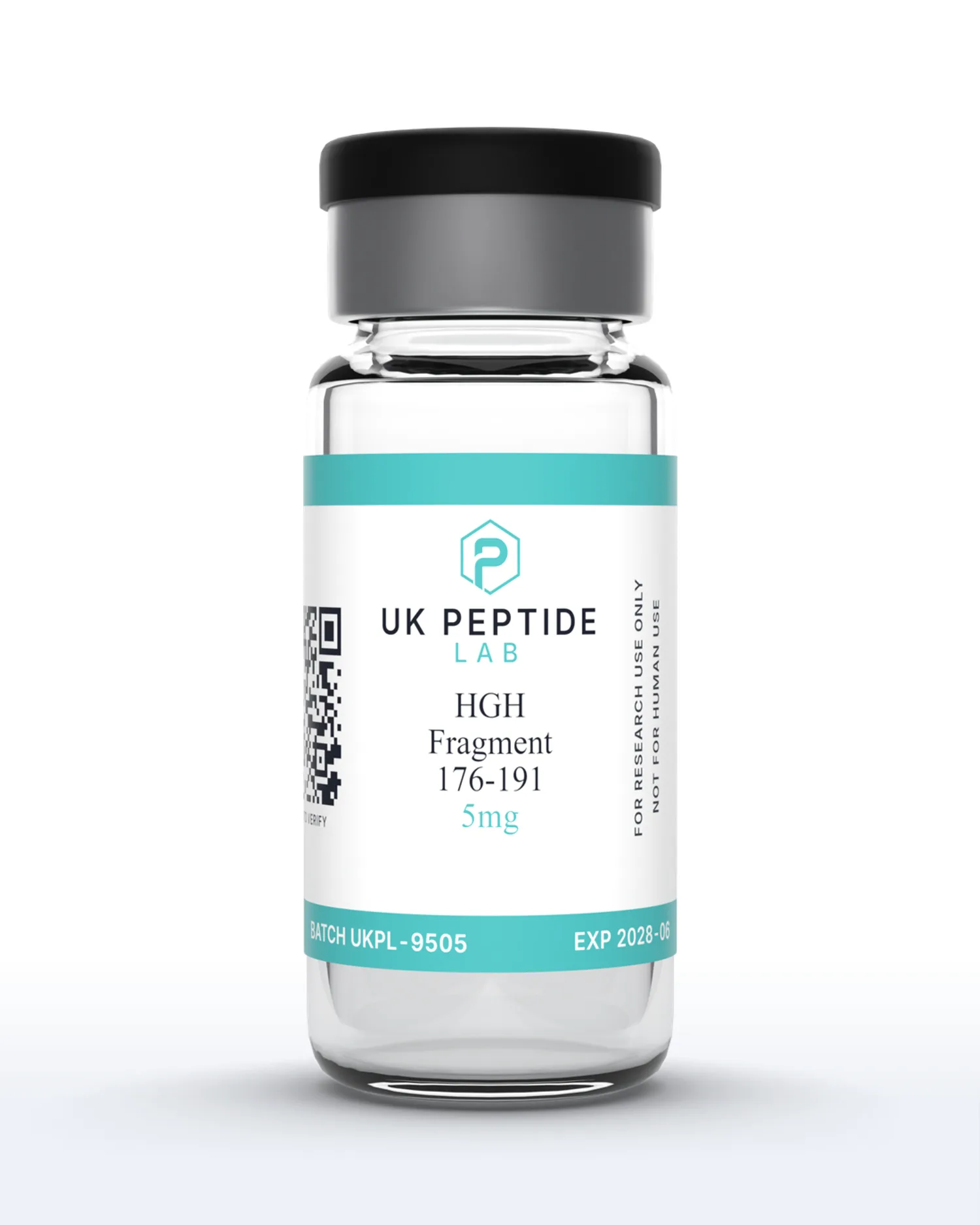
HGH Fragment 176-191
5mg
HGH fragment 176-191 is the C-terminal 16-residue sequence of human growth hormone (Tyr-Leu-Arg-Ile-Val-Gln-Cys-Arg-Ser-Val-Glu-Gly-Ser-Cys-Gly-Phe). Research has focused on this region as the lipolytic domain of the parent hormone, and its modified derivative AOD-9604 is among the most studied analogues of the fragment. Supplied as lyophilised powder, supplier-tested, with the certificate published on this page and independent third-party verification pending.
Published research on HGH Fragment 176-191 is indexed on PubMed.
Intended Use: Strictly for in-vitro laboratory research. Not for use in humans or animals. Not to be used in foods, drugs, or medical diagnostics. This product has not been evaluated by the MHRA or FDA. Buyer assumes full responsibility for safe handling and regulatory compliance.
TBC
Purity
LAB
Certified
SAME
Day Ship
Quantity
Add £15.01 more for free UK delivery
Damaged or lost? Free reshipment guaranteed
Bacteriostatic Water 10ml
Required to reconstitute lyophilised peptides.
Research Use Only
This product is intended strictly for research and laboratory use only. Not for human consumption, medical use, or diagnostic purposes.
Certificate of Analysis
Third-party tested
Lyophilised Stability
24 months
Sealed at -20°C, light-protected
Reconstituted Stability
Up to 3 months
Stored at 2-8°C after mixing
Cold-Chain Shipping
Always
Dry-cold pack, Royal Mail Tracked 24
Important Notice
All compounds are sold individually and do not include research supplies. Products are provided in lyophilised (powder) form and require proper reconstitution before use in research settings.
Related Products
HGH Fragment 176-191 Price (UK)
HGH Fragment 176-191 5mg is £29.99 per vial, supplied from stock in the UK with a third-party HPLC certificate published on this page. UK delivery is £4.50 by Royal Mail Tracked 24, or free once your basket reaches £45 (£15.01 away at this price). Orders placed before 2pm on a working day are dispatched the same day.
| Vial | Price | Cost per mg | Availability |
|---|---|---|---|
| HGH Fragment 176-191 5mgThis page | £29.99 | £6.00 | In stock |
Prices are in GBP and shown per vial as supplied, lyophilised, for in-vitro laboratory research only. Cost per mg is given so researchers can compare vial sizes on a like-for-like basis. Stock and pricing on this table are read live from our inventory, so they match the basket. See our FAQ for delivery and payment options, and quality & testing for how each batch is verified.
Product Specifications
Research Overview
HGH Fragment 176-191 is the C-terminal 16-residue sequence of human growth hormone, residues 176 to 191 of the 191-residue protein, sequence Tyr-Leu-Arg-Ile-Val-Gln-Cys-Arg-Ser-Val-Glu-Gly-Ser-Cys-Gly-Phe (YLRIVQCRSVEGSCGF), molecular formula C₇₈H₁₂₅N₂₃O₂₃S₂, molecular weight 1817.09 g/mol, CAS 66004-57-1. Because residue 176 of the intact hormone is a tyrosine, the fragment is sequence-identical to AOD-9604, the hexadecapeptide Tyr-hGH(177-191) that Metabolic Pharmaceuticals developed from the same region. The two cysteine residues, at fragment positions 7 and 14 (hGH residues 182 and 189), form the intrachain disulfide bridge that closes the small C-terminal loop of the native hormone, the conformation characterised by Ogru and colleagues (J Pept Res, 2000).
Research has focused on this region as the lipolytic domain of the parent hormone: the segment credited with its lipid-mobilising activity, separable from its growth-promoting and diabetogenic actions. The early work is the synthetic C-terminal fragment programme of Ng and Bornstein (Am J Physiol, 1978), and the fuller metabolic characterisation comes from the AOD-9401 and AOD-9604 literature on the same sequence, including molecular and cellular studies in Zucker fatty rats (Ng et al., J Mol Endocrinol, 2000) and chronic treatment work in obese mice and beta-3-adrenergic receptor knock-out mice reporting reduced body weight and body fat without IGF-1-mediated growth effects (Heffernan et al., Endocrinology, 2001). Its modified derivative AOD-9604 is among the most studied analogues of the fragment and reached phase 2b clinical development, with six randomised trials summarised by Stier and colleagues (J Endocrinol Metab, 2013). A separate modern line uses the unmodified fragment in drug-delivery research, where Habibullah and colleagues (Drug Des Devel Ther, 2022) reported that the peptide enhanced the toxicity of doxorubicin-loaded chitosan nanoparticles against MCF-7 breast cancer cells.
It is worth being direct about the state of the evidence. The human clinical data belong to AOD-9604, not to the unmodified fragment, and even there efficacy was never established: the phase 2b programme was wound down and no marketing authorisation exists anywhere. HGH Fragment 176-191 is supplied here as lyophilised powder, supplier-tested, with the certificate published on this page and independent third-party verification pending, for in-vitro laboratory research only.
Product Specifications
Laboratory Handling
- Store lyophilised vials at -20°C, protected from light and moisture. Reconstituted solution should be kept at 2-8°C and used within 4 weeks.
- Reconstitute with bacteriostatic water, adding the solvent slowly down the inner glass wall rather than directly onto the powder, then swirl gently until fully dissolved. Do not shake or vortex.
- The cysteines at positions 7 and 14 form an intrachain disulfide bridge, and oxidation of that bridge is the degradation route to design against: minimise headspace and stopper-open time, keep solutions cold, and prepare single-use aliquots rather than repeatedly accessing one vial.
- Handle under aseptic laboratory conditions with alcohol-swabbed stoppers and sterile syringes. Avoid repeated freeze-thaw cycles, which accelerate aggregation and loss of intact material.
Frequently Asked Questions
What is HGH Fragment 176-191?
HGH Fragment 176-191 is the native C-terminal 16-residue sequence of human growth hormone, residues 176 to 191 of the 191-residue protein, sequence Tyr-Leu-Arg-Ile-Val-Gln-Cys-Arg-Ser-Val-Glu-Gly-Ser-Cys-Gly-Phe, written YLRIVQCRSVEGSCGF, molecular weight 1817.09 g/mol, CAS 66004-57-1. Research has focused on this region as the lipolytic domain of the parent hormone, the segment credited with its lipid-mobilising activity and separable from its growth-promoting and diabetogenic actions, a separation first explored with synthetic C-terminal fragments by Ng and Bornstein (Am J Physiol, 1978). The two cysteine residues, at fragment positions 7 and 14 (hGH residues 182 and 189), form the intrachain disulfide bridge that closes the small C-terminal loop of the native hormone, the 'cyclic anti-obesity peptide' conformation characterised by NMR in the analysis of Ogru and colleagues (J Pept Res, 2000). Because residue 176 of the intact hormone is itself a tyrosine, the fragment is sequence-identical to AOD-9604, the hexadecapeptide written Tyr-hGH(177-191) that Metabolic Pharmaceuticals developed from the same region; described as a modified derivative of the fragment, AOD-9604 is among the most studied analogues of the region and reached phase 2b clinical development. Supplied as lyophilised powder for in-vitro research use only, not a licensed medicine anywhere.
HGH Fragment 176-191 vs AOD-9604
The two compounds share the same sixteen residues, the same intrachain disulfide bridge and the same folded loop; what separates them is provenance and the literature attached to each name, not primary structure. HGH Fragment 176-191 is the native sequence, residues 176 to 191 exactly as they occur at the C-terminus of the 191-residue human growth hormone, with the N-terminal tyrosine occurring naturally at position 176. AOD-9604 is the developed hexadecapeptide written Tyr-hGH(177-191), the fifteen residues from position 177 onward with a tyrosine added at the N-terminus for stability. Because that added tyrosine is precisely the native residue 176, the two are sequence-identical, YLRIVQCRSVEGSCGF in both cases, and both carry the disulfide between the cysteines at positions 7 and 14 that closes the native C-terminal loop (Ogru et al., J Pept Res, 2000). The practical difference is the literature each name maps onto. The unmodified fragment appears in the early synthetic C-terminal fragment work (Ng and Bornstein, Am J Physiol, 1978; Bornstein et al., Acta Endocrinol, 1983) and in a modern drug-delivery study (Habibullah et al., Drug Des Devel Ther, 2022), whereas AOD-9604 is the developed candidate that carried the clinical programme, six randomised trials summarised by Stier and colleagues (J Endocrinol Metab, 2013). Researchers choosing between them are mostly choosing which name maps to which literature; the peptide chain is the same.
HGH Fragment 176-191 Research Applications
HGH Fragment 176-191 is used in metabolic research on the C-terminal lipolytic domain of human growth hormone: lipolysis and lipogenesis assays in adipocyte and hepatocyte preparations, structure-activity work on the disulfide-constrained C-terminal loop, and study designs that separate the lipid-mobilising activity of hGH from its growth-promoting and diabetogenic actions. The foundation is the synthetic C-terminal fragment work of Ng and Bornstein (Am J Physiol, 1978), who reported hyperglycaemic activity for synthetic C-terminal sequences, and Bornstein and colleagues (Acta Endocrinol, 1983), who reported inhibition of acetyl-CoA carboxylase by a carboxyl-terminal part sequence acting through a second messenger. The fuller metabolic characterisation comes from the AOD-9401 and AOD-9604 literature on the same sequence: Ng and colleagues (J Mol Endocrinol, 2000) described the molecular and cellular actions on lipid metabolism in Zucker fatty rats, Heffernan and colleagues (Am J Physiol Endocrinol Metab, 2000) reported altered lipid metabolism after oral administration in rodents, and the group's chronic treatment study in obese mice and beta-3-adrenergic receptor knock-out mice (Endocrinology, 2001) reported reduced body weight and body fat with restoration of beta-3-adrenergic receptor expression, without raising IGF-1 or impairing glucose handling. A separate modern line uses the unmodified fragment itself in drug delivery: Habibullah and colleagues (Drug Des Devel Ther, 2022) reported that the peptide enhanced the toxicity of doxorubicin-loaded chitosan nanoparticles against MCF-7 breast cancer cells. The honest boundary: the human clinical literature belongs to AOD-9604 rather than to the unmodified fragment, human efficacy was never established, the phase 2b programme was wound down without a marketing authorisation anywhere, and material supplied here is for in-vitro laboratory research only.
Reconstitution Guide
Allow the vial to reach room temperature, then sterilise the rubber stopper of both the peptide vial and the bacteriostatic water vial with an alcohol swab. Slowly draw bacteriostatic water into a sterile syringe and inject it gently down the inner glass wall of the peptide vial, never directly onto the lyophilised cake. Swirl the vial slowly in a circular motion until the powder is fully dissolved and the solution is clear and colourless; never shake or vortex, as mechanical shear and foaming degrade the peptide. The fragment carries two cysteine residues, at positions 7 and 14, which form the intrachain disulfide bridge of the native C-terminal loop, so treat oxidation as the degradation route to design against: work efficiently, avoid introducing excess air into the vial, and re-seal promptly after each draw. Use sterile, pyrogen-free consumables throughout and work in a laminar flow hood where available. If the solution appears turbid or the cake fails to dissolve completely, discard the vial rather than forcing dissolution. Record the reconstitution date, solvent volume and resulting concentration on the vial label, then refrigerate immediately. For in-vitro laboratory research use only.
See our full peptide reconstitution guide and reconstitution calculator for step-by-step protocol.
Storage Instructions
Store lyophilised vials at -20°C, protected from light and moisture, for long-term stability of up to 24 months; the lyophilised cake tolerates short transit at ambient temperature but should be moved to the freezer on receipt. Once reconstituted with bacteriostatic water, hold the solution at 2-8°C (standard refrigerator) and use within approximately 4 weeks, as hydrolysis proceeds once the peptide is in solution. For longer storage, prepare single-use aliquots at -20°C and thaw each aliquot only once; repeated freeze-thaw cycles are the fastest route to aggregation and loss of intact material. The degradation route to design against is oxidation of the intrachain disulfide between the cysteines at positions 7 and 14: keep vials tightly sealed with minimal headspace, protect from light, and never store the solution in contact with oxidising agents. Handle under sterile laboratory conditions throughout, and keep the batch number and certificate of analysis on file for experimental records. For in-vitro laboratory research use only.
Frequently Asked Questions
Research References
- Hyperglycemic action of synthetic C-terminal fragments of human growth hormone (Ng and Bornstein, Am J Physiol, 1978)
- Molecular and cellular actions of a structural domain of human growth hormone (AOD9401) on lipid metabolism in Zucker fatty rats (Ng et al., J Mol Endocrinol, 2000)
- The effects of human GH and its lipolytic fragment (AOD9604) on lipid metabolism following chronic treatment in obese mice and beta(3)-AR knock-out mice (Heffernan et al., Endocrinology, 2001)
- The conformational and biological analysis of a cyclic anti-obesity peptide from the C-terminal domain of human growth hormone (Ogru et al., J Pept Res, 2000)
- Human growth hormone fragment 176-191 peptide enhances the toxicity of doxorubicin-loaded chitosan nanoparticles against MCF-7 breast cancer cells (Habibullah et al., Drug Des Devel Ther, 2022)
Related Research Compounds
HGH Fragment 176-191
5mg · £29.99