
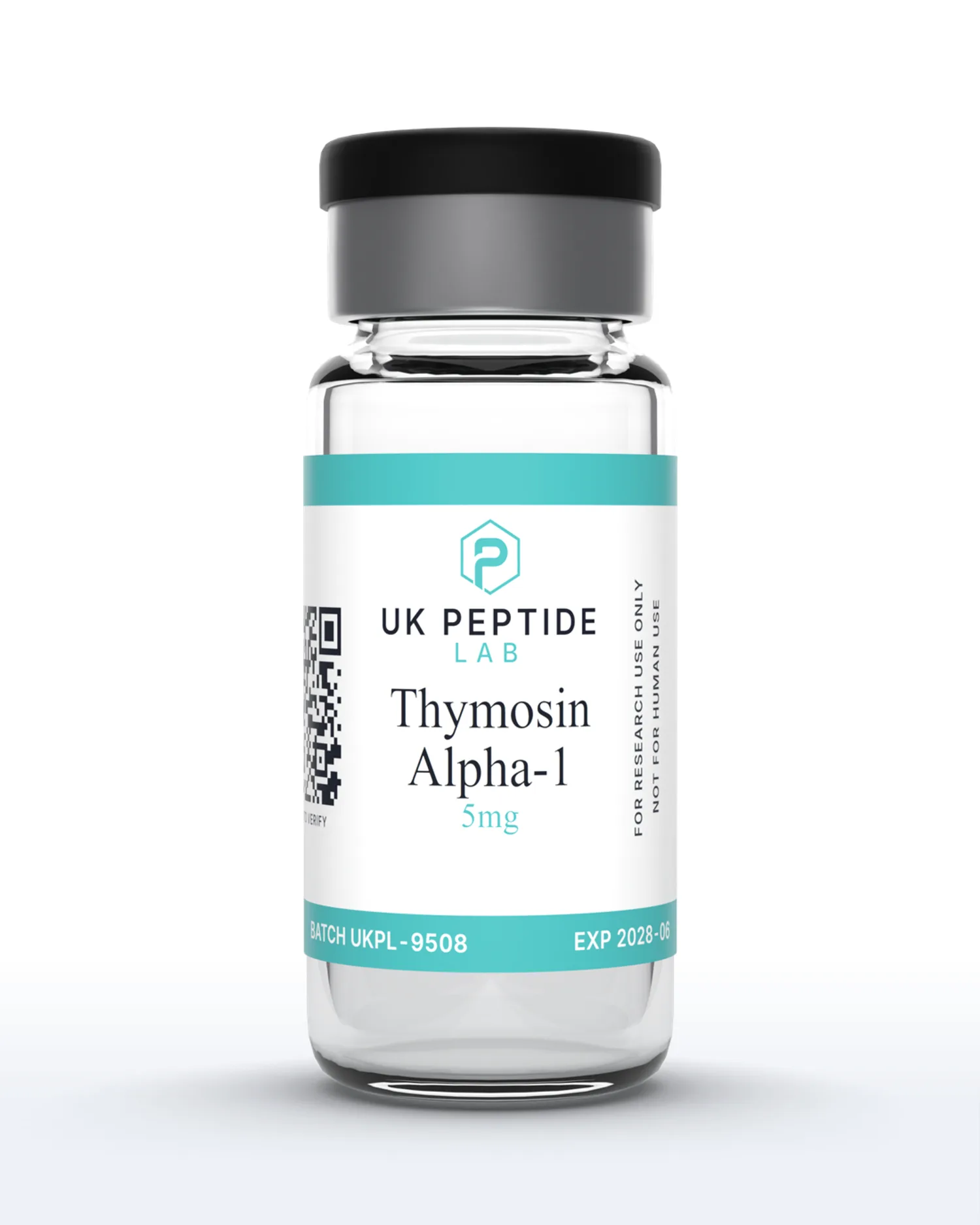
Thymosin Alpha-1
5mg
Thymosin alpha-1 is a 28 amino acid peptide first isolated from thymic tissue, corresponding to the N-terminal region of prothymosin alpha. Research has examined its reported effects on T-cell maturation and function, dendritic cell activity and cytokine regulation, and it holds pharmaceutical licences in several countries for immunomodulatory indications. This 5mg presentation is the lower-mass research format of our 10mg vial. Supplied as lyophilised powder, supplier-tested, with the certificate published on this page and independent third-party verification pending.
Published research on Thymosin Alpha-1 is indexed on PubMed.
Intended Use: Strictly for in-vitro laboratory research. Not for use in humans or animals. Not to be used in foods, drugs, or medical diagnostics. This product has not been evaluated by the MHRA or FDA. Buyer assumes full responsibility for safe handling and regulatory compliance.
TBC
Purity
LAB
Certified
SAME
Day Ship
Quantity
Add £15.01 more for free UK delivery
Damaged or lost? Free reshipment guaranteed
Bacteriostatic Water 10ml
Required to reconstitute lyophilised peptides.
Research Use Only
This product is intended strictly for research and laboratory use only. Not for human consumption, medical use, or diagnostic purposes.
Certificate of Analysis
Third-party tested
Lyophilised Stability
24 months
Sealed at -20°C, light-protected
Reconstituted Stability
Up to 3 months
Stored at 2-8°C after mixing
Cold-Chain Shipping
Always
Dry-cold pack, Royal Mail Tracked 24
Important Notice
All compounds are sold individually and do not include research supplies. Products are provided in lyophilised (powder) form and require proper reconstitution before use in research settings.
Related Products
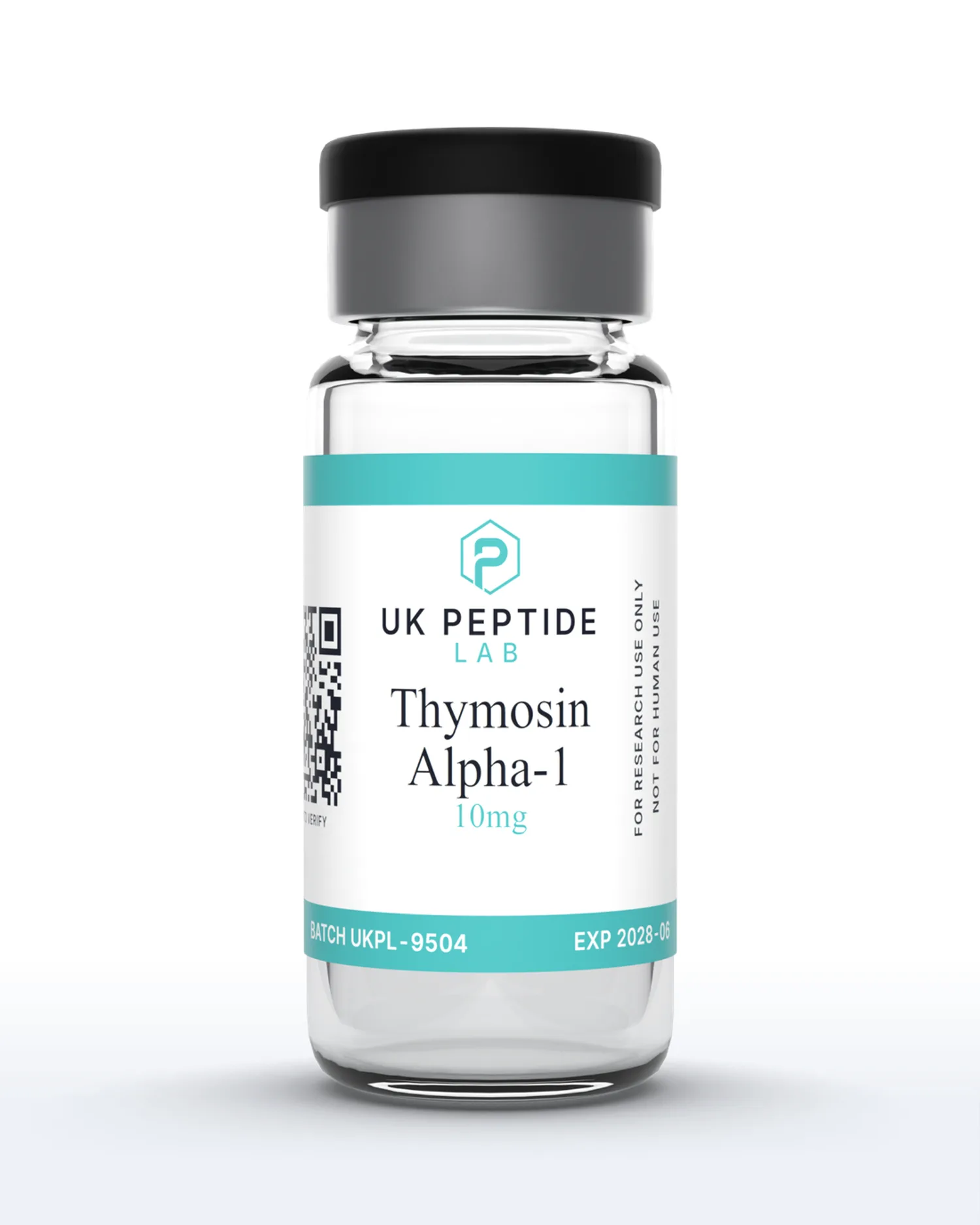
Thymosin Alpha-1 Price (UK)
Thymosin Alpha-1 is supplied in 2 vial sizes, priced from £29.99 for 5mg to £44.99 for 10mg. Every size ships from our UK facility with the same third-party HPLC certificate published on this page. UK delivery is £4.50 by Royal Mail Tracked 24, or free once your basket reaches £45 (£15.01 away at this price). Orders placed before 2pm on a working day are dispatched the same day.
| Vial | Price | Cost per mg | Availability |
|---|---|---|---|
| Thymosin Alpha-1 10mg | £44.99 | £4.50Best value | In stock |
| Thymosin Alpha-1 5mgThis page | £29.99 | £6.00 | In stock |
Prices are in GBP and shown per vial as supplied, lyophilised, for in-vitro laboratory research only. Cost per mg is given so researchers can compare vial sizes on a like-for-like basis. Stock and pricing on this table are read live from our inventory, so they match the basket. See our FAQ for delivery and payment options, and quality & testing for how each batch is verified.
Product Specifications
Research Overview
Thymosin alpha-1, also written thymosin α1 or TA1, and known by its INN thymalfasin, is a 28-residue peptide with an acetylated N-terminus, sequence Ac-Ser-Asp-Ala-Ala-Val-Asp-Thr-Ser-Ser-Glu-Ile-Thr-Thr-Lys-Asp-Leu-Lys-Glu-Lys-Lys-Glu-Val-Val-Glu-Glu-Ala-Glu-Asn (Ac-SDAAVDTSSEITTKDLKEKKEVVEEAEN), molecular formula C₁₂₉H₂₁₅N₃₃O₅₅, molecular weight 3108.28 g/mol and CAS number 62304-98-7. It is the N-terminal 28-residue fragment of prothymosin alpha, the acidic nuclear protein from which it is released by proteolysis, and it was first isolated from bovine thymus, specifically from calf thymosin fraction 5, and sequenced by Goldstein and colleagues (Proc Natl Acad Sci USA, 1977). The N-terminal acetylation is the molecule's defining chemical feature: it blocks aminopeptidase degradation and is considered necessary for full activity. The sequence contains no cysteine and no methionine, so TA1 carries no disulfides and is spared the methionine-oxidation liability that dominates handling guidance for many other research peptides; what it does carry is a C-terminal asparagine, which makes deamidation the principal degradation route to design against.
This page covers the 5mg presentation, the lower-mass research format of the compound supplied in the 10mg vial. The molecule is identical in both sizes: same sequence, same molecular weight, same receptor pharmacology, with the full chemistry and literature documented on the main Thymosin Alpha-1 page. What differs is vial content. The 5mg vial holds half the lyophilised mass in the same single-vial glass format, so a given fill volume yields half the concentration of the 10mg vial, and each size is its own batch with its own certificate of analysis. The 5mg format suits pilot and screening designs with a smaller total peptide mass, and its shorter in-use window naturally limits the cumulative deamidation history any one reconstituted stock accumulates.
The regulatory history is unusual for a peptide in this catalogue and worth stating precisely. Under the brand name Zadaxin, developed by SciClone Pharmaceuticals, thymosin alpha-1 (thymalfasin) is licensed as a prescription medicine in more than 35 countries, principally in Asia and the Middle East, for immunomodulatory indications most notably including chronic hepatitis B. The evidence base includes randomised controlled trials such as Chien and colleagues' 98-patient trial (Hepatology, 1998), and the history is reviewed by Camerini and Garaci (Expert Opin Biol Ther, 2015). It has never been licensed in the United Kingdom, the European Union or the United States. That asymmetry matters for researchers: a compound with a genuine pharmaceutical dossier in some jurisdictions remains an unlicensed substance in others, and no thymosin alpha-1 product is an approved medicine in the UK.
Mechanistically, the most cited modern work centres on toll-like receptor signalling rather than a classical single receptor. Romani and colleagues reported in Blood (2004) that thymosin alpha 1 activates myeloid dendritic cells for Th1-type responses through a TLR9-dependent, MyD88-mediated signalling pathway. Around that anchor sit the older T-cell literature, maturation, differentiation and function of thymocytes and peripheral T cells, alongside reports of natural killer cell activity and broad cytokine regulation, reviewed by Garaci (Ann N Y Acad Sci, 2007). The most active current direction is oncology, including a 2025 retrospective analysis of TA1 added to PD-1/PD-L1 inhibitor plus chemotherapy in platinum-resistant recurrent ovarian cancer (Wang et al., Cancer Manag Res, 2025). The honest position follows: the licensed indications are prescription medicine uses in specific jurisdictions, nothing on this page describes or endorses any human use, and the material supplied here is for in-vitro laboratory research only. Much of the older immunology literature is small and heterogeneous, and the recent checkpoint-inhibitor combination data are largely retrospective. Thymosin alpha-1 is supplied as lyophilised powder, batch UKPL-9508, at 99.48% purity by HPLC with the supplier certificate of analysis published on the product page, with independent third-party verification pending.
Product Specifications
Laboratory Handling
- Store lyophilised vials at -20°C, protected from light and moisture. Reconstituted solution should be held at 2-8°C and used within 4 weeks.
- Reconstitute with bacteriostatic water introduced slowly down the inner glass wall, never directly onto the lyophilised cake. Swirl gently until fully dissolved; never shake or vortex.
- Work under aseptic conditions with sterile syringes and alcohol-swabbed stoppers. The sequence contains no cysteine or methionine, so no disulfide or oxidation-specific handling is required.
- Protect the C-terminal asparagine from deamidation: keep reconstituted solutions cold, minimise time at room temperature, and prepare single-use aliquots rather than repeatedly accessing one vial. The 5mg vial is typically exhausted within fewer sessions than the 10mg vial, which naturally limits cumulative exposure.
Frequently Asked Questions
What is Thymosin Alpha-1?
The 5mg vial is the lower-mass presentation of thymosin alpha-1 (TA1, INN thymalfasin), the 28-residue, N-terminally acetylated peptide of sequence Ac-SDAAVDTSSEITTKDLKEKKEVVEEAEN, molecular weight 3108.28 g/mol, CAS 62304-98-7. The compound is identical to the one in the 10mg vial, same sequence, same receptor pharmacology, and the full chemistry (first isolation from bovine thymus and characterisation by Goldstein and colleagues, Proc Natl Acad Sci USA, 1977), the Zadaxin licensing history and the toll-like receptor mechanism reported by Romani and colleagues (Blood, 2004) are documented on the main Thymosin Alpha-1 page and are not repeated here. This page covers what is specific to the 5mg format: half the lyophilised mass of the 10mg vial in the same single-vial glass format, which means half the concentration at a given fill volume, a smaller total peptide mass for pilot and screening-stage designs, and a shorter in-use window per vial that naturally limits cumulative exposure of the deamidation-prone C-terminal asparagine. Supplied as lyophilised powder for in-vitro laboratory research use only.
Thymosin Alpha-1 5mg vs 10mg
The two vials contain the same molecule, so this is a handling and logistics comparison rather than a chemical one, and there is deliberately no purity or quality difference between the sizes. Each vial size is its own batch with its own certificate of analysis: the 5mg batch UKPL-9508 carries its own published certificate rather than inheriting the 10mg batch's figures. The 5mg vial is the lower-mass format for protocols that call for a smaller total peptide mass, 5mg lyophilised in the same single-vial glass format as the 10mg vial. At an identical fill volume the reconstituted stock reaches half the concentration of the 10mg vial, so fill volumes must be scaled rather than carried over from larger-vial work. The trade-offs run in both directions. In the 10mg vial's favour: batch continuity, since one batch under one certificate covers double the work, and a lower cost per milligram, since vial, stopper, lyophilisation and assay costs are incurred per vial rather than per milligram. In the 5mg vial's favour: a lower upfront cost for pilot and screening work, a shorter in-use window per vial that limits the cumulative exposure any single reconstituted stock accumulates, and less unused material left over when a design is revised or abandoned. The counterpoint is that a large design run on 5mg vials spans more batches than the same design on 10mg vials, so inter-batch variance and certificate management scale accordingly. Which size to choose is a logistics decision, not a scientific one.
Thymosin Alpha-1 Research Applications
The applications are those documented for the 10mg vial, since the compound is the same: T-cell maturation and function models, dendritic cell and natural killer cell activity assays, cytokine regulation studies and toll-like receptor signalling work following Romani and colleagues (Blood, 2004), plus recent oncology literature examining TA1 alongside immune checkpoint inhibitors (Wang et al., Cancer Manag Res, 2025). Vial content affects study logistics rather than endpoint selection. A 5mg vial suits pilot runs, dose-response screening across a modest plate count, and designs where the total peptide mass required is small enough that a 10mg vial would leave substantial unused material. The honest boundaries are unchanged from the main page: the licensed indications are prescription medicine uses in specific jurisdictions, much of the older immunology literature is small and heterogeneous, and the recent checkpoint-inhibitor combination data are largely retrospective. Material supplied here is for in-vitro laboratory research only.
Reconstitution Guide
Allow the vial to reach room temperature, then sterilise the rubber stopper of both the peptide vial and the bacteriostatic water vial with an alcohol swab. Draw the bacteriostatic water into a sterile syringe and inject it slowly down the inner glass wall of the peptide vial, never directly onto the lyophilised powder. Swirl gently in a slow circular motion until fully dissolved; the solution should be clear and colourless. Do not shake or vortex. The sequence contains no cysteine and no methionine, so no disulfide or oxidation-specific handling is required, but the C-terminal asparagine is deamidation-prone: reconstitute promptly, avoid introducing excess air, and refrigerate immediately after labelling the vial with the reconstitution date. One point is specific to the 5mg vial: set the fill volume from your target concentration, since 5mg reaches half the concentration of 10mg at identical volume. We specify no fill volume, as that is a protocol decision, and provide no dosing information.
See our full peptide reconstitution guide and reconstitution calculator for step-by-step protocol.
Storage Instructions
Lyophilised vials should be stored at -20°C, protected from light and moisture, and remain stable for up to 24 months. Once reconstituted with bacteriostatic water, store the solution at 2-8°C (standard refrigerator) and use within approximately 4 weeks. For longer storage, prepare single-use aliquots at -20°C and avoid repeated freeze-thaw cycles. The degradation route to design against is deamidation of the C-terminal asparagine, which is accelerated in solution at higher pH and temperature. The 5mg format's practical advantage is that a single reconstituted stock is typically consumed within fewer working sessions, so cumulative room-temperature exposure is naturally limited; the matching discipline is to keep each session short, keep the vial cold between draws, and never store the solution in contact with alkaline solutions. Handle under sterile laboratory conditions throughout.
Frequently Asked Questions
Research References
- Thymosin alpha1: isolation and sequence analysis of an immunologically active thymic polypeptide (Goldstein et al., Proc Natl Acad Sci USA, 1977)
- Thymosin alpha 1 activates dendritic cells for antifungal Th1 resistance through toll-like receptor signaling (Romani et al., Blood, 2004)
- Thymosin alpha1: a historical overview (Garaci, Ann N Y Acad Sci, 2007)
Related Research Compounds
Thymosin Alpha-1
5mg · £29.99