
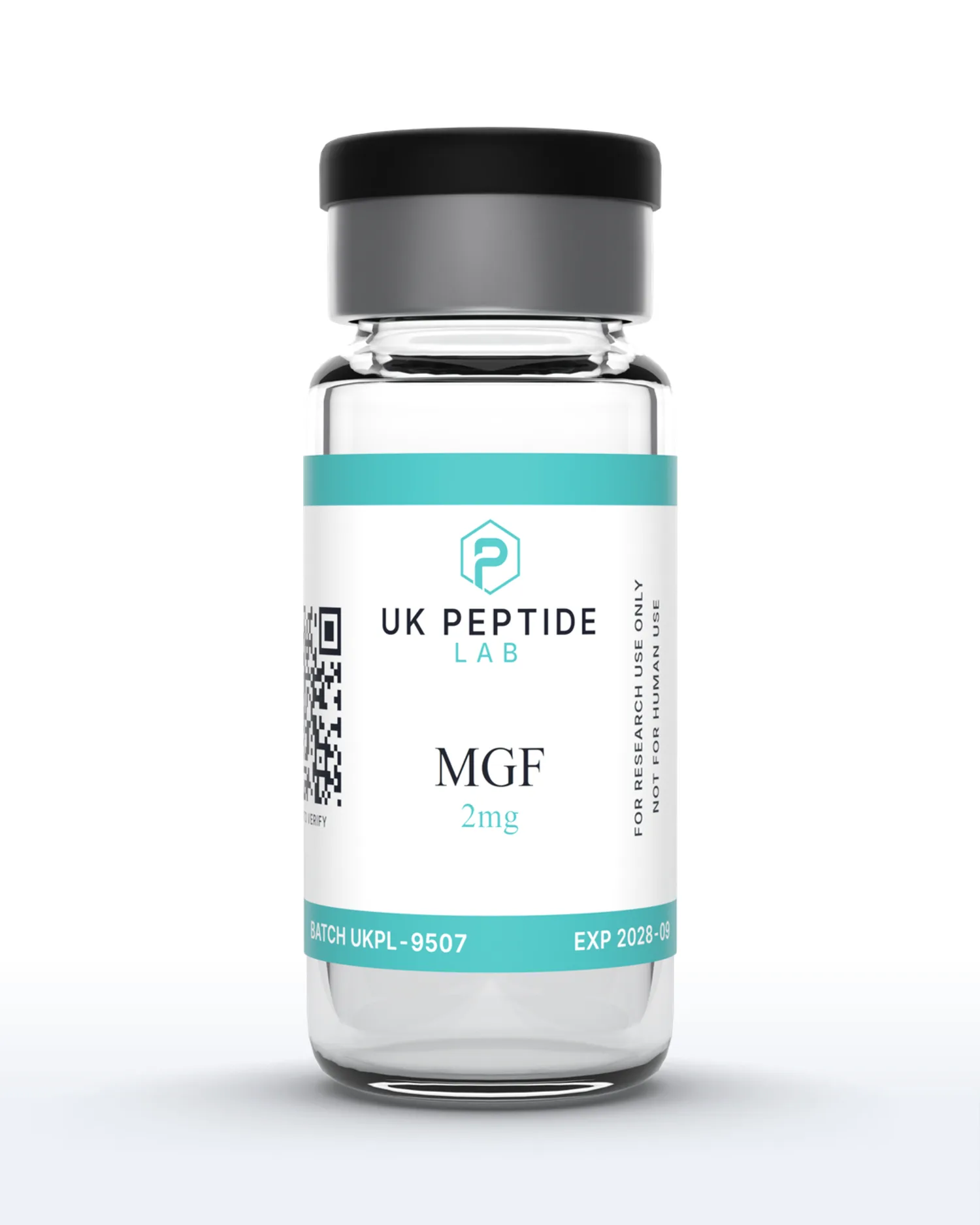
MGF
2mg
Mechano growth factor (MGF) is the 24-residue E-domain peptide released from IGF-1Ec after exercise-induced splicing in muscle tissue (Tyr-Gln-Pro-Pro-Ser-Thr-Asn-Lys-Asn-Thr-Lys-Ser-Gln-Arg-Arg-Lys-Gly-Ser-Thr-Phe-Glu-Glu-His-Lys). Research has examined its role in satellite cell activation and muscle cell proliferation following mechanical load. Supplied as lyophilised powder, supplier-tested, with the certificate published on this page and independent third-party verification pending.
Published research on MGF is indexed on PubMed.
Intended Use: Strictly for in-vitro laboratory research. Not for use in humans or animals. Not to be used in foods, drugs, or medical diagnostics. This product has not been evaluated by the MHRA or FDA. Buyer assumes full responsibility for safe handling and regulatory compliance.
TBC
Purity
LAB
Certified
SAME
Day Ship
Quantity
Add £20.01 more for free UK delivery
Damaged or lost? Free reshipment guaranteed
Bacteriostatic Water 10ml
Required to reconstitute lyophilised peptides.
Research Use Only
This product is intended strictly for research and laboratory use only. Not for human consumption, medical use, or diagnostic purposes.
Certificate of Analysis
Third-party tested
Lyophilised Stability
24 months
Sealed at -20°C, light-protected
Reconstituted Stability
Up to 3 months
Stored at 2-8°C after mixing
Cold-Chain Shipping
Always
Dry-cold pack, Royal Mail Tracked 24
Important Notice
All compounds are sold individually and do not include research supplies. Products are provided in lyophilised (powder) form and require proper reconstitution before use in research settings.
Related Products
MGF Price (UK)
MGF 2mg is £24.99 per vial, supplied from stock in the UK with a third-party HPLC certificate published on this page. UK delivery is £4.50 by Royal Mail Tracked 24, or free once your basket reaches £45 (£20.01 away at this price). Orders placed before 2pm on a working day are dispatched the same day.
| Vial | Price | Cost per mg | Availability |
|---|---|---|---|
| MGF 2mgThis page | £24.99 | £12.49 | In stock |
Prices are in GBP and shown per vial as supplied, lyophilised, for in-vitro laboratory research only. Cost per mg is given so researchers can compare vial sizes on a like-for-like basis. Stock and pricing on this table are read live from our inventory, so they match the basket. See our FAQ for delivery and payment options, and quality & testing for how each batch is verified.
Product Specifications
Research Overview
MGF, short for mechano growth factor, is the 24-residue C-terminal E-domain peptide of the IGF-1Ec splice variant of insulin-like growth factor 1, sequence Tyr-Gln-Pro-Pro-Ser-Thr-Asn-Lys-Asn-Thr-Lys-Ser-Gln-Arg-Arg-Lys-Gly-Ser-Thr-Phe-Glu-Glu-His-Lys, written YQPPSTNKNTKSQRRKGSTFEEHK, molecular weight 2866.4 g/mol. It is the peptide cleaved from the IGF-1 precursor during processing of the mature 70-residue hormone, and it is expressed from an exercise-sensitive splice form of the IGF-1 gene that appears in muscle tissue after mechanical load. Research has examined its role in satellite cell activation and muscle cell proliferation following mechanical load.
The peptide was cloned and characterised in stretched skeletal muscle by Yang and colleagues, who reported the IGF-1 isoform and named the splice variant mechano growth factor (J Muscle Res Cell Motil, 1996). In the founding functional study, Yang and Goldspink (FEBS Lett, 2002) reported that the synthetic E-peptide increased myoblast proliferation while mature IGF-1 promoted differentiation, and Hill and Goldspink (J Physiol, 2003) reported that MGF expression in rodent muscle coincided with markers of muscle satellite (stem) cell activation after local tissue damage. Owino, Yang and Goldspink (FEBS Lett, 2001) reported that aged rat muscle expressed markedly less MGF in response to mechanical overload than young muscle.
It is worth being direct about the state of the evidence, because MGF is a peptide whose early findings have not been reproduced consistently. The primary positive data originate mostly from one research group, in rodent models and cell culture, and no human data exist for the peptide. Fornaro and colleagues (Am J Physiol Endocrinol Metab, 2014) tested native and stabilised MGF peptides on myoblasts and primary muscle stem cells and reported no effect on proliferation or activation in systems where mature IGF-1 produced a robust response, and the balanced review by Matheny, Nindl and Adamo (Endocrinology, 2010) concluded that the evidence for MGF as an in-vivo product of IGF-1 gene expression with a repair role is inadequate. No dedicated receptor for the peptide has been identified.
That contested status is precisely why it remains an interesting research tool rather than a settled one, and it is stated plainly here rather than papered over with confident mechanism claims. MGF is not an approved medicine in any jurisdiction and is supplied as lyophilised powder for in-vitro laboratory research only.
Product Specifications
Laboratory Handling
- Store lyophilised vials at -20°C, protected from light and moisture. Reconstituted MGF should be refrigerated at 2-8°C and used within 4 weeks.
- Reconstitute with bacteriostatic water, injecting the solvent slowly down the inner glass wall rather than directly onto the powder, then swirl gently until fully dissolved. Avoid shaking or vortexing the peptide solution.
- Handle under aseptic laboratory conditions using sterile equipment throughout reconstitution and aliquoting, and minimise stopper-open time.
- Avoid repeated freeze-thaw cycles. Prepare measured single-use aliquots from reconstituted stock for consistent experimental use.
Frequently Asked Questions
What is MGF?
MGF, short for mechano growth factor, is the 24-residue C-terminal E-domain peptide of the human IGF-1Ec splice variant of insulin-like growth factor 1, sequence Tyr-Gln-Pro-Pro-Ser-Thr-Asn-Lys-Asn-Thr-Lys-Ser-Gln-Arg-Arg-Lys-Gly-Ser-Thr-Phe-Glu-Glu-His-Lys, written YQPPSTNKNTKSQRRKGSTFEEHK, molecular weight 2866.4 g/mol. It is the peptide cleaved from the IGF-1 precursor when the mature 70-residue hormone is processed, and it is expressed from the IGF-1 gene through an exercise-sensitive splice form that appears in muscle tissue after mechanical load. The peptide was cloned and characterised in stretched skeletal muscle by Yang and colleagues (J Muscle Res Cell Motil, 1996), who named the splice variant mechano growth factor, and its chemistry is distinctive but uncomplicated: four lysine and two arginine residues make it a strongly basic peptide, and it carries no methionine, cysteine or tryptophan, so it has none of the oxidation-prone residues that dominate handling for other sequences. Supplied as lyophilised powder for in-vitro laboratory research use only, and it holds no marketing authorisation in any jurisdiction.
MGF vs PEG-MGF
The two products contain the same 24-residue E-domain sequence; what separates them is a polyethylene glycol modification. MGF is the unmodified peptide, exactly the molecule used in the primary literature: Yang and Goldspink (FEBS Lett, 2002) worked with the unmodified E-peptide when they reported distinct roles for MGF and mature IGF-1 in myoblast proliferation and differentiation, and the satellite-cell expression work of Hill and Goldspink (J Physiol, 2003) concerns the endogenous, unmodified splice product. PEG-MGF is that sequence with a PEG moiety conjugated to slow enzymatic clearance and extend the peptide's lifetime in solution and in circulation. The trade-off runs the other way for interpretability: the unmodified peptide maps directly onto the published findings and is the correct choice for replication work, while PEG-MGF adds a pharmacokinetic variable on top of a peptide whose biology is already contested (Matheny, Nindl and Adamo, Endocrinology, 2010). Researchers choose MGF when fidelity to the reference molecule matters, and PEG-MGF when solution or in-vivo lifetime is the design priority.
MGF Research Applications
MGF is used in muscle-biology research along the two lines of work it was built around. The satellite-cell line: activation and proliferation assays in myogenic cell lines and primary muscle stem cells, following Yang and Goldspink (FEBS Lett, 2002), who reported that the synthetic E-peptide increased myoblast proliferation while mature IGF-1 promoted differentiation, and Hill and Goldspink (J Physiol, 2003), who measured IGF-1 splice-variant expression in rodent muscle after local tissue damage and reported that MGF expression coincided with markers of muscle satellite (stem) cell activation. The mechanical-load line: studies of exercise- and stretch-induced IGF-1 splicing, in which MGF expression is read as an early marker of the muscle's response to load, following the cloning work of Yang and colleagues (J Muscle Res Cell Motil, 1996) and the splicing model set out by Goldspink (Physiology, 2005). A third line concerns ageing: Owino, Yang and Goldspink (FEBS Lett, 2001) reported that muscles of aged rats expressed markedly less MGF in response to mechanical overload than young muscle. The honest boundaries: the primary data originate mostly from one research group, a careful negative replication by Fornaro and colleagues (Am J Physiol Endocrinol Metab, 2014) found no effect of native or stabilised MGF peptides on myoblasts or primary muscle stem cells, the balanced review by Matheny, Nindl and Adamo (Endocrinology, 2010) concluded that the in-vivo evidence is inadequate, and no human data of any kind exist for the peptide. Material supplied here is for in-vitro laboratory research only.
Reconstitution Guide
Allow vials to reach room temperature, then sterilise the rubber stopper of both the peptide vial and the bacteriostatic water vial with an alcohol swab. Slowly draw your bacteriostatic water into a sterile insulin syringe, then inject it gently down the inner glass wall of the peptide vial, never directly onto the lyophilised powder. Once added, gently swirl the vial in a slow circular motion until fully dissolved. Never shake or vortex. The 24-residue sequence carries no methionine, cysteine or tryptophan, so it has none of the strongly oxidation-prone residues that dictate handling precautions for longer sequences, and it dissolves readily to a clear, colourless solution. The peptide is strongly basic, with four lysine and two arginine residues, so work efficiently, minimise stopper-open time, and label the vial with the reconstitution date before refrigerating immediately. Aseptic technique, not chemistry, is the limiting factor here.
See our full peptide reconstitution guide and reconstitution calculator for step-by-step protocol.
Storage Instructions
Lyophilised vials should be stored at -20°C, protected from light and moisture, and remain stable for up to 24 months. Once reconstituted with bacteriostatic water, store the solution at 2-8°C (standard refrigerator) and use within approximately 4 weeks, preparing single-use aliquots at -20°C for longer storage. The sequence carries no labile residues, so in practice the in-use limit is set by sterility rather than chemical degradation, an argument for aliquoting rather than repeatedly puncturing one stock vial. Handle under sterile laboratory conditions throughout.
Frequently Asked Questions
Research References
- Different roles of the IGF-I Ec peptide (MGF) and mature IGF-I in myoblast proliferation and differentiation (Yang and Goldspink, FEBS Lett, 2002)
- Expression and splicing of the insulin-like growth factor gene in rodent muscle is associated with muscle satellite (stem) cell activation following local tissue damage (Hill and Goldspink, J Physiol, 2003)
- Minireview: Mechano-growth factor: a putative product of IGF-I gene expression involved in tissue repair and regeneration (Matheny et al., Endocrinology, 2010)
Related Research Compounds
MGF
2mg · £24.99