
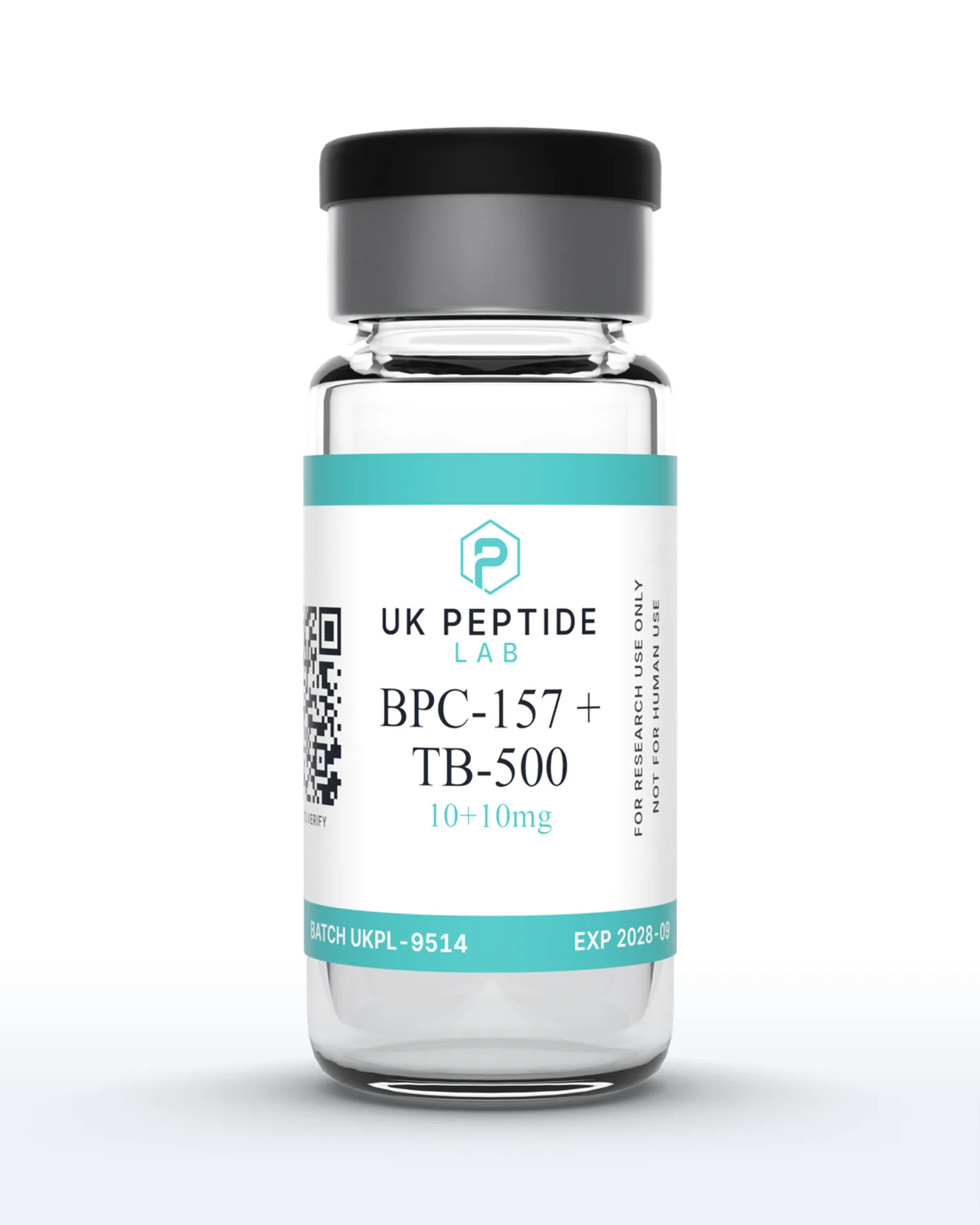
BPC-157 + TB-500
10+10mg
This blend pairs BPC-157 (Gly-Glu-Pro-Pro-Pro-Gly-Lys-Pro-Ala-Asp-Asp-Ala-Gly-Leu-Val) with TB-500, the synthetic 17-23 fragment of thymosin beta-4 (Ac-Leu-Lys-Lys-Thr-Glu-Thr-Gln), in a 10+10mg presentation. Both are among the most referenced peptides in cell migration, angiogenesis and tissue repair research. Supplied as lyophilised powder, supplier-tested, with the certificate published on this page and independent third-party verification pending.
Published research on BPC-157 + TB-500 is indexed on PubMed.
Intended Use: Strictly for in-vitro laboratory research. Not for use in humans or animals. Not to be used in foods, drugs, or medical diagnostics. This product has not been evaluated by the MHRA or FDA. Buyer assumes full responsibility for safe handling and regulatory compliance.
TBC
Purity
LAB
Certified
SAME
Day Ship
Quantity
Qualifies for free UK delivery · Royal Mail Tracked 24
Damaged or lost? Free reshipment guaranteed
Bacteriostatic Water 10ml
Required to reconstitute lyophilised peptides.
Research Use Only
This product is intended strictly for research and laboratory use only. Not for human consumption, medical use, or diagnostic purposes.
Certificate of Analysis
Third-party tested
Lyophilised Stability
24 months
Sealed at -20°C, light-protected
Reconstituted Stability
Up to 3 months
Stored at 2-8°C after mixing
Cold-Chain Shipping
Always
Dry-cold pack, Royal Mail Tracked 24
Important Notice
All compounds are sold individually and do not include research supplies. Products are provided in lyophilised (powder) form and require proper reconstitution before use in research settings.
Related Products
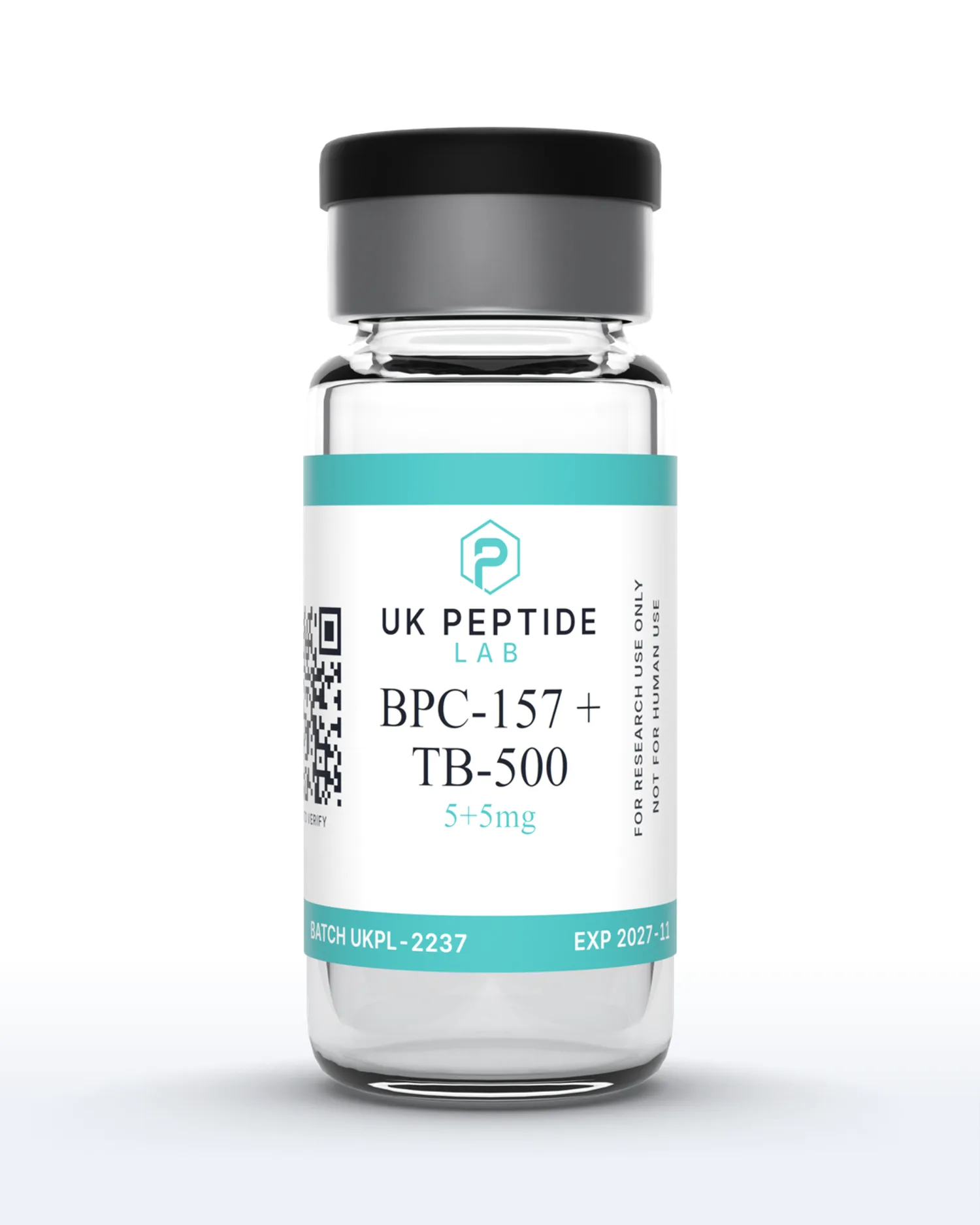
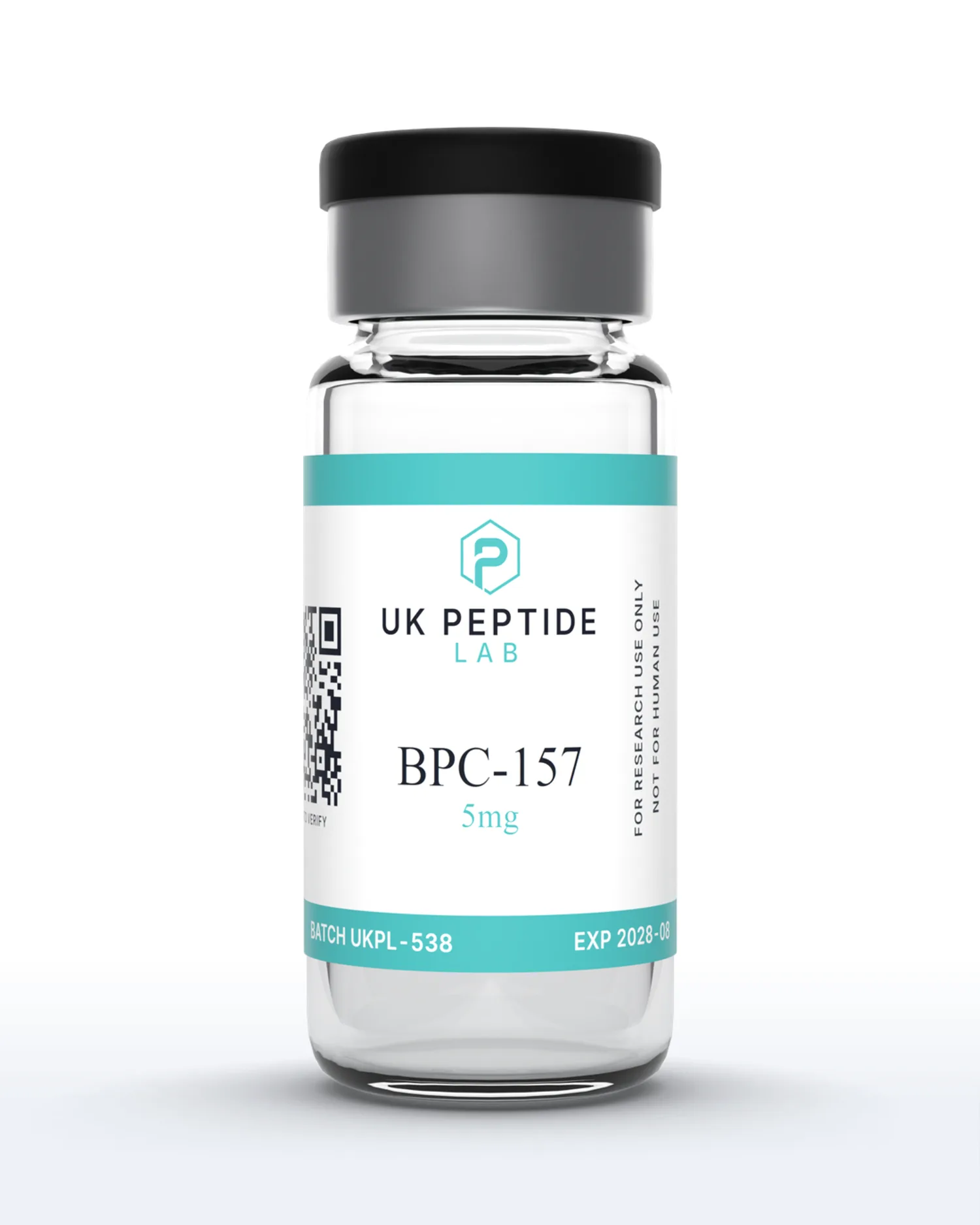
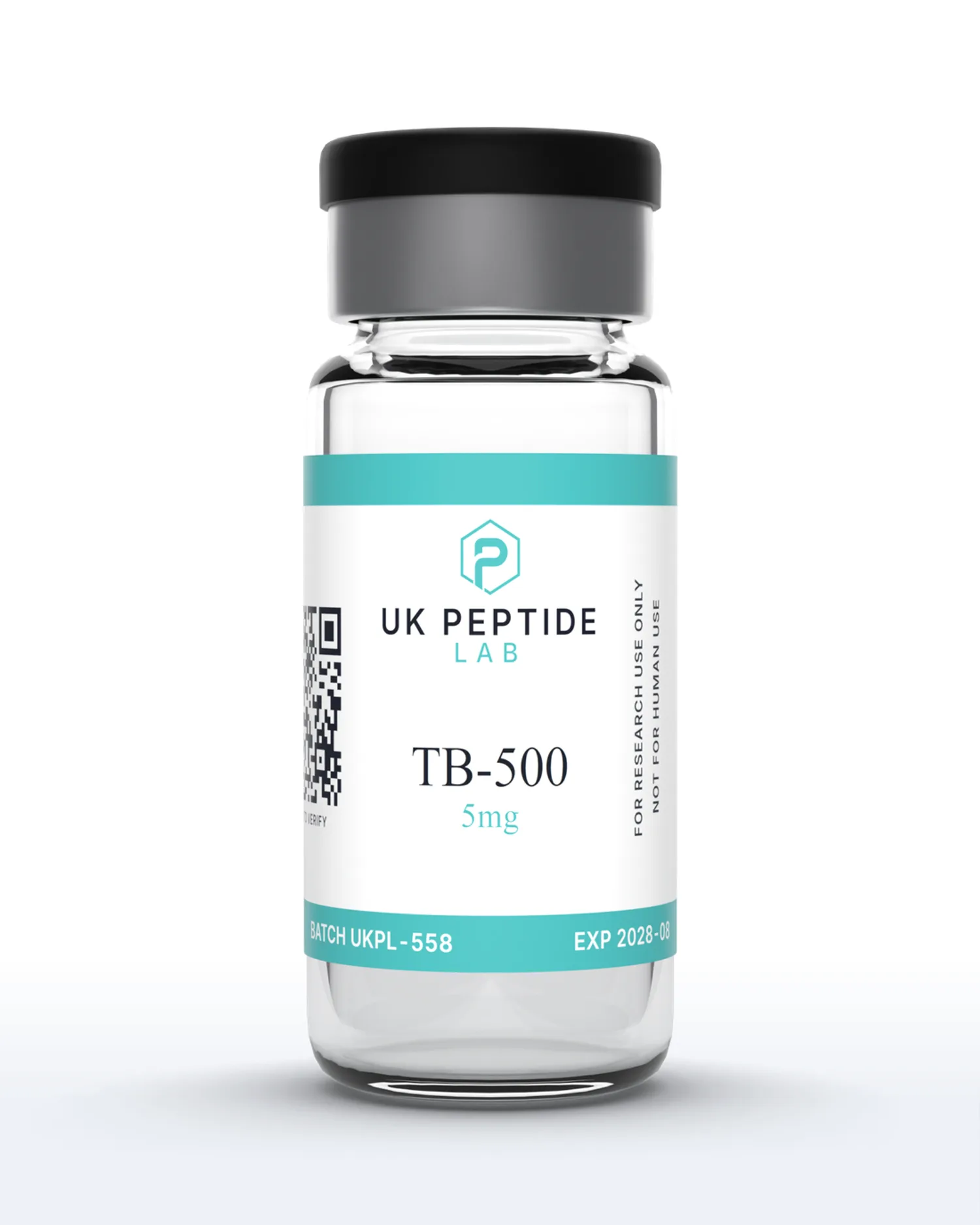
BPC-157 + TB-500 Price (UK)
BPC-157 + TB-500 is supplied in 2 vial sizes, priced from £29.99 for 5+5mg to £54.99 for 10+10mg. Every size ships from our UK facility with the same third-party HPLC certificate published on this page. This vial clears the £45 threshold on its own, so UK Royal Mail Tracked 24 delivery is free. Orders placed before 2pm on a working day are dispatched the same day.
| Vial | Price | Cost per mg | Availability |
|---|---|---|---|
| BPC-157 + TB-500 5+5mg | £29.99 | £3.00 | In stock |
| BPC-157 + TB-500 10+10mgThis page | £54.99 | £2.75Best value | In stock |
Prices are in GBP and shown per vial as supplied, lyophilised, for in-vitro laboratory research only. Cost per mg is given so researchers can compare vial sizes on a like-for-like basis. Stock and pricing on this table are read live from our inventory, so they match the basket. See our FAQ for delivery and payment options, and quality & testing for how each batch is verified.
Product Specifications
Research Overview
BPC-157 + TB-500 10+10mg is a co-formulated research vial holding 10mg of each peptide, 20mg of total peptide, supplied as lyophilised powder. BPC-157 is the pentadecapeptide Gly-Glu-Pro-Pro-Pro-Gly-Lys-Pro-Ala-Asp-Asp-Ala-Gly-Leu-Val, CAS 137525-51-0, molecular weight 1419.53 g/mol. TB-500 is the synthetic 17-23 fragment of thymosin beta-4, Ac-Leu-Lys-Lys-Thr-Glu-Thr-Gln, CAS 77591-33-4, molecular weight 4963.4 g/mol. Both compounds sit among the most referenced peptides in cell migration, angiogenesis and tissue repair research, and their individual literatures are covered in full on the separate BPC-157 and TB-500 product pages.
The two components report through distinct mechanisms. For BPC-157, Hsieh and colleagues (J Mol Med, 2017) reported upregulation and internalisation of VEGFR2 in human endothelial cells, and Chang and colleagues (J Appl Physiol, 2011) reported increased phosphorylation of focal adhesion kinase and paxillin in cultured rat tendon fibroblasts. For thymosin beta-4, Bock-Marquette and colleagues (Nature, 2004) reported cell migration and survival effects in mouse cardiac injury models, and Philp and colleagues (Wound Repair Regen, 2003) found the synthetic actin-binding domain peptide LKKTETQ promoted dermal wound repair in diabetic and aged mice.
This is the higher-mass presentation of the blend also offered at 5+5mg, and the chemistry is identical; what changes is quantity. Doubling the mass doubles the molar amounts without altering the ratio: 10mg of BPC-157 is roughly 7.0 µmol and 10mg of TB-500 roughly 2.0 µmol, an approximate 3.5 to 1 molar ratio in favour of BPC-157, exactly as in the 5+5mg rung. The 10+10mg vial means fewer vials, fewer reconstitution events and fewer lot boundaries for a given total mass, at the cost of placing 20mg behind a single in-use window.
No controlled study has evaluated this specific combination, so combination-specific claims cannot be supported, and a 2025 review by McGuire and colleagues (Curr Rev Musculoskelet Med) found no adequately powered randomised controlled trials for BPC-157 in musculoskeletal healing. The product is supplied as lyophilised powder for in-vitro laboratory research only, supplier-tested under batch UKPL-9514 with per-component content verified, with the certificate published on this page and independent third-party verification pending. It is not a licensed medicine and is not for human consumption.
Product Specifications
Laboratory Handling
- Store lyophilised vials at -20°C, protected from light and moisture. Reconstituted solution should be kept at 2-8°C and used within 4 weeks.
- Reconstitute with bacteriostatic water added slowly down the inner glass wall rather than onto the lyophilised cake, then swirl gently until fully dissolved. Do not shake or vortex, as agitation reduces recovery of intact TB-500.
- The two components cannot be separated after reconstitution, and the shorter of the two in-use windows governs the whole preparation. Express the preparation in molar terms only if the 3.5 to 1 asymmetry is accounted for.
- Handle under aseptic laboratory conditions with sterile equipment, prepare single-use aliquots for longer storage, and avoid repeated freeze-thaw cycles.
Frequently Asked Questions
What is BPC-157 + TB-500?
This is the higher-mass presentation of the pre-blended format, a single lyophilised vial co-formulated with BPC-157 10mg and TB-500 10mg, 20mg of total peptide under batch UKPL-9514. The two components are the same chemistry as the 5+5mg rung. BPC-157 is the pentadecapeptide Gly-Glu-Pro-Pro-Pro-Gly-Lys-Pro-Ala-Asp-Asp-Ala-Gly-Leu-Val, molecular weight 1419.53 g/mol, CAS 137525-51-0. TB-500 is the synthetic 17-23 fragment of thymosin beta-4, Ac-Leu-Lys-Lys-Thr-Glu-Thr-Gln, molecular weight 4963.4 g/mol, CAS 77591-33-4. The individual mechanisms and literatures are covered on the separate BPC-157 and TB-500 product pages; this page documents the blend as a format and the 10+10mg presentation specifically. What the higher-mass rung changes is procedural: the molar ratio is untouched by doubling the mass, the number of reconstitution events and lot boundaries falls, and the honest position that no controlled study has evaluated this specific combination is unchanged. Supplied as lyophilised powder for in-vitro research use only, not a licensed medicine.
10+10mg vs 5+5mg: What the Rung Changes
Nothing chemical distinguishes the two rungs. The sequences, masses and ratio are identical, and 10mg plus 10mg is still equal by mass and roughly 3.5 to 1 by moles in favour of BPC-157, because doubling both masses scales moles in step. What differs is procedural. The 10+10mg vial delivers twice the peptide per reconstitution event, so a study needing a given total mass uses half the vials, half the diluent transfers and one lot boundary instead of two, and it supports either double the working concentration at a fixed fill volume or double the volume at a fixed concentration. The costs sit on the other side of the scale. Once reconstituted, 20mg is committed to a single in-use window, which is wasteful for low-throughput designs that would otherwise spread the same mass across two staggered reconstitutions, and a handling error at reconstitution destroys twice the material. Analytically, the certificate must resolve two species of very different mass in either rung, though the larger absolute masses in the 10+10mg vial put marginally more signal behind the assay of each component.
BPC-157 + TB-500 Research Applications
The 10+10mg presentation suits preclinical soft-tissue and cell-migration designs whose timelines or cell numbers consume more peptide than a 5+5mg vial supplies: long-duration explant and co-culture experiments, concentration-response matrices, and designs that must hold one lot across every arm. The underlying literatures remain separate and preclinical for musculoskeletal endpoints. BPC-157 work centres on local angiogenic signalling, with Hsieh and colleagues (J Mol Med, 2017) reporting VEGFR2 upregulation and internalisation in human endothelial cells, and Chang and colleagues (J Appl Physiol, 2011) reporting increased focal adhesion kinase and paxillin phosphorylation in cultured rat tendon fibroblasts. Thymosin beta-4 work centres on actin binding and cell migration, with Bock-Marquette and colleagues (Nature, 2004) reporting cell migration and survival effects in mouse cardiac injury models and Philp and colleagues (Wound Repair Regen, 2003) reporting that the synthetic actin-binding domain peptide LKKTETQ promoted dermal wound repair in diabetic and aged mice. No controlled study has tested the two in combination against either alone, and a 2025 review by McGuire and colleagues (Curr Rev Musculoskelet Med) identified only three human pilot studies for BPC-157, with no adequately powered randomised controlled trials.
Reconstitution Guide
Treat the vial as a single 20mg preparation, with one fill volume set by the concentration your protocol specifies. Allow the vial and the bacteriostatic water to reach room temperature, swab both rubber stoppers with alcohol, then inject the diluent slowly down the inner glass wall rather than onto the lyophilised cake, and swirl gently until fully dissolved. Never shake or vortex: the TB-500 chain is shear sensitive and agitation reduces recovery of intact peptide, and the larger 20mg cake can take slightly longer to dissolve completely, so wait for a fully clear, colourless solution before drawing. Two points are specific to the blended format. First, the components cannot be separated after reconstitution, so protocols needing an independently chosen ratio require separate vials. Second, when expressing the preparation in molar terms, the components are present at roughly 7.0 µmol and 2.0 µmol respectively, not in equal molar amounts. Label the vial with the fill volume, resulting concentration and reconstitution date.
See our full peptide reconstitution guide and reconstitution calculator for step-by-step protocol.
Storage Instructions
Lyophilised vials should be stored at -20°C, protected from light and moisture, and remain stable for up to 24 months. Once reconstituted, hold the solution at 2-8°C and prepare single-use aliquots at -20°C for anything beyond short-term use. Because both components share one reconstitution date in a co-formulated vial, the shorter of the two in-use windows governs the whole preparation, and at 10+10mg that single window covers twice the peptide, so aliquot early rather than repeatedly accessing one stock. Avoid repeated freeze-thaw cycles, which reduce recovery of the TB-500 chain in particular, label every aliquot with the reconstitution date, and handle throughout under sterile laboratory conditions.
Frequently Asked Questions
Research References
- Therapeutic potential of pro-angiogenic BPC157 is associated with VEGFR2 activation and up-regulation (Hsieh et al., J Mol Med, 2017)
- The promoting effect of pentadecapeptide BPC 157 on tendon healing involves tendon outgrowth, cell survival, and cell migration (Chang et al., J Appl Physiol, 2011)
- Thymosin beta4 activates integrin-linked kinase and promotes cardiac cell migration, survival and cardiac repair (Bock-Marquette et al., Nature, 2004)
- Thymosin beta 4 and a synthetic peptide containing its actin-binding domain promote dermal wound repair in db/db diabetic mice and in aged mice (Philp et al., Wound Repair Regen, 2003)
- Regeneration or Risk? A Narrative Review of BPC-157 for Musculoskeletal Healing (McGuire et al., Curr Rev Musculoskelet Med, 2025)
BPC-157 + TB-500
10+10mg · £54.99