
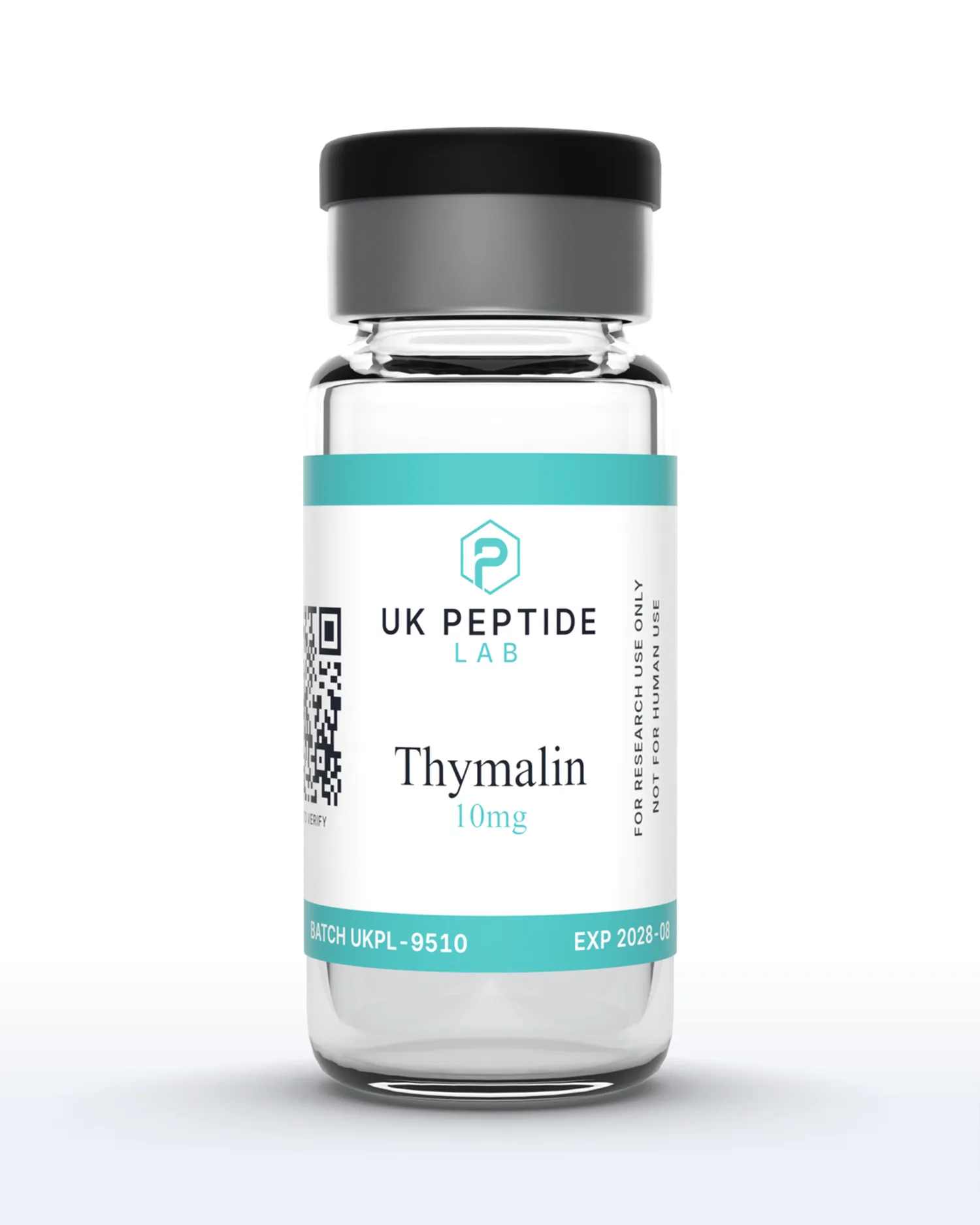
Thymalin
10mg
Thymalin is the thymus-derived dipeptide Glu-Trp, also referred to as timogen, first isolated from calf thymus extracts in the Soviet immunomodulator research programme. Research on thymus peptides has examined their reported effects on T-cell function and immune restoration in aged animal models. Supplied as lyophilised powder, supplier-tested, with the certificate published on this page and independent third-party verification pending.
Published research on Thymalin is indexed on PubMed.
Intended Use: Strictly for in-vitro laboratory research. Not for use in humans or animals. Not to be used in foods, drugs, or medical diagnostics. This product has not been evaluated by the MHRA or FDA. Buyer assumes full responsibility for safe handling and regulatory compliance.
TBC
Purity
LAB
Certified
SAME
Day Ship
Quantity
Add £17.01 more for free UK delivery
Damaged or lost? Free reshipment guaranteed
Bacteriostatic Water 10ml
Required to reconstitute lyophilised peptides.
Research Use Only
This product is intended strictly for research and laboratory use only. Not for human consumption, medical use, or diagnostic purposes.
Certificate of Analysis
Third-party tested
Lyophilised Stability
24 months
Sealed at -20°C, light-protected
Reconstituted Stability
Up to 3 months
Stored at 2-8°C after mixing
Cold-Chain Shipping
Always
Dry-cold pack, Royal Mail Tracked 24
Important Notice
All compounds are sold individually and do not include research supplies. Products are provided in lyophilised (powder) form and require proper reconstitution before use in research settings.
Related Products
Thymalin Price (UK)
Thymalin 10mg is £27.99 per vial, supplied from stock in the UK with a third-party HPLC certificate published on this page. UK delivery is £4.50 by Royal Mail Tracked 24, or free once your basket reaches £45 (£17.01 away at this price). Orders placed before 2pm on a working day are dispatched the same day.
| Vial | Price | Cost per mg | Availability |
|---|---|---|---|
| Thymalin 10mgThis page | £27.99 | £2.80 | In stock |
Prices are in GBP and shown per vial as supplied, lyophilised, for in-vitro laboratory research only. Cost per mg is given so researchers can compare vial sizes on a like-for-like basis. Stock and pricing on this table are read live from our inventory, so they match the basket. See our FAQ for delivery and payment options, and quality & testing for how each batch is verified.
Product Specifications
Research Overview
Thymalin, as supplied here, is the thymus-derived dipeptide L-glutamyl-L-tryptophan, written Glu-Trp and in one-letter code EW, with the molecular formula C₁₆H₁₉N₃O₅, a molecular weight of 333.34 g/mol and CAS number 38101-59-6. It is the synthetic dipeptide also referred to as timogen (also written thymogen). The name carries a precise history: thymalin originally denoted a polypeptide complex isolated from calf thymus extracts in the Soviet immunomodulator research programme by Morozov and Khavinson (Biokhimiya, 1981), and the Glu-Trp dipeptide was later separated from that complex by reversed-phase HPLC, synthesised and taken forward as a discrete immunomodulatory molecule (Morozov and Khavinson, Int J Immunopharmacol, 1997; Khavinson et al., Biol Bull Rev, 2021).
Research on thymus peptides has examined their reported effects on T-cell function and immune restoration in aged animal models. The English-language review by Khavinson and colleagues (Biol Bull Rev, 2021) summarises the reported immunoprotective effects of the thymus peptides: restoration of the number and ratio of T and B lymphocytes and their subpopulations, an increase in their functional activity, and increased phagocytosis in immunodepressed states. Anisimov and Khavinson (Biogerontology, 2010) review the same programme's geroprotective work across the thymus and pineal preparations. For the dipeptide specifically, the defining animal study is Anisimov, Khavinson and Morozov (Biogerontology, 2000), who reported that L-Glu-L-Trp slowed the ageing rate, increased survival and decreased spontaneous tumour incidence, roughly 1.5-fold, in outbred female rats.
The chemistry worth knowing before experimental design is concentrated in the tryptophan residue. The indole side chain absorbs UV light strongly, which makes the dipeptide convenient to follow spectrophotometrically, and it oxidises readily in solution, which is the degradation route to design against in handling and storage.
It is worth being direct about two things. First, the evidence base: the primary data originate overwhelmingly from one affiliated research cluster, much of it is Russian-language, the human evidence is small and does not meet modern regulatory standards, and thymalin holds no marketing authorisation in the UK, the EU or the United States. Second, the naming: thymulin, the distinct zinc-dependent nonapeptide characterised by Bach and colleagues (Nature, 1977), is a different molecule with a different literature, and the two names are routinely confused. Thymalin is supplied as lyophilised powder for in-vitro laboratory research only.
Product Specifications
Laboratory Handling
- Store lyophilised vials at -20°C, protected from light and moisture. Reconstituted Thymalin should be refrigerated at 2-8°C and used within 4 weeks.
- Reconstitute with bacteriostatic water, injecting the solvent slowly down the inner glass wall rather than directly onto the powder, then swirl gently until fully dissolved. Avoid shaking or vortexing the peptide solution.
- The tryptophan indole side chain is oxidation- and light-sensitive: minimise stopper-open time and headspace air, protect reconstituted solutions from light, and handle under aseptic laboratory conditions with sterile equipment throughout.
- Avoid repeated freeze-thaw cycles. Prepare measured single-use aliquots from reconstituted stock for consistent experimental use.
Frequently Asked Questions
What is Thymalin?
Thymalin, as supplied here, is the thymus-derived dipeptide L-glutamyl-L-tryptophan, written Glu-Trp or in one-letter code EW, molecular formula C₁₆H₁₉N₃O₅, molecular weight 333.34 g/mol, CAS 38101-59-6. It is the synthetic dipeptide also referred to as timogen (also written thymogen), and its history is worth stating precisely because the name carries more than one meaning. The original thymalin was a polypeptide complex isolated from calf thymus in the Soviet immunomodulator research programme by Morozov and Khavinson (Biokhimiya, 1981), and the Glu-Trp dipeptide was later separated from that complex by reversed-phase HPLC, synthesised, and taken forward as a discrete immunomodulatory molecule (Morozov and Khavinson, Int J Immunopharmacol, 1997; Khavinson et al., Biol Bull Rev, 2021). Because the dipeptide carries a tryptophan residue, the indole side chain is the chemistry to design around: it absorbs UV light strongly and is oxidation-sensitive in solution. The compound must not be confused with thymulin, the distinct zinc-dependent nonapeptide characterised by Bach and colleagues (Nature, 1977), which is a different molecule with a different literature. Supplied as lyophilised powder for in-vitro laboratory research use only, and it holds no marketing authorisation in the UK, the EU or the United States.
Thymalin vs Thymulin
The two names differ by a single letter and describe two different molecules, which is why the confusion persists. Thymalin, as supplied here, is the dipeptide Glu-Trp (EW), molecular weight 333.34 g/mol, CAS 38101-59-6, the defined sequence identified within the calf-thymus polypeptide complex of the Soviet programme and studied for reported effects on T-cell function and immune restoration in aged animal models (Anisimov et al., Biogerontology, 2000; Khavinson et al., Biol Bull Rev, 2021). Thymulin, historically called facteur thymique sérique or FTS, is a distinct nonapeptide of sequence Glu-Ala-Lys-Ser-Gln-Gly-Gly-Ser-Asn whose biological activity and antigenicity depend on zinc coordination, first characterised by Bach and colleagues (Nature, 1977). The two come from the same organ and share an immunology-adjacent literature, but they are chemically unrelated: a two-residue synthetic dipeptide against a nine-residue zinc-bound thymic hormone. Any protocol, search string or citation built on one should not be transferred to the other without checking, and summaries that blur the two names should be treated with caution.
Thymalin Research Applications
Thymalin is used in immunology research as a defined short peptide within the thymus-peptide literature: T-cell function assays, T- and B-lymphocyte subset analyses, and models of age-related immunodepression in which restoration of lymphocyte numbers and functional activity is the measured endpoint. The reference frame is the Soviet and Russian thymus programme, reviewed in English by Khavinson and colleagues (Biol Bull Rev, 2021), which summarises reported restoration of the number and ratio of T and B lymphocytes and their subpopulations, increased functional activity, and increased phagocytosis in immunodepressed states, alongside geroprotective endpoints in aged animals (Anisimov and Khavinson, Biogerontology, 2010). For the dipeptide specifically, the defining animal study is Anisimov, Khavinson and Morozov (Biogerontology, 2000), who treated outbred female rats and reported a slowed ageing rate, increased survival and a roughly 1.5-fold decrease in spontaneous tumour incidence relative to control animals. The honest boundary: the primary literature is concentrated in one research cluster, much of it is Russian-language, the human evidence is small and does not meet modern regulatory standards, and the compound holds no marketing authorisation in the UK, the EU or the United States. Material supplied here is for in-vitro laboratory research only.
Reconstitution Guide
Allow vials to reach room temperature, then sterilise the rubber stopper of both the peptide vial and the bacteriostatic water vial with an alcohol swab. Slowly draw your bacteriostatic water into a sterile syringe, then inject it gently down the inner glass wall of the peptide vial, never directly onto the lyophilised powder. Once added, gently swirl the vial in a slow circular motion until fully dissolved. Never shake or vortex. Thymalin is a short two-residue peptide and dissolves readily to a clear solution, but it carries a tryptophan residue whose indole side chain is oxidation- and light-sensitive, so work efficiently, minimise stopper-open time, avoid introducing excess air, and protect the solution from light where practical. Label the vial with the reconstitution date and refrigerate immediately.
See our full peptide reconstitution guide and reconstitution calculator for step-by-step protocol.
Storage Instructions
Lyophilised vials should be stored at -20°C, protected from light and moisture, and remain stable for up to 24 months. Once reconstituted with bacteriostatic water, store the solution at 2-8°C (standard refrigerator) and use within approximately 4 weeks. For longer storage, prepare single-use aliquots at -20°C and avoid repeated freeze-thaw cycles. The degradation route to design against with thymalin is oxidation of the tryptophan indole ring: keep vials tightly sealed with minimal headspace, protect the solution from light, and never store it in contact with oxidising agents. Handle under sterile laboratory conditions throughout.
Frequently Asked Questions
Research References
- Isolation, purification, and identification of an immunomodulatory polypeptide found in the thymus of calves and humans (Morozov and Khavinson, Biokhimiya, 1981)
- Immunomodulatory synthetic dipeptide L-Glu-L-Trp slows down aging and inhibits spontaneous carcinogenesis in rats (Anisimov et al., Biogerontology, 2000)
Related Research Compounds
Thymalin
10mg · £27.99