
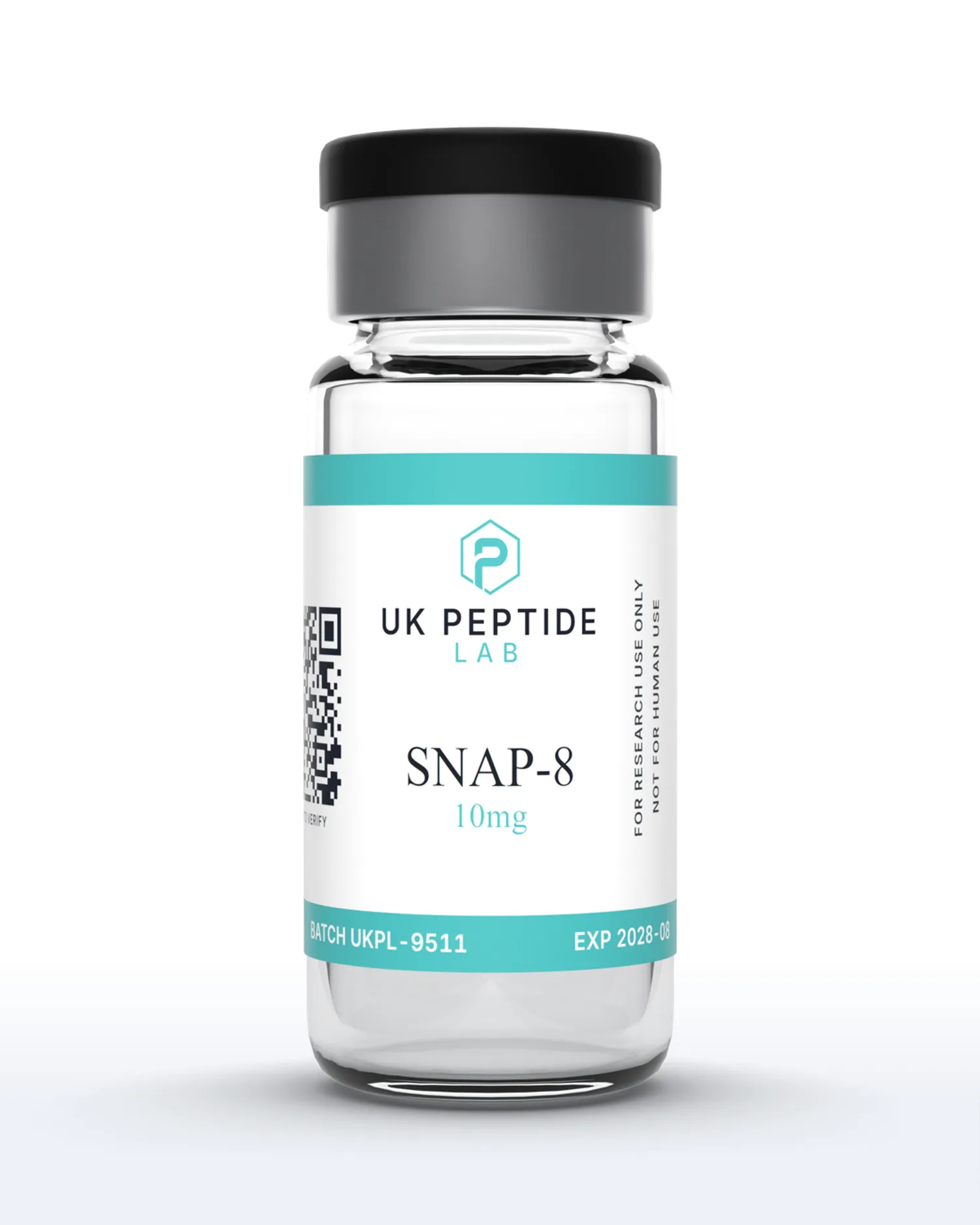
SNAP-8
10mg
SNAP-8 is an acetyl octapeptide (Glu-Glu-Met-Gln-Arg-Arg-Ala-Asp-NH2) designed to extend the sequence of acetyl hexapeptide-3. Research has examined its reported inhibition of SNARE complex formation and catecholamine release in models of neuromuscular signalling, with applications studied primarily in cosmetic science. Supplied as lyophilised powder, supplier-tested, with the certificate published on this page and independent third-party verification pending.
Published research on SNAP-8 is indexed on PubMed.
Intended Use: Strictly for in-vitro laboratory research. Not for use in humans or animals. Not to be used in foods, drugs, or medical diagnostics. This product has not been evaluated by the MHRA or FDA. Buyer assumes full responsibility for safe handling and regulatory compliance.
TBC
Purity
LAB
Certified
SAME
Day Ship
Quantity
Add £25.01 more for free UK delivery
Damaged or lost? Free reshipment guaranteed
Bacteriostatic Water 10ml
Required to reconstitute lyophilised peptides.
Research Use Only
This product is intended strictly for research and laboratory use only. Not for human consumption, medical use, or diagnostic purposes.
Certificate of Analysis
Third-party tested
Lyophilised Stability
24 months
Sealed at -20°C, light-protected
Reconstituted Stability
Up to 3 months
Stored at 2-8°C after mixing
Cold-Chain Shipping
Always
Dry-cold pack, Royal Mail Tracked 24
Important Notice
All compounds are sold individually and do not include research supplies. Products are provided in lyophilised (powder) form and require proper reconstitution before use in research settings.
Related Products
SNAP-8 Price (UK)
SNAP-8 10mg is £19.99 per vial, supplied from stock in the UK with a third-party HPLC certificate published on this page. UK delivery is £4.50 by Royal Mail Tracked 24, or free once your basket reaches £45 (£25.01 away at this price). Orders placed before 2pm on a working day are dispatched the same day.
| Vial | Price | Cost per mg | Availability |
|---|---|---|---|
| SNAP-8 10mgThis page | £19.99 | £2.00 | In stock |
Prices are in GBP and shown per vial as supplied, lyophilised, for in-vitro laboratory research only. Cost per mg is given so researchers can compare vial sizes on a like-for-like basis. Stock and pricing on this table are read live from our inventory, so they match the basket. See our FAQ for delivery and payment options, and quality & testing for how each batch is verified.
Product Specifications
Research Overview
SNAP-8, catalogued as acetyl octapeptide-3, is a synthetic eight-residue peptide with the sequence Ac-Glu-Glu-Met-Gln-Arg-Arg-Ala-Asp-NH₂, molecular formula C₄₁H₇₀N₁₆O₁₆S and molecular weight approximately 1075 g/mol (CAS 868844-74-0). It was designed as an extended form of acetyl hexapeptide-3 (Argireline), the six-residue peptide Ac-Glu-Glu-Met-Gln-Arg-Arg-NH₂, by adding an alanine and an aspartate at the C-terminus, and it was developed and marketed for cosmetic science by Lipotec. Both sequences are patterned after the N-terminal region of SNAP-25, the synaptosome-associated 25 kDa protein of the neuronal SNARE complex. SNAP-25 contributes two helices to this four-helix assembly, which drives calcium-dependent vesicle fusion at the synapse, and it is the substrate cleaved by botulinum neurotoxin A at the neuromuscular junction. Peptides that mimic its N-terminal domain are proposed to compete with native SNAP-25 for complex formation. The reference mechanistic work is Blanes-Mira and colleagues (J Neurochem, 2004), who reported that such peptides inhibit SNARE complex assembly and calcium-dependent catecholamine exocytosis in chromaffin cell models. Research interest in SNAP-8 is therefore centred on models of neuromuscular signalling, with applications studied primarily in cosmetic science as a botulinum-toxin-mimetic model peptide, a class catalogued by Pintea and colleagues (Biomolecules, 2025).
The chromaffin cell model that underpins this field predates the peptide itself: Gutierrez and colleagues (J Biol Chem, 1997) used C-terminal SNAP-25 peptides to block secretory vesicle docking in chromaffin cells, establishing the experimental system in which the later N-terminal peptide series was characterised.
The honest boundary of the evidence is worth stating plainly. The peer-reviewed mechanistic literature is small and originates largely from a single research group. The octapeptide has no published, independent, randomised cosmetic trial of its own; most efficacy figures circulating for it trace to manufacturer technical dossiers rather than journals. And the widely quoted 30% wrinkle-depth figure belongs to the hexapeptide's small open-label volunteer study (Blanes-Mira et al., Int J Cosmet Sci, 2002), not to the octapeptide. SNAP-8 holds no marketing authorisation in any jurisdiction and is supplied as lyophilised powder for in-vitro laboratory research only.
UK Peptide Lab supplies SNAP-8 10mg at £19.99, batch UKPL-9511, supplier-tested at 98.92% purity by RP-HPLC, with the certificate of analysis published on this page and independent third-party verification pending.
Product Specifications
Laboratory Handling
- Store lyophilised vials at -20°C, protected from light and moisture. Reconstituted solution should be kept at 2-8°C and used within 4 weeks.
- Reconstitute with bacteriostatic water, injecting the solvent slowly down the inner glass wall rather than onto the powder, then swirl gently until fully dissolved. Do not shake or vortex.
- The sequence carries a methionine at position three, so oxidation is the degradation route to design against. Minimise headspace and stopper-open time, keep solutions cold, and prepare single-use aliquots rather than repeatedly accessing one vial.
- Handle under aseptic laboratory conditions with alcohol-swabbed stoppers and sterile syringes. Avoid repeated freeze-thaw cycles, and discard any solution that becomes turbid.
Frequently Asked Questions
What is SNAP-8?
SNAP-8, catalogued as acetyl octapeptide-3, is a synthetic eight-residue peptide with the sequence Ac-Glu-Glu-Met-Gln-Arg-Arg-Ala-Asp-NH₂, molecular formula C₄₁H₇₀N₁₆O₁₆S, molecular weight approximately 1075 g/mol, CAS 868844-74-0. It was designed as an extended form of acetyl hexapeptide-3 (Argireline), the six-residue peptide Ac-Glu-Glu-Met-Gln-Arg-Arg-NH₂, adding an alanine and an aspartate at the C-terminus, and it was developed and marketed for cosmetic science by Lipotec. Both sequences are patterned after the N-terminal region of SNAP-25, the synaptosome-associated 25 kDa protein that contributes two helices to the neuronal SNARE complex, the four-helix assembly that drives calcium-dependent vesicle fusion at the synapse and that is cleaved by botulinum neurotoxin A at the neuromuscular junction. The core mechanistic literature is Blanes-Mira and colleagues (J Neurochem, 2004), who reported that peptides patterned after the N-terminal domain of SNAP-25 inhibit SNARE complex formation and calcium-dependent catecholamine exocytosis in chromaffin cell models. Applications are studied primarily in cosmetic science, a field catalogued by Pintea and colleagues (Biomolecules, 2025). SNAP-8 holds no marketing authorisation in any jurisdiction and is supplied as lyophilised powder for in-vitro laboratory research only.
SNAP-8 vs Argireline (Acetyl Hexapeptide-3)
Argireline and SNAP-8 come from the same design programme and share six of their residues, so the difference between them is genuinely small in chemistry and large in published evidence. Argireline is the hexapeptide Ac-Glu-Glu-Met-Gln-Arg-Arg-NH₂, molecular weight approximately 889 g/mol. SNAP-8 extends that sequence by two residues at the C-terminus, giving Ac-Glu-Glu-Met-Gln-Arg-Arg-Ala-Asp-NH₂ at approximately 1075 g/mol (CAS 868844-74-0), which matches SNAP-25 residues 12 to 19. Both are proposed to act by competing with native SNAP-25 for SNARE complex assembly, which would attenuate the exocytosis that releases acetylcholine at the neuromuscular junction and catecholamines from chromaffin cells. The published record separates them. The hexapeptide carries the direct cosmetic study: Blanes-Mira and colleagues (Int J Cosmet Sci, 2002) reported that a 10% oil-in-water emulsion reduced wrinkle depth by up to 30% after 30 days in a small open-label volunteer study, alongside in-vitro neurotransmitter-release data. The octapeptide's peer-reviewed record is thinner and rests largely on the N-terminal peptide programme of the same group (J Neurochem, 2004) plus manufacturer technical dossiers. Researchers comparing the two should treat the Ala-Asp extension, not any circulating potency ranking, as the variable of interest, because published head-to-head data are sparse.
SNAP-8 Research Applications
SNAP-8 is used in in-vitro research on the SNAP-25 component of the neuronal SNARE complex: SNARE assembly and disassembly assays, competition studies against native SNAP-25 and syntaxin, and models of calcium-dependent exocytosis and catecholamine release in chromaffin cells, following the N-terminal peptide series reported by Blanes-Mira and colleagues (J Neurochem, 2004). The chromaffin cell system has a long lineage in this field, established for the complementary C-terminal SNAP-25 peptides by Gutierrez and colleagues (J Biol Chem, 1997), who showed that such a peptide blocks secretory vesicle docking. In cosmetic science the peptide is studied as a botulinum-toxin-mimetic model compound, a class catalogued by Pintea and colleagues (Biomolecules, 2025), and analytical methods for quantifying it in formulations have been published (Ji et al., J Anal Sci Technol, 2020). The honest boundaries: the mechanistic literature is small and concentrated in one research group, the cosmetic efficacy data for the octapeptide itself are largely manufacturer dossier material rather than independent published trials, and no marketing authorisation exists anywhere. Material supplied here is for in-vitro laboratory research only.
Reconstitution Guide
Allow the vial to reach room temperature, then sterilise the rubber stoppers of both the peptide vial and the bacteriostatic water vial with an alcohol swab. Slowly draw your bacteriostatic water into a sterile syringe and inject it gently down the inner glass wall of the vial, never directly onto the lyophilised powder. Swirl slowly in a circular motion until the powder is fully dissolved and the solution is clear and colourless; never shake or vortex. The three arginine residues give the peptide a strong positive charge, so dissolution is normally unproblematic, but the methionine at position three is oxidation-prone: work efficiently, avoid introducing excess air into the vial, and re-seal promptly after each draw. Label the vial with the reconstitution date and refrigerate immediately.
See our full peptide reconstitution guide and reconstitution calculator for step-by-step protocol.
Storage Instructions
Store lyophilised vials at -20°C, protected from light and moisture, for long-term stability of up to 24 months; the lyophilised powder tolerates short transit at ambient temperature but should be moved to the freezer on receipt. Once reconstituted with bacteriostatic water, hold the solution at 2-8°C (standard refrigerator) and use within approximately 4 weeks, or prepare single-use aliquots at -20°C for longer storage and thaw each aliquot only once. The degradation route to design against is oxidation of the methionine at position three: keep vials tightly sealed with minimal headspace, protect from light, and never store the solution in contact with oxidising agents. Handle under sterile laboratory conditions throughout and discard any solution that becomes turbid.
Frequently Asked Questions
Research References
Related Research Compounds
SNAP-8
10mg · £19.99