
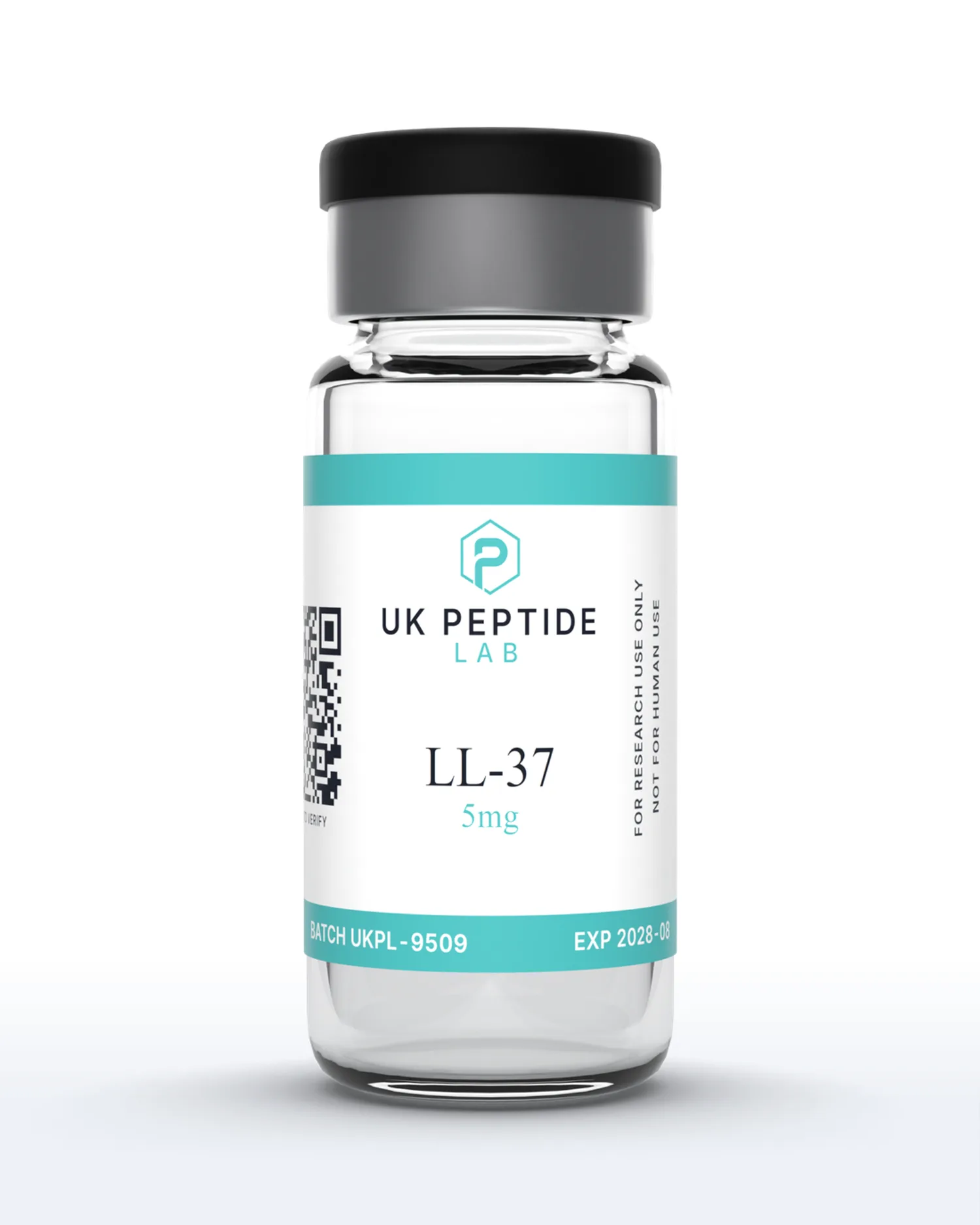
LL-37
5mg
LL-37 is a 37-residue cathelicidin-derived antimicrobial peptide (LLGDFFRKSKEKIGKEFKRIVQRIKDFLRNLVPRTES), the only human member of the cathelicidin family. Research has examined its broad-spectrum antimicrobial activity, its role in wound healing and angiogenesis, and its immunomodulatory effects on epithelial tissues. Supplied as lyophilised powder, supplier-tested, with the certificate published on this page and independent third-party verification pending.
Published research on LL-37 is indexed on PubMed.
Intended Use: Strictly for in-vitro laboratory research. Not for use in humans or animals. Not to be used in foods, drugs, or medical diagnostics. This product has not been evaluated by the MHRA or FDA. Buyer assumes full responsibility for safe handling and regulatory compliance.
TBC
Purity
LAB
Certified
SAME
Day Ship
Quantity
Add £10.01 more for free UK delivery
Damaged or lost? Free reshipment guaranteed
Bacteriostatic Water 10ml
Required to reconstitute lyophilised peptides.
Research Use Only
This product is intended strictly for research and laboratory use only. Not for human consumption, medical use, or diagnostic purposes.
Certificate of Analysis
Third-party tested
Lyophilised Stability
24 months
Sealed at -20°C, light-protected
Reconstituted Stability
Up to 3 months
Stored at 2-8°C after mixing
Cold-Chain Shipping
Always
Dry-cold pack, Royal Mail Tracked 24
Important Notice
All compounds are sold individually and do not include research supplies. Products are provided in lyophilised (powder) form and require proper reconstitution before use in research settings.
Related Products
LL-37 Price (UK)
LL-37 5mg is £34.99 per vial, supplied from stock in the UK with a third-party HPLC certificate published on this page. UK delivery is £4.50 by Royal Mail Tracked 24, or free once your basket reaches £45 (£10.01 away at this price). Orders placed before 2pm on a working day are dispatched the same day.
| Vial | Price | Cost per mg | Availability |
|---|---|---|---|
| LL-37 5mgThis page | £34.99 | £7.00 | In stock |
Prices are in GBP and shown per vial as supplied, lyophilised, for in-vitro laboratory research only. Cost per mg is given so researchers can compare vial sizes on a like-for-like basis. Stock and pricing on this table are read live from our inventory, so they match the basket. See our FAQ for delivery and payment options, and quality & testing for how each batch is verified.
Product Specifications
Research Overview
LL-37 is a 37-residue, cationic, amphipathic antimicrobial peptide corresponding to the C-terminal region of the human cathelicidin precursor hCAP-18, with the sequence Leu-Leu-Gly-Asp-Phe-Phe-Arg-Lys-Ser-Lys-Glu-Lys-Ile-Gly-Lys-Glu-Phe-Lys-Arg-Ile-Val-Gln-Arg-Ile-Lys-Asp-Phe-Leu-Arg-Asn-Leu-Val-Pro-Arg-Thr-Glu-Ser, molecular formula C₂₀₅H₃₄₀N₆₀O₅₃, molecular weight 4493.3 g/mol and CAS number 154947-66-7. It is the only human member of the cathelicidin family of antimicrobial peptides, carrying a net charge of +6 with no cysteine, methionine or tryptophan in its sequence. The peptide was first predicted as FALL-39 from a human bone-marrow cDNA library (Agerberth et al., Proc Natl Acad Sci USA, 1995), the mature peptide was isolated from human granulocytes and its gene characterised by Gudmundsson and colleagues (Eur J Biochem, 1996), and its release from the inactive precursor hCAP-18 by the neutrophil enzyme proteinase 3 was characterised by Sorensen and colleagues (Blood, 2001). In membrane-mimetic environments LL-37 folds into an amphipathic alpha-helix, the conformation solved alongside that of its smallest antimicrobial fragment KR-12 in lipid micelles by Wang (J Biol Chem, 2008), and the field is reviewed comprehensively by Dürr and colleagues (Biochim Biophys Acta, 2006).
Research has examined LL-37's broad-spectrum antimicrobial activity, its role in wound healing and angiogenesis, and its immunomodulatory effects on epithelial tissues. The foundational antimicrobial study is Turner and colleagues (Antimicrob Agents Chemother, 1998), who reported activity against Pseudomonas aeruginosa, including mucoid and antibiotic-resistant strains, Escherichia coli, Staphylococcus aureus and vancomycin-resistant enterococci, with later work extending to anti-biofilm and antiviral assays. Angiogenesis and wound-healing work includes the report of endothelial proliferation and new vessel formation in model systems by Koczulla and colleagues (J Clin Invest, 2003), keratinocyte migration and improved wound healing in diabetic mice by Carretero and colleagues (J Invest Dermatol, 2008), and stimulated proliferation and wound closure in airway epithelial cells by Shaykhiev and colleagues (Am J Physiol Lung Cell Mol Physiol, 2005). Epithelial immunomodulation work includes chemotactic and cytokine-modulating activities and, in psoriasis, the formation of complexes with self-DNA that activate plasmacytoid dendritic cells through Toll-like receptor 9 (Lande et al., Nature, 2007).
It is worth being direct about the state of the human evidence, because the in-vitro literature is large and the human literature is not. Most findings come from cell-culture assays and animal models, and the human clinical record is limited to a single randomised, placebo-controlled trial of topical LL-37 in hard-to-heal venous leg ulcers (Grönberg et al., Wound Repair Regen, 2014), which reported that treatment was safe and well tolerated, that the highest concentration tested showed no difference from placebo, and that effects on healing-related predictors at the two lower concentrations warranted further investigation. LL-37 holds no marketing authorisation in any jurisdiction and is supplied here as lyophilised powder, supplier-tested, with the certificate published on this page and independent third-party verification pending, strictly for in-vitro laboratory research use only.
Product Specifications
Laboratory Handling
- Store lyophilised vials at -20°C, protected from light and moisture. Reconstituted LL-37 should be kept at 2-8°C and used within 4 weeks.
- Reconstitute with bacteriostatic water, injecting the diluent slowly down the inner glass wall rather than directly onto the powder, then swirl gently until fully dissolved. Do not shake or vortex the peptide solution.
- LL-37 is a cationic peptide that adsorbs to plastic surfaces and aggregates in solution; work with cold diluents, minimise dilution steps in plastic vessels and prepare fresh working dilutions rather than storing them.
- Handle under aseptic laboratory conditions using sterile equipment throughout reconstitution and aliquoting, and avoid repeated freeze-thaw cycles. Prepare measured single-use aliquots from reconstituted stock.
Frequently Asked Questions
What is LL-37?
LL-37 is a 37-residue, cationic, amphipathic antimicrobial peptide comprising the C-terminal region of the human cathelicidin precursor hCAP-18, sequence Leu-Leu-Gly-Asp-Phe-Phe-Arg-Lys-Ser-Lys-Glu-Lys-Ile-Gly-Lys-Glu-Phe-Lys-Arg-Ile-Val-Gln-Arg-Ile-Lys-Asp-Phe-Leu-Arg-Asn-Leu-Val-Pro-Arg-Thr-Glu-Ser, written LLGDFFRKSKEKIGKEFKRIVQRIKDFLRNLVPRTES, molecular formula C₂₀₅H₃₄₀N₆₀O₅₃, molecular weight 4493.3 g/mol, CAS 154947-66-7. It is the only human member of the cathelicidin family of antimicrobial peptides, released from the inactive precursor hCAP-18 by the neutrophil enzyme proteinase 3 (Sorensen et al., Blood, 2001). The peptide was first predicted as FALL-39 from a human bone-marrow cDNA library (Agerberth et al., Proc Natl Acad Sci USA, 1995), and the mature peptide was isolated from human granulocytes and its gene characterised by Gudmundsson and colleagues (Eur J Biochem, 1996); the name LL-37 records the two N-terminal leucines and the 37 residues. Eleven basic residues against five acidic residues give a net charge of +6 at neutral pH, and the sequence carries no cysteine, methionine or tryptophan, so the molecule has no disulfides and no oxidation-prone residues; in membrane-mimetic environments it folds into an amphipathic alpha-helix, the conformation solved alongside that of its smallest antimicrobial fragment KR-12 in lipid micelles by Wang (J Biol Chem, 2008). The standard structural and functional review of the field is Dürr and colleagues (Biochim Biophys Acta, 2006). Supplied as lyophilised powder, supplier-tested, with the certificate published on this page and independent third-party verification pending. For in-vitro laboratory research use only; LL-37 holds no marketing authorisation anywhere.
LL-37 vs KR-12
The two peptides are the closest chemical comparators in this catalogue: LL-37 is the full-length 37-residue human cathelicidin, and KR-12 is its smallest fragment that retains antimicrobial activity, spanning residues 18 to 29 (Lys-Arg-Ile-Val-Gln-Arg-Ile-Lys-Asp-Phe-Leu-Arg, written KRIVQRIKDFLR). Wang (J Biol Chem, 2008) solved the structures of both peptides in lipid micelles, and the pair now serves as the standard system for mapping which features of the full-length sequence are load-bearing. The full-length peptide carries the complete set of activities documented in the literature, antimicrobial, angiogenic, wound-healing and immunomodulatory, but it is aggregation-prone in solution and its antimicrobial activity is attenuated by serum, limitations discussed by Dürr and colleagues (Biochim Biophys Acta, 2006). KR-12 strips the sequence to its minimal amphipathic core: it is easier to keep in solution, cheaper to synthesise and cleaner to interpret in structure-activity work, but findings made with it cannot be assumed to transfer to the full-length peptide. Researchers choose LL-37 when fidelity to the endogenous human molecule matters, and KR-12 when the question is which residues and which helical features are necessary for membrane activity.
LL-37 Research Applications
LL-37 is used in in-vitro and model-organism research along three lines. Antimicrobial work follows Turner and colleagues (Antimicrob Agents Chemother, 1998), who reported activity of the neutrophil peptide against Pseudomonas aeruginosa, including mucoid and antibiotic-resistant strains, Salmonella typhimurium, Escherichia coli, Listeria monocytogenes, Staphylococcus aureus and vancomycin-resistant enterococci, and the field has since extended to anti-biofilm and antiviral assays; activity is attenuated by serum, a limitation discussed by Dürr and colleagues (Biochim Biophys Acta, 2006). Wound-healing and angiogenesis work follows Koczulla and colleagues (J Clin Invest, 2003), who reported endothelial proliferation and new vessel formation in model systems, Carretero and colleagues (J Invest Dermatol, 2008), who reported keratinocyte migration in vitro and improved wound healing in diabetic mice through adenovirus-mediated gene transfer, and Shaykhiev and colleagues (Am J Physiol Lung Cell Mol Physiol, 2005), who reported proliferation and wound closure in airway epithelial cells. Immunomodulatory work includes chemotaxis and cytokine-release assays and, most prominently, the self-DNA sensing mechanism described in psoriasis by Lande and colleagues (Nature, 2007). The honest boundary: the human clinical evidence consists of a single randomised, placebo-controlled trial of topical LL-37 in hard-to-heal venous leg ulcers (Grönberg et al., Wound Repair Regen, 2014), which reported that treatment was safe and well tolerated but that the highest concentration tested showed no difference from placebo, and most published findings are in-vitro or preclinical. Material supplied here is for in-vitro laboratory research only.
Reconstitution Guide
Allow vials to reach room temperature, then sterilise the rubber stopper of both the peptide vial and the bacteriostatic water vial with an alcohol swab. Slowly draw your bacteriostatic water into a sterile insulin syringe, then inject it gently down the inner glass wall of the peptide vial, never directly onto the lyophilised powder. Once added, gently swirl the vial in a slow circular motion until fully dissolved. Never shake or vortex. Two cautions are specific to LL-37: the peptide adsorbs to plastic surfaces, so keep transfer steps in glass where practical and work efficiently, and it aggregates in solution, so use cold diluent and avoid long holding times before use. The solution should be clear and colourless. Label the vial with the reconstitution date and refrigerate immediately.
See our full peptide reconstitution guide and reconstitution calculator for step-by-step protocol.
Storage Instructions
Lyophilised vials should be stored at -20°C, protected from light and moisture, and remain stable for up to 24 months. Once reconstituted with bacteriostatic water, store the solution at 2-8°C (standard refrigerator) and use within approximately 4 weeks. For longer storage, prepare single-use aliquots at -20°C and avoid repeated freeze-thaw cycles. The degradation routes to design against with LL-37 are aggregation and surface adsorption rather than oxidation: the sequence carries no cysteine, methionine or tryptophan, but the peptide self-associates in solution and binds to plastic, so keep solutions cold, minimise dilution steps in plastic vessels and handle under sterile laboratory conditions throughout.
Frequently Asked Questions
Research References
Related Research Compounds
LL-37
5mg · £34.99