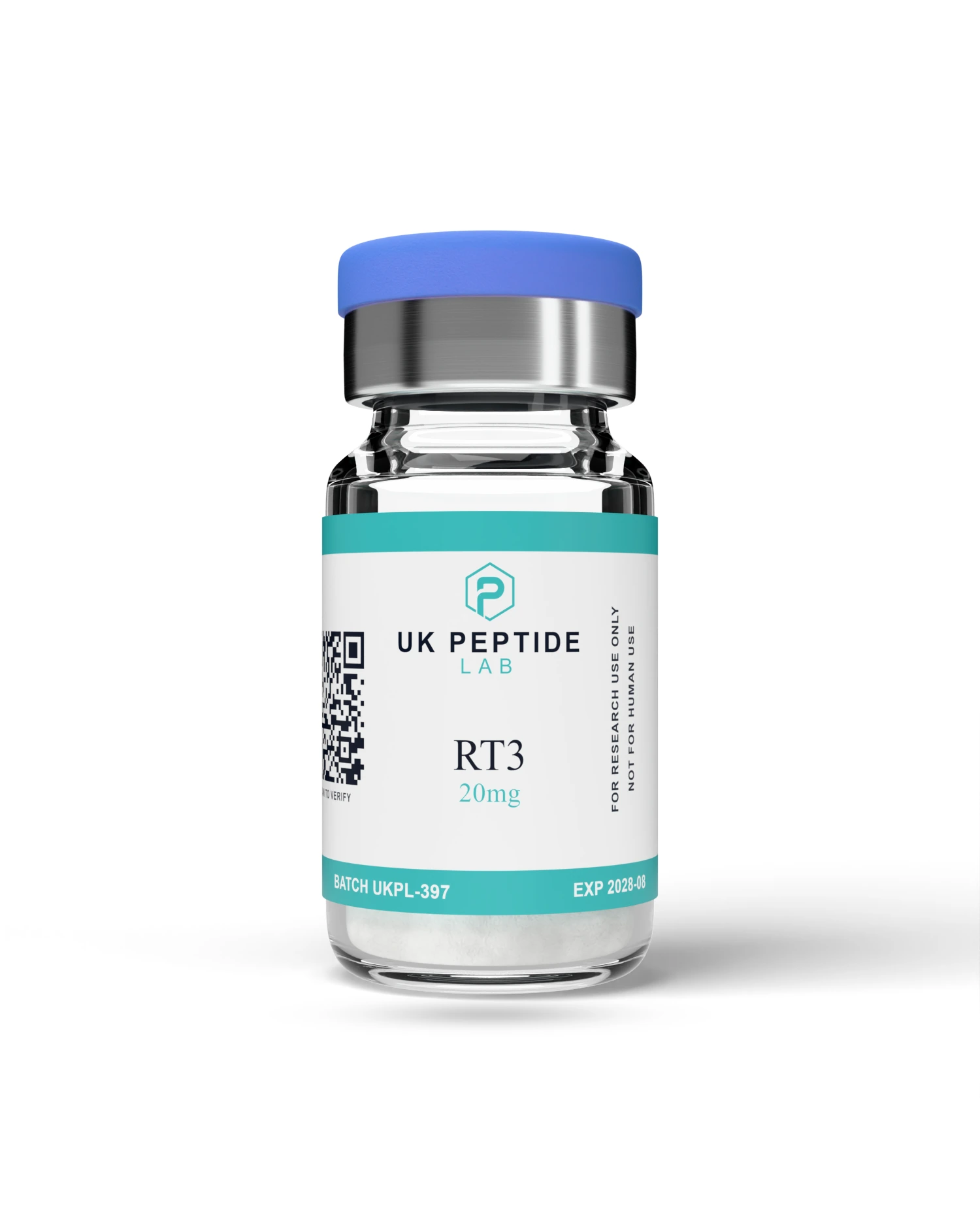
RT3
20mg
RT3 20mg is a higher-content variant of the same synthetic research peptide as our 10mg vial, with twice the lyophilised powder mass per vial for protocols requiring extended supply. Supplied as lyophilised powder, third-party tested, with the batch certificate published on this page. Not a medicine; supplied strictly for laboratory research use.
Published research on RT3 is indexed on PubMed.
Intended Use: Strictly for in-vitro laboratory research. Not for use in humans or animals. Not to be used in foods, drugs, or medical diagnostics. This product has not been evaluated by the MHRA or FDA. Buyer assumes full responsibility for safe handling and regulatory compliance.
99.95%
Purity
LAB
Certified
SAME
Day Ship
Quantity
Qualifies for free UK delivery · Royal Mail Tracked 24
Damaged or lost? Free reshipment guaranteed
Bacteriostatic Water 10ml
Required to reconstitute lyophilised peptides.
Research Use Only
This product is intended strictly for research and laboratory use only. Not for human consumption, medical use, or diagnostic purposes.
Certificate of Analysis
Third-party tested
Lyophilised Stability
24 months
Sealed at -20°C, light-protected
Reconstituted Stability
Up to 3 months
Stored at 2-8°C after mixing
Cold-Chain Shipping
Always
Dry-cold pack, Royal Mail Tracked 24
Important Notice
All compounds are sold individually and do not include research supplies. Products are provided in lyophilised (powder) form and require proper reconstitution before use in research settings.
Related Products
RT3 Price (UK)
RT3 is supplied in 3 vial sizes, priced from £59.99 for 10mg to £134.99 for 30mg. Every size ships from our UK facility with the same third-party HPLC certificate published on this page. This vial clears the £45 threshold on its own, so UK Royal Mail Tracked 24 delivery is free. Orders placed before 2pm on a working day are dispatched the same day.
Prices are in GBP and shown per vial as supplied, lyophilised, for in-vitro laboratory research only. Cost per mg is given so researchers can compare vial sizes on a like-for-like basis. Stock and pricing on this table are read live from our inventory, so they match the basket. See our FAQ for delivery and payment options, and quality & testing for how each batch is verified.
Product Specifications
Research Overview
This page covers the 20mg presentation of RT3 specifically. The compound is identical to that supplied in the 10mg vial, the same lyophilised reference material, and general product information is set out on the main RT3 page. What changes at 20mg is the supply and handling arithmetic, which is what actually determines whether this is the right presentation for a given protocol. Vial content is the first variable. A 20mg vial holds twice the lyophilised mass of the 10mg vial in the same glass format, so at any given bacteriostatic water fill volume the reconstituted stock sits at twice the concentration. Researchers working to a fixed target concentration therefore scale fill volume with vial content rather than carrying over a house default from 10mg work, and the volume used should be recorded against the batch. Cost per milligram is the second. Lyophilisation, vial, stopper, certificate of analysis and cold-chain packaging are costs incurred largely per vial rather than per milligram, so cost per milligram of peptide falls as vial content rises. That is the ordinary reason multi-milligram presentations exist across research supply, and it reflects nothing about the material itself. Batch continuity is the third. A single 20mg vial draws from one batch with one certificate of analysis, whereas the same total mass split across two 10mg vials may span two batches and two purity figures. Where inter-batch variance is a confounder, consolidating into fewer, larger vials removes a variable. Supplied as lyophilised powder for in-vitro research use only.
Product Specifications
Laboratory Handling
- Scale the bacteriostatic water fill volume to the concentration your protocol specifies. A 20mg vial reaches twice the concentration of a 10mg vial at the same fill volume, so a volume carried over from 10mg work will not reproduce a 10mg stock concentration.
- Record the fill volume, the resulting concentration and the reconstitution date on the vial label. On a larger vial the whole content shares one in-use window from the moment it is opened.
- Introduce the diluent slowly down the inner glass wall rather than directly onto the lyophilised cake, then swirl gently until the solution is clear and colourless. Never shake or vortex.
- Draw single-use aliquots immediately after reconstitution and hold them at -20°C rather than repeatedly re-entering one refrigerated stock. The larger the vial, the more freeze-thaw cycles and stopper penetrations a single stock would otherwise accumulate.
- Store lyophilised vials at -20°C, protected from light and moisture. Bring the vial to room temperature before opening so condensation does not settle on the powder.
Frequently Asked Questions
What is RT3?
RT3 20mg is the 20 milligram vial presentation of RT3, holding twice the lyophilised peptide mass of the standard 10mg vial in the same glass format. The compound is identical in both. General product information is covered on the main RT3 page and is not repeated here. This page exists to document what is specific to the 20mg format: the concentration reached at a given reconstitution volume, the single in-use window that the whole vial shares once opened, and the batch continuity that one vial and one certificate of analysis provide. Supplied as lyophilised powder for in-vitro research use only.
RT3 20mg vs 10mg vs 30mg: Choosing a Vial Size
All three presentations contain the same compound at the same specification, so the choice is a supply decision rather than a pharmacological one. The 10mg vial suits pilot studies and method development, where committing a larger mass to one reconstitution date would waste material. The 20mg vial is the middle option, halving the number of vials and certificates to reconcile against a 10mg-only supply while keeping the in-use window manageable. The 30mg vial gives the lowest cost per milligram and the greatest batch continuity, and is the right choice only where the content will genuinely be consumed inside a sensible working life. Two secondary points apply across all three. First, concentration scales with vial content at fixed fill volume, so a 20mg vial reconstituted with a volume carried over from 10mg work yields double the intended concentration. Second, larger vials concentrate risk as well as mass, since one contamination event or one mishandled freeze-thaw cycle costs proportionally more material.
RT3 Research Applications
The 20mg presentation is selected on protocol scale rather than on research application, and the applications themselves are identical to those documented for the 10mg vial: analytical in-vitro laboratory work such as method development and reference standardisation. Where vial content becomes relevant is in study design logistics. Multi-arm or multi-timepoint designs that would otherwise draw across several 10mg batches can run against a single 20mg batch and a single purity figure, removing inter-batch variance as a confounder. Analytical method development and reference-standard preparation also favour a larger vial, since repeated standard preparations from one batch are more internally consistent than the same work spread across batches.
Reconstitution Guide
Allow the vial and the bacteriostatic water to reach room temperature, then swab both rubber stoppers with an alcohol swab. Draw the diluent into a sterile syringe and inject it slowly down the inner glass wall of the peptide vial, never directly onto the lyophilised powder. Swirl gently in a slow circular motion until fully dissolved. Never shake or vortex. The solution should be clear and colourless. The point specific to a 20mg vial is that fill volume must be set from your target concentration and not carried over from smaller-vial work: 20mg reconstituted with 2mL gives a 10mg/mL stock, while the same 20mg in 1mL gives 20mg/mL. We do not specify a fill volume, as that is a protocol decision, and we provide no dosing information of any kind. Label the vial with the fill volume, the resulting concentration and the reconstitution date, then draw single-use aliquots before returning anything to storage.
See our full peptide reconstitution guide and reconstitution calculator for step-by-step protocol.
Storage Instructions
Lyophilised vials should be stored at -20°C, protected from light and moisture, and remain stable for up to 24 months. Once reconstituted, hold the solution at 2-8°C. Because a 20mg vial commits twice the mass of a 10mg vial to a single reconstitution date, aliquoting matters more here: prepare single-use aliquots and hold them at -20°C rather than repeatedly re-entering one refrigerated stock, since every re-entry adds a stopper penetration and a temperature excursion to material that has to last the whole protocol. Avoid repeated freeze-thaw cycles, label every aliquot with the reconstitution date, and handle throughout under sterile laboratory conditions.
Frequently Asked Questions
Related Research Compounds
RT3
20mg · £99.99