
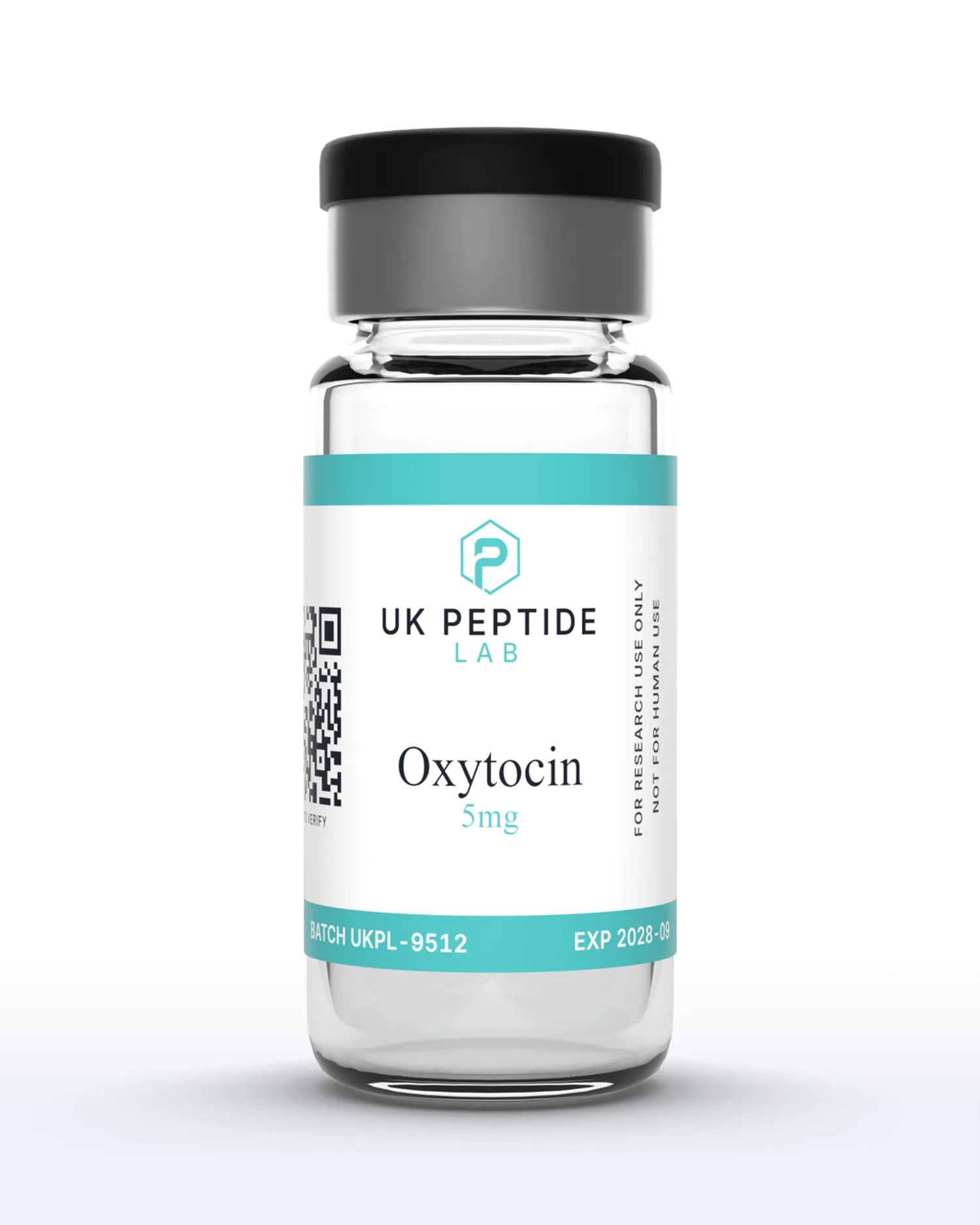
Oxytocin
5mg
Oxytocin is a cyclic nonapeptide (Cys-Tyr-Ile-Gln-Asn-Cys-Pro-Leu-Gly) with a disulphide bridge between the two cysteine residues, first isolated and synthesised in the 1950s. It is one of the most heavily studied neuropeptides, with research spanning social behaviour, pair bonding, stress response and peripheral receptor pharmacology, and it is a licensed human pharmaceutical in several formulations. Supplied as lyophilised powder, supplier-tested, with the certificate published on this page and independent third-party verification pending.
Published research on Oxytocin is indexed on PubMed.
Intended Use: Strictly for in-vitro laboratory research. Not for use in humans or animals. Not to be used in foods, drugs, or medical diagnostics. This product has not been evaluated by the MHRA or FDA. Buyer assumes full responsibility for safe handling and regulatory compliance.
TBC
Purity
LAB
Certified
SAME
Day Ship
Quantity
Add £20.01 more for free UK delivery
Damaged or lost? Free reshipment guaranteed
Bacteriostatic Water 10ml
Required to reconstitute lyophilised peptides.
Research Use Only
This product is intended strictly for research and laboratory use only. Not for human consumption, medical use, or diagnostic purposes.
Certificate of Analysis
Third-party tested
Lyophilised Stability
24 months
Sealed at -20°C, light-protected
Reconstituted Stability
Up to 3 months
Stored at 2-8°C after mixing
Cold-Chain Shipping
Always
Dry-cold pack, Royal Mail Tracked 24
Important Notice
All compounds are sold individually and do not include research supplies. Products are provided in lyophilised (powder) form and require proper reconstitution before use in research settings.
Related Products
Oxytocin Price (UK)
Oxytocin 5mg is £24.99 per vial, supplied from stock in the UK with a third-party HPLC certificate published on this page. UK delivery is £4.50 by Royal Mail Tracked 24, or free once your basket reaches £45 (£20.01 away at this price). Orders placed before 2pm on a working day are dispatched the same day.
| Vial | Price | Cost per mg | Availability |
|---|---|---|---|
| Oxytocin 5mgThis page | £24.99 | £5.00 | In stock |
Prices are in GBP and shown per vial as supplied, lyophilised, for in-vitro laboratory research only. Cost per mg is given so researchers can compare vial sizes on a like-for-like basis. Stock and pricing on this table are read live from our inventory, so they match the basket. See our FAQ for delivery and payment options, and quality & testing for how each batch is verified.
Product Specifications
Research Overview
Oxytocin is a cyclic nonapeptide with the sequence Cys-Tyr-Ile-Gln-Asn-Cys-Pro-Leu-Gly-NH₂, written CYIQNCPLG-NH₂, molecular formula C₄₃H₆₆N₁₂O₁₂S₂, molecular weight 1007.19 g/mol and CAS number 50-56-6. Its defining structural feature is the disulphide bridge joining the cysteine residues at positions 1 and 6, which closes the molecule into a twenty-atom ring and constrains the conformation of the backbone; the C-terminus is a primary amide, and both features are conserved across the vasotocin-oxytocin peptide family. The sequence, and the proposal that the cysteines are bridged, were published by du Vigneaud, Ressler and Trippett (J Biol Chem, 1953), and the first synthesis of the molecule was reported by du Vigneaud and colleagues (J Am Chem Soc, 1953), work that earned the 1955 Nobel Prize in Chemistry. Oxytocin is one of the most heavily studied neuropeptides in the literature.
Mechanistically, oxytocin acts at the oxytocin receptor (OXTR), a class A G-protein-coupled receptor coupled through Gq/11 and phospholipase C, expressed in uterine smooth muscle, mammary myoepithelial cells and a wide set of central nervous system structures. The receptor system was catalogued in depth by Gimpl and Fahrenholz (Physiol Rev, 2001) and updated by Jurek and Neumann (Physiol Rev, 2018), and the human receptor structure was solved in complex with a ligand by Waltenspühl and colleagues (Sci Adv, 2020), which opened structural biology work on OXTR. Research use of the peptide spans receptor binding and calcium mobilisation assays, structural studies, and behavioural neuroscience models of social behaviour and pair bonding (Insel and Hulihan, Behav Neurosci, 1995; Donaldson and Young, Science, 2008).
Two honest points belong up front. First, oxytocin is a licensed human pharmaceutical in injectable formulations, and in the UK those products are prescription-only medicines. The lyophilised material supplied here is not a pharmaceutical product: it is an analytical reference material for in-vitro laboratory research, and it is not supplied for, and must not be used for, human or veterinary administration. Second, the popular account of oxytocin as a trust or love hormone runs well ahead of the evidence. The influential human study reporting increased trust after oxytocin administration (Kosfeld et al., Nature, 2005) has not replicated robustly, and Nave and colleagues (Perspect Psychol Sci, 2015) concluded that the cumulative human data do not provide convergent evidence that trust is reliably caused by oxytocin.
That gap between the animal social behaviour literature, which is comparatively strong, and the human social cognition literature, which is contested, is part of what makes oxytocin a productive research subject. It is supplied as lyophilised powder, supplier-tested, with the certificate published on this page and independent third-party verification pending.
Product Specifications
Laboratory Handling
- Store lyophilised vials at -20°C, protected from light and moisture. Reconstituted solution should be held at 2-8°C and used within 4 weeks.
- Reconstitute with bacteriostatic water introduced slowly down the inner glass wall, never directly onto the lyophilised cake. Swirl gently until clear and colourless; never shake or vortex, agitation oxidises the disulphide bridge.
- The Cys1-Cys6 disulphide bridge is the oxidation-sensitive site: minimise headspace and stopper-open time, work away from strong light, and re-seal promptly after each draw.
- Avoid repeated freeze-thaw cycles. Prepare single-use aliquots at reconstitution and label each with the reconstitution date. Handle under sterile laboratory conditions throughout; this material is a research reagent, not a pharmaceutical product.
Frequently Asked Questions
What is Oxytocin?
Oxytocin is a cyclic nonapeptide with the sequence Cys-Tyr-Ile-Gln-Asn-Cys-Pro-Leu-Gly-NH₂ (CYIQNCPLG-NH₂), molecular formula C₄₃H₆₆N₁₂O₁₂S₂, molecular weight 1007.19 g/mol, CAS 50-56-6. A disulphide bridge between the cysteine residues at positions 1 and 6 closes the molecule into a twenty-atom ring that gives it its constrained cyclic architecture, and the C-terminus is a primary amide rather than a free carboxyl. The sequence and proposed structure were published by du Vigneaud, Ressler and Trippett (J Biol Chem, 1953), and the first synthesis was reported the same year by du Vigneaud and colleagues (J Am Chem Soc, 1953), work recognised with the Nobel Prize in Chemistry in 1955. Oxytocin is one of the most heavily studied neuropeptides in existence, with a literature spanning social behaviour, pair bonding, stress response, peripheral receptor pharmacology and structural biology, and it is a licensed human pharmaceutical in several injectable formulations. Because of that licensed status, the material supplied here is positioned strictly as an analytical research reagent: it is provided as lyophilised powder for in-vitro laboratory research use only, it is not a pharmaceutical product, and no therapeutic use is suggested or implied.
Oxytocin vs Vasopressin
Oxytocin and arginine vasopressin are the two cyclic nonapeptides of the posterior pituitary, and they are the standard comparator pair in neuropeptide pharmacology because they differ at only two residues. Vasopressin carries phenylalanine at position 3 and arginine at position 8 (CYFQNCPRG-NH₂), where oxytocin carries isoleucine and leucine, yet the two ligands diverged into largely separate receptor systems: oxytocin acts principally at the oxytocin receptor (OXTR), while vasopressin acts at the V1a, V1b and V2 receptors, with measurable cross-binding at higher concentrations, as catalogued by Gimpl and Fahrenholz (Physiol Rev, 2001) and reviewed alongside the receptor genetics by Donaldson and Young (Science, 2008). The experimental consequence is that the two cannot be treated as interchangeable tools. Researchers select oxytocin when the design concerns OXTR pharmacology, reproductive-tissue receptor biology or the social behaviour and pair bonding literature, and vasopressin when fluid balance, vascular tone or male-biased social recognition endpoints are in question. Residues 3 and 8 are also the obvious handles for analogue design, since subtype selectivity traces to exactly those side chains.
Oxytocin Research Applications
Oxytocin is studied along four main lines of research. The receptor pharmacology line uses oxytocin as the reference agonist at OXTR, a class A G-protein-coupled receptor coupled through Gq/11 and phospholipase C, with binding, cAMP and calcium mobilisation assays in OXTR-transfected cell lines following the framework set out by Gimpl and Fahrenholz (Physiol Rev, 2001) and updated by Jurek and Neumann (Physiol Rev, 2018). The structural biology line was opened by the crystal structure of the human receptor in complex with a ligand (Waltenspühl et al., Sci Adv, 2020), which makes oxytocin a benchmark ligand for receptor structure work. The behavioural neuroscience line covers pair bonding and social behaviour, built on prairie vole pharmacology (Insel and Hulihan, Behav Neurosci, 1995; Insel and Young, Nat Rev Neurosci, 2001; Donaldson and Young, Science, 2008). The stress and human social cognition line spans hypothalamic-pituitary-adrenal axis interaction work (Grinevich and Neumann, Mol Psychiatry, 2021) and controlled human experiments on trust behaviour (Kosfeld et al., Nature, 2005), a strand whose replication record is contested (Nave et al., Perspect Psychol Sci, 2015). Peripheral receptor pharmacology, myometrial contraction and mammary myoepithelial biology complete the picture.
Reconstitution Guide
Allow the vial to reach room temperature, then sterilise the rubber stopper of both the peptide vial and the bacteriostatic water vial with an alcohol swab. Slowly draw your bacteriostatic water into a sterile insulin syringe, then inject it gently down the inner glass wall of the peptide vial, never directly onto the lyophilised powder. Once added, gently swirl the vial in a slow circular motion until fully dissolved. Never shake or vortex, agitation accelerates oxidation of the disulphide bridge. The solution should be clear and colourless. The material in this vial is an analytical research reagent, not a pharmaceutical product: it must be handled in a laboratory setting and is not supplied for, and must not be used for, human or veterinary administration. Label the vial with the reconstitution date and refrigerate immediately.
See our full peptide reconstitution guide and reconstitution calculator for step-by-step protocol.
Storage Instructions
Lyophilised vials should be stored at -20°C, protected from light and moisture, and remain stable for up to 24 months. Once reconstituted with bacteriostatic water, store the solution at 2-8°C and use within approximately 4 weeks, preparing single-use aliquots at -20°C for longer storage. The disulphide bridge between Cys1 and Cys6 is the degradation route to design against: oxidation and disulphide scrambling generate the dimer and related species that resolve as new peaks on RP-HPLC, and repeated freeze-thaw cycles accelerate both. Keep vials tightly sealed with minimal headspace, aliquot rather than repeatedly accessing one stock, and handle under sterile laboratory conditions throughout. Supplied for in-vitro research use only.
Frequently Asked Questions
Research References
- The sequence of amino acids in oxytocin, with a proposal for the structure of oxytocin (du Vigneaud, Ressler and Trippett, J Biol Chem, 1953)
- The oxytocin receptor system: structure, function, and regulation (Gimpl and Fahrenholz, Physiol Rev, 2001)
- Oxytocin, vasopressin, and the neurogenetics of sociality (Donaldson and Young, Science, 2008)
- Crystal structure of the human oxytocin receptor (Waltenspühl et al., Sci Adv, 2020)
Related Research Compounds
Oxytocin
5mg · £24.99