
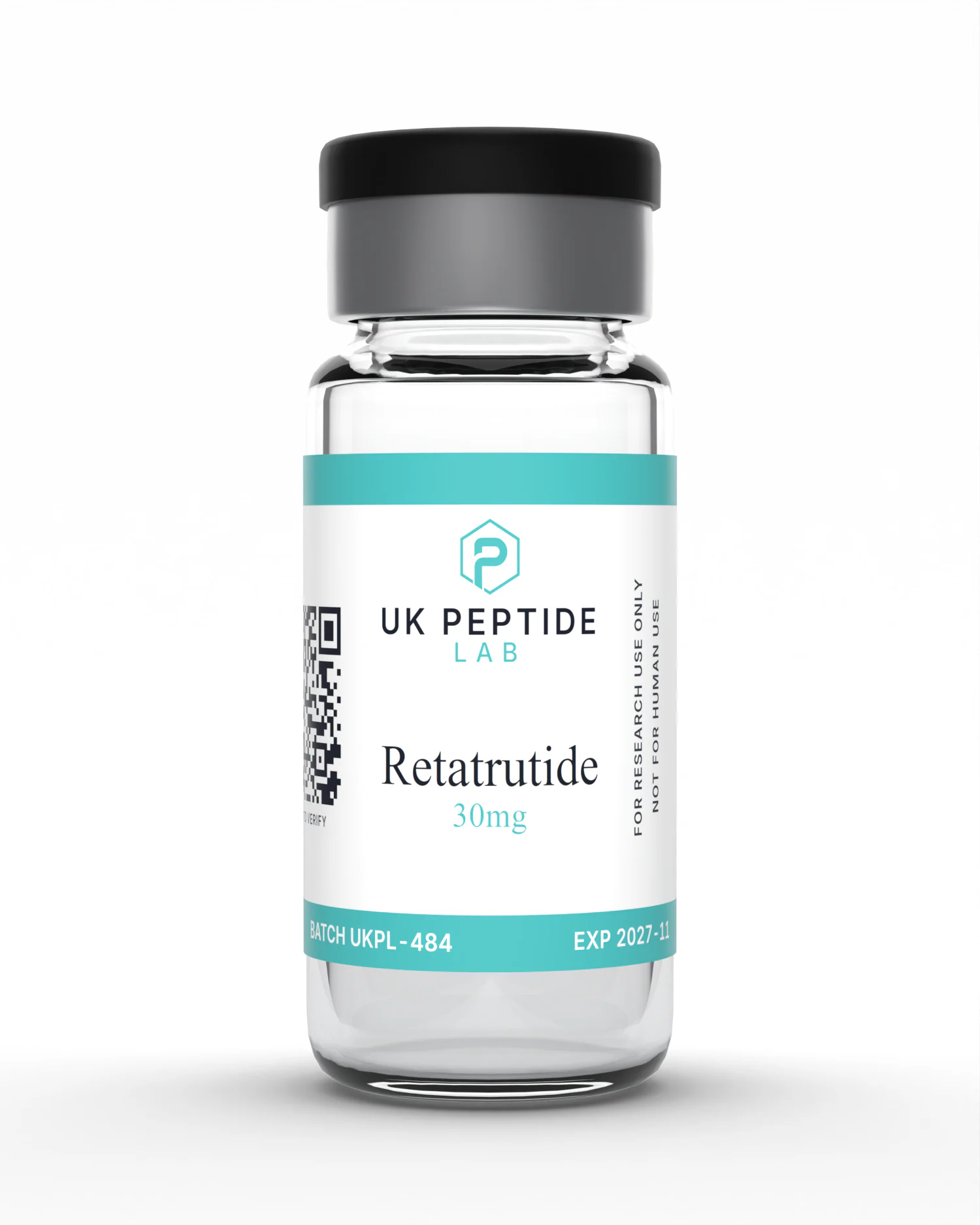
Retatrutide
30mg
Retatrutide 30mg is the highest-content variant of the triple GIP/GLP-1/glucagon receptor agonist peptide. Same compound as our 10mg and 20mg vials, three times the lyophilised powder mass per vial for extended research protocols and bulk reconstitution. Retatrutide simultaneously activates GIP, GLP-1 and glucagon receptors, a triple-agonist pharmacological profile that has dominated late-stage metabolic research. Studies have focused on energy homeostasis, body composition and metabolic pathway modulation via simultaneous incretin and glucagon engagement. Third-party tested.
Published research on Retatrutide is indexed on PubMed. See our full UK buyer's guide for Retatrutide.
Intended Use: Strictly for in-vitro laboratory research. Not for use in humans or animals. Not to be used in foods, drugs, or medical diagnostics. This product has not been evaluated by the MHRA or FDA. Buyer assumes full responsibility for safe handling and regulatory compliance.
99.85%
Purity
LAB
Certified
SAME
Day Ship
Quantity
Qualifies for free UK delivery · Royal Mail Tracked 24
Damaged or lost? Free reshipment guaranteed
Bacteriostatic Water 10ml
Required to reconstitute lyophilised peptides.
Research Use Only
This product is intended strictly for research and laboratory use only. Not for human consumption, medical use, or diagnostic purposes.
Certificate of Analysis
Third-party tested
Lyophilised Stability
24 months
Sealed at -20°C, light-protected
Reconstituted Stability
Up to 3 months
Stored at 2-8°C after mixing
Cold-Chain Shipping
Always
Dry-cold pack, Royal Mail Tracked 24
Important Notice
All compounds are sold individually and do not include research supplies. Products are provided in lyophilised (powder) form and require proper reconstitution before use in research settings.
Related Products
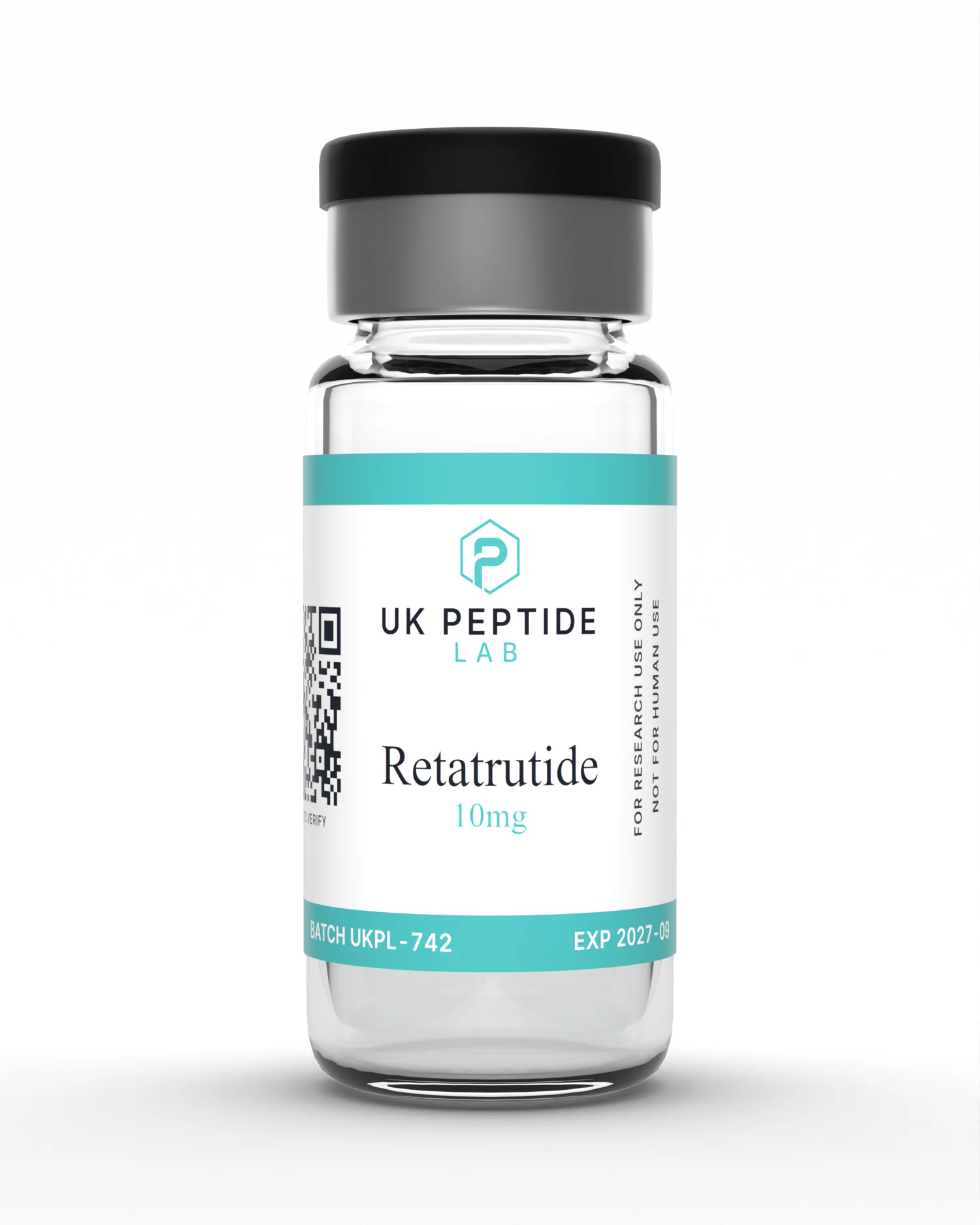

Retatrutide Price (UK)
Retatrutide is supplied in 3 vial sizes, priced from £59.99 for 10mg to £134.99 for 30mg. Every size ships from our UK facility with the same third-party HPLC certificate published on this page. This vial clears the £45 threshold on its own, so UK Royal Mail Tracked 24 delivery is free. Orders placed before 2pm on a working day are dispatched the same day.
| Vial | Price | Cost per mg | Availability |
|---|---|---|---|
| Retatrutide 10mg | £59.99 | £6.00 | In stock |
| Retatrutide 20mg | £99.99 | £5.00 | In stock |
| Retatrutide 30mgThis page | £134.99 | £4.50Best value | In stock |
Prices are in GBP and shown per vial as supplied, lyophilised, for in-vitro laboratory research only. Cost per mg is given so researchers can compare vial sizes on a like-for-like basis. Stock and pricing on this table are read live from our inventory, so they match the basket. See our FAQ for delivery and payment options, and quality & testing for how each batch is verified.
Product Specifications
Research Overview
This page covers the 30mg presentation of Retatrutide, the largest vial content stocked. The compound is the same triple GIP/GLP-1/glucagon receptor agonist supplied in the 10mg and 20mg vials, molecular formula C₂₂₁H₃₄₂N₄₆O₆₈, molecular weight 4731.3 g/mol, CAS 2381089-83-2, and the triple-agonist pharmacology and the published clinical record are covered on the main Retatrutide page. What follows is specific to the 30mg format. Three times the lyophilised mass occupies the same glass vial, so the concentration reached on reconstitution is three times that of a 10mg vial filled to the same volume. Solubility is not the limiting factor at this scale, retatrutide is reported soluble in water on the order of 100 mg/mL, so a 30mg vial dissolves fully well inside the fill volumes normally used with bacteriostatic water. The real constraint is the in-use window, because the entire vial is committed to a single reconstitution date the moment it is opened. That makes aliquoting the central handling decision at this size rather than an optional refinement. Drawing single-use aliquots immediately after reconstitution and holding them frozen, instead of repeatedly re-entering one refrigerated stock, is what preserves a 30mg vial across an extended protocol. The arguments for the largest presentation are batch continuity and cost per milligram. One vial is one batch with one certificate of analysis, so a long protocol runs against a single purity figure rather than stitching several together. And because vial, stopper, lyophilisation and assay costs are incurred per vial rather than per milligram, cost per milligram falls as content rises. Supplied as lyophilised powder for in-vitro research use only.
Product Specifications
Laboratory Handling
- Set the bacteriostatic water fill volume from the concentration your protocol requires. At a fixed fill volume a 30mg vial reaches three times the concentration of a 10mg vial, so volumes cannot be carried across vial sizes unchanged.
- Aliquot into single-use volumes immediately after reconstitution and hold them at -20°C. This is the single most important handling step on the largest vial, since the whole 30mg otherwise shares one in-use window and one accumulating freeze-thaw history.
- Introduce the diluent slowly down the inner glass wall, never directly onto the lyophilised cake, and swirl gently until fully dissolved. Do not shake or vortex. The solution should be clear and colourless.
- Label the vial and every aliquot with the fill volume, resulting concentration and reconstitution date, and keep that record against batch UKPL-484 for traceability across a long protocol.
- Store lyophilised vials at -20°C, protected from light and moisture, and allow the vial to reach room temperature before opening to prevent condensation settling on the powder.
Frequently Asked Questions
What is Retatrutide?
Retatrutide 30mg is the largest vial presentation of Retatrutide stocked, holding three times the lyophilised peptide mass of the standard 10mg vial in the same glass format. The compound is the same synthetic triple receptor agonist at GIPR, GLP-1R and GCGR across every vial size, molecular formula C₂₂₁H₃₄₂N₄₆O₆₈, molecular weight 4731.3 g/mol, CAS 2381089-83-2. The triple-agonist mechanism, the comparison against semaglutide and tirzepatide and the published trial record are documented on the main Retatrutide page and are not restated here. This page documents what is specific to the 30mg format: the concentration reached at a given fill volume, why aliquoting becomes the governing handling decision at this mass, the fact that solubility is not the limiting constraint at this scale, and the batch continuity a single large vial provides across an extended protocol. Supplied as lyophilised powder for in-vitro research use only.
Retatrutide 30mg vs Smaller Vial Sizes
The 30mg vial is not a different or more potent material, it is the same compound at the highest mass per vial, and the trade-offs run in both directions. In its favour: the lowest cost per milligram of the three presentations, because vial, stopper, lyophilisation and third-party assay costs are incurred per vial rather than per milligram; and the greatest batch continuity, since one vial means one batch and one purity figure across a long protocol instead of several stitched together. Against it: the entire 30mg is committed to a single reconstitution date the moment the vial is opened, so a protocol that will not consume the content inside a sensible working life is better served by 10mg or 20mg vials. Concentration is the other consideration, since at a fixed fill volume a 30mg vial reaches three times the concentration of a 10mg vial, meaning fill volumes cannot be transferred between sizes unchanged. Solubility does not enter into it, aqueous solubility for retatrutide is reported on the order of 100 mg/mL.
Retatrutide Research Applications
Research applications are identical to those of the smaller presentations, since the compound is the same: models of glucose homeostasis, lipid metabolism, energy expenditure, body composition and receptor crosstalk across GIP, GLP-1 and glucagon signalling pathways. Vial content is a logistics variable rather than a scientific one. The 30mg format is chosen for extended or high-throughput protocols, for multi-arm designs where running every arm against one batch removes inter-batch variance as a confounder, and for analytical work where a single large batch supports repeated reference-standard preparation with better internal consistency than the same work spread across batches. It is a poor fit for pilot studies and one-off method development, where most of the vial would age in storage.
Reconstitution Guide
Allow the vial and the bacteriostatic water to reach room temperature, then swab both rubber stoppers with alcohol. Draw the diluent into a sterile syringe and inject it slowly down the inner glass wall of the peptide vial, never directly onto the lyophilised cake. Swirl gently until fully dissolved. Never shake or vortex. The solution should be clear and colourless. Two points are specific to a 30mg vial. First, solubility is not the constraint: aqueous solubility for retatrutide is reported on the order of 100 mg/mL, so 30mg dissolves completely well inside the fill volumes normally used with bacteriostatic water, and if material remains after gentle swirling the answer is more time at room temperature rather than agitation. Second, fill volume must be set from your target concentration, since 30mg reaches three times the concentration of 10mg at identical volume. We specify no fill volume, as that is a protocol decision, and provide no dosing information. Draw single-use aliquots immediately after reconstitution and label each with the reconstitution date.
See our full peptide reconstitution guide and reconstitution calculator for step-by-step protocol.
Storage Instructions
Lyophilised vials should be stored at -20°C, protected from light and moisture, and remain stable for up to 24 months. Once reconstituted, hold the solution at 2-8°C. Aliquoting is the governing handling decision on the largest vial rather than an optional refinement, because the whole 30mg shares one reconstitution date and a stock intended to span an extended protocol would otherwise accumulate repeated stopper penetrations and freeze-thaw cycles. Prepare single-use aliquots at -20°C immediately after reconstitution, label each with the reconstitution date, and avoid repeated freeze-thaw of any aliquot. Keep the fill volume, resulting concentration and batch number on record for traceability across the protocol, and handle throughout under sterile laboratory conditions.
Frequently Asked Questions
Research References
Related Research Compounds
Retatrutide
30mg · £134.99