
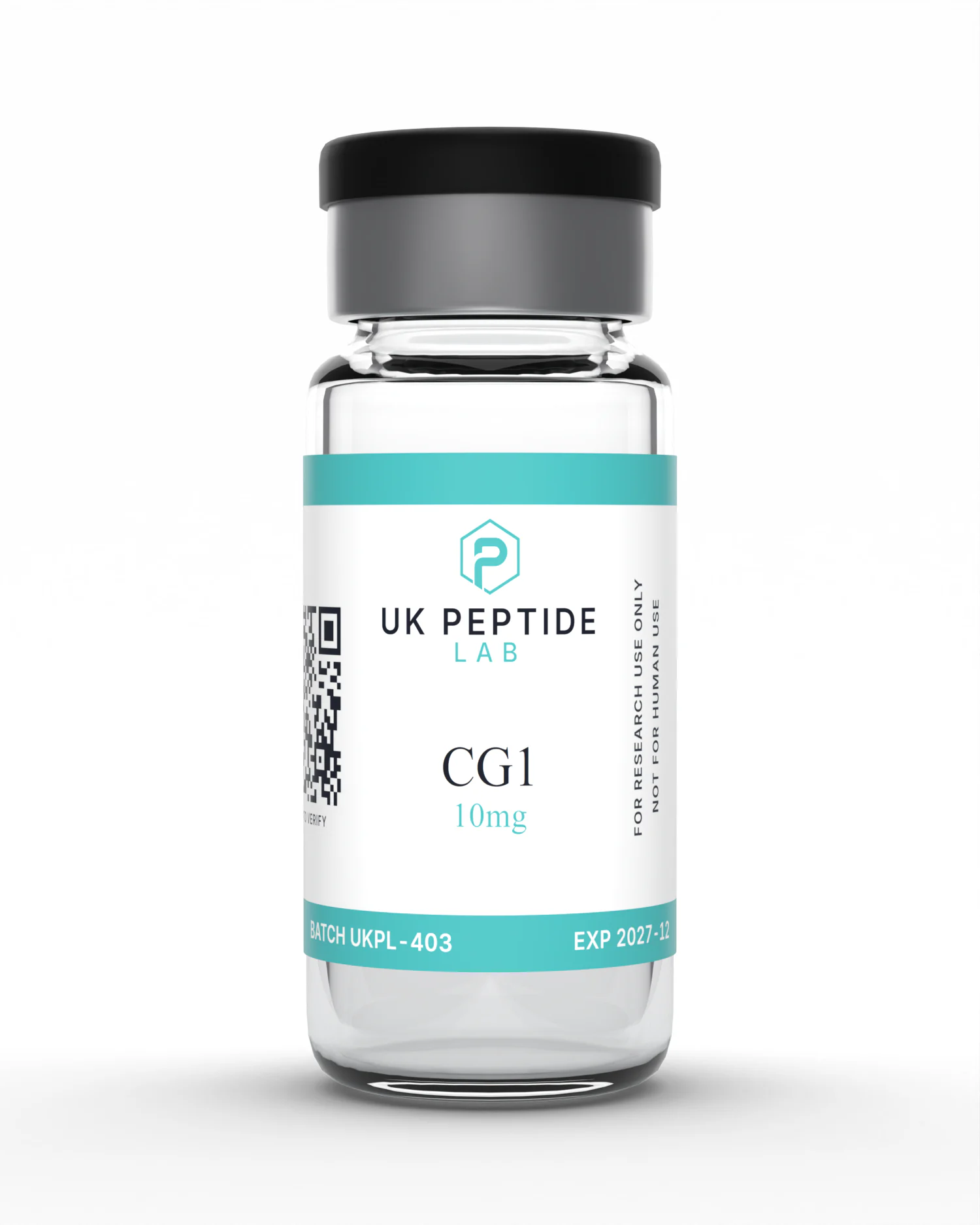
CG1
10mg
CG1 is a synthetic long-acting research peptide supplied as a lyophilised laboratory reference material for in-vitro work. Supplied as lyophilised powder, third-party tested, with the batch certificate published on this page. CG1 holds no marketing authorisation, is not a medicine, and is supplied strictly for laboratory research use — not for human or veterinary administration.
Published research on CG1 is indexed on PubMed.
Intended Use: Strictly for in-vitro laboratory research. Not for use in humans or animals. Not to be used in foods, drugs, or medical diagnostics. This product has not been evaluated by the MHRA or FDA. Buyer assumes full responsibility for safe handling and regulatory compliance.
≥98%
Purity
LAB
Certified
SAME
Day Ship
Expected back in stock in approximately 10 days. We'll email you as soon as this batch is available.
Certificate of Analysis
Third-party tested
Lyophilised Stability
24 months
Sealed at -20°C, light-protected
Reconstituted Stability
Up to 3 months
Stored at 2-8°C after mixing
Cold-Chain Shipping
Always
Dry-cold pack, Royal Mail Tracked 24
Important Notice
All compounds are sold individually and do not include research supplies. Products are provided in lyophilised (powder) form and require proper reconstitution before use in research settings.
Related Products
CG1 Price (UK)
CG1 10mg is £74.99 per vial, supplied from stock in the UK with a third-party HPLC certificate published on this page. This vial clears the £45 threshold on its own, so UK Royal Mail Tracked 24 delivery is free. Orders placed before 2pm on a working day are dispatched the same day.
| Vial | Price | Cost per mg | Availability |
|---|---|---|---|
| CG1 10mgThis page | £74.99 | £7.50 | Out of stock |
Prices are in GBP and shown per vial as supplied, lyophilised, for in-vitro laboratory research only. Cost per mg is given so researchers can compare vial sizes on a like-for-like basis. Stock and pricing on this table are read live from our inventory, so they match the basket. See our FAQ for delivery and payment options, and quality & testing for how each batch is verified.
Product Specifications
Research Overview
CG1 is a synthetic long-acting peptide supplied as a laboratory reference material for in-vitro use. It is characterised on this page only by the properties we can evidence for the vial you receive: batch identity, purity, appearance and physical form.
Aggregation is the governing handling consideration for this material, so the laboratory handling notes below cover storage temperature, reconstitution technique and inspection before use.
We do not publish sequence detail, structural characterisation, receptor pharmacology or comparisons with any licensed medicine for this item. Researchers requiring that information should refer to the primary literature independently of this listing.
CG1 holds no marketing authorisation in any jurisdiction and is not a medicine. It is supplied as lyophilised powder for in-vitro laboratory research only, not for human or veterinary administration, and no therapeutic, diagnostic or preventative use is offered, claimed or implied.
Product Specifications
Laboratory Handling
- Store lyophilised vials at -20°C, protected from light and moisture. Allow the vial to reach room temperature before opening so condensation does not settle on the powder.
- Reconstitute with bacteriostatic water, injecting slowly down the inner glass wall rather than onto the lyophilised cake. Swirl gently until dissolved and never shake or vortex.
- Treat aggregation as the primary handling risk. Avoid mechanical shear, avoid leaving concentrated solution standing at room temperature, and inspect for haze, filaments or opalescence before use.
- Hold reconstituted solution at 2-8°C and prepare single-use aliquots for longer storage at -20°C. Repeated freeze-thaw cycling is a general cause of peptide loss.
- Handle under aseptic conditions. Swab the stopper of both the CG1 vial and the bacteriostatic water vial with alcohol before each needle entry and use a fresh sterile syringe for every transfer.
- The site reconstitution guide and reconstitution calculator cover the full aseptic workflow and dilution arithmetic for lyophilised research peptides.
Frequently Asked Questions
What is CG1?
CG1 is a synthetic long-acting research peptide supplied as a lyophilised laboratory reference material. We publish only what we can evidence for the vial you receive — batch identity, purity, appearance and physical form — and no pharmacological or structural characterisation. CG1 holds no marketing authorisation and is not a medicine; it is supplied for in-vitro research use only.
How CG1 Is Supplied
Each CG1 vial is supplied as lyophilised powder with no excipients, preservatives or diluent included. Purity is determined by HPLC and identity confirmed analytically, with the third-party certificate for the current batch published on this product page rather than issued on request. Vials are dispatched from the UK and should be moved to -20°C storage on arrival. Aggregation is the governing handling consideration for this material, so inspect reconstituted solution against a light source before every use.
CG1 Research Applications
CG1 is stocked as a laboratory reference material for in-vitro assay work by qualified researchers. Typical uses are analytical: method development, reference standardisation, and comparative purity or stability work. Researchers requiring pharmacological characterisation should refer to the primary literature independently of this listing. No therapeutic, diagnostic or preventative use is offered, claimed or implied.
Reconstitution Guide
Allow vials to reach room temperature, then sterilise the rubber stopper of both the peptide vial and the bacteriostatic water vial with an alcohol swab. Slowly draw your bacteriostatic water into a sterile insulin syringe, then inject it gently down the inner glass wall of the peptide vial, never directly onto the lyophilised powder. Once added, gently swirl the vial in a slow circular motion until fully dissolved. Never shake or vortex. Aggregation is the specific risk with this material, so inspect the solution against a light source for haze, opalescence or filaments before use. The solution should be clear and colourless. Label the vial with the reconstitution date and refrigerate immediately.
See our full peptide reconstitution guide and reconstitution calculator for step-by-step protocol.
Storage Instructions
Lyophilised vials should be stored at -20°C, protected from light and moisture, and remain stable for up to 24 months. Once reconstituted with bacteriostatic water, store the solution at 2-8°C and use within approximately 4 weeks. For longer storage prepare single-use aliquots at -20°C rather than repeatedly accessing a single stock, since freeze-thaw cycling drives both peptide loss and aggregation. Handle under sterile laboratory conditions throughout.